

Who Can Administer IV Vitamin Therapy and Keep It Legal
Who Can Administer IV Therapy — and Why It Matters
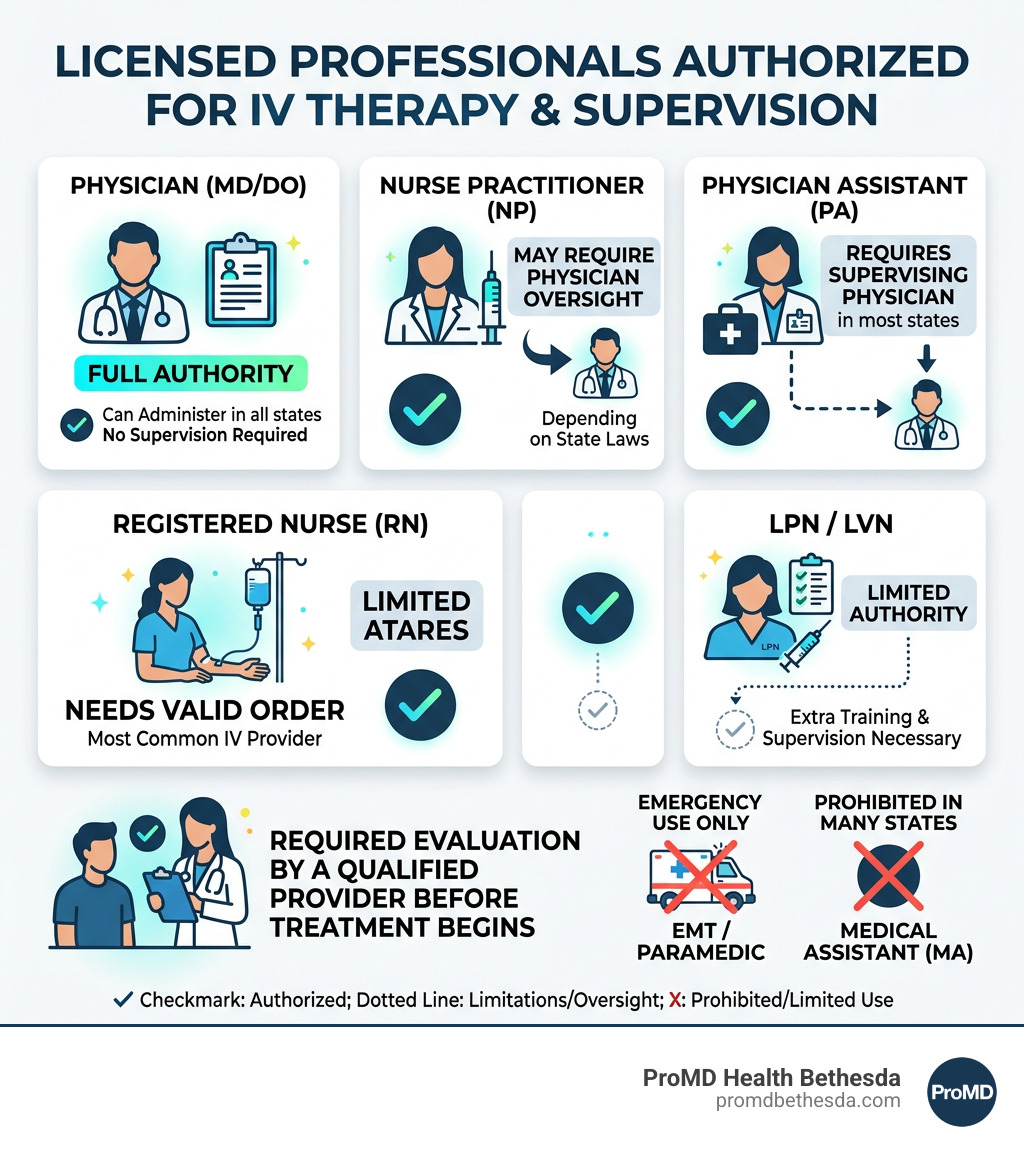
Who can administer iv therapy is not a simple question. The answer depends on your state, the setting, and the specific professional’s license and training. Here’s a quick overview:
| Professional | Can Administer IV Therapy? | Notes |
|---|---|---|
| Physician (MD/DO) | Yes | Full authority in all states |
| Nurse Practitioner (NP) | Yes | May require physician oversight depending on state |
| Physician Assistant (PA) | Yes | Requires supervising physician in most states |
| Registered Nurse (RN) | Yes | Most common IV provider; needs valid order |
| LPN / LVN | Limited | Requires extra training and supervision |
| Medical Assistant (MA) | Rarely | Prohibited in many states; needs direct supervision where allowed |
| EMT / Paramedic | Emergency only | Not authorized in elective wellness settings |
The short version: only licensed healthcare professionals can legally administer IV therapy — and in every state, a qualified provider must first evaluate you before treatment begins.
IV therapy has moved far beyond hospital walls. You can now find it at wellness clinics, med spas, and even mobile services that come to your home or office. But the regulations haven’t loosened — if anything, states are paying closer attention as the industry grows. The procedure involves piercing the skin and introducing fluids directly into the bloodstream, which puts it squarely in the category of a regulated medical intervention, not a casual wellness service.
That distinction matters a lot if you’re choosing a provider.
I’m Mandy Fawcett, PA-C, a Board-Certified Physician Assistant with over 8 years of clinical experience and specialized training in aesthetic and wellness procedures — including navigating the regulatory standards that govern who can administer iv therapy safely and legally. In this guide, I’ll walk you through exactly what those standards mean for you as a patient.
Understanding IV Therapy as a Regulated Medical Procedure
While it might feel as simple as getting a facial, IV Therapy is a clinical medical service. Because the process involves piercing the epidermis to reach the vein, it is legally classified as the practice of medicine. This isn’t just a technicality; it’s a safety standard. When we bypass the digestive system, we also bypass the body’s natural filters and protections.
According to scientific research on IV therapy safety, while generally safe when performed correctly, the procedure carries risks like infection, phlebitis (vein inflammation), and electrolyte imbalances. Because of these risks, every IV drip—whether it’s for hydration, vitamins, or recovery—requires a medical order (a prescription) from a licensed provider such as a Physician, Nurse Practitioner, or Physician Assistant.
The Rapid Growth of the IV Wellness Industry
The demand for elective wellness is skyrocketing. In 2024 alone, the intravenous therapy industry brought in a staggering $2.1 billion in revenue in the U.S. This growth is driven by people seeking rapid relief from fatigue, dehydration, and nutrient deficiencies. Unlike oral supplements, which may only have a 50-60% absorption rate, IV therapy offers 100% bioavailability, sending nutrients directly into the bloodstream for immediate use.
As more clinics open to meet this demand, understanding the “who” and “how” of legal administration becomes vital for patient safety. At ProMD Health Bethesda, we pride ourselves on being part of this growth while maintaining the highest clinical standards. You can meet our team to see the licensed experts who oversee our protocols.
Who Can Administer IV Therapy? Authorized Healthcare Professionals
Not just anyone with a steady hand can start an IV. To protect the public, state laws strictly define which licenses are required to perform venipuncture and manage infusions.
Registered Nurses as Front-Line Experts
Registered Nurses (RNs) are often called the “workhorses” of the IV world. Scientific research on registered nurse roles confirms that RNs are uniquely positioned to manage IV therapy due to their extensive clinical training.
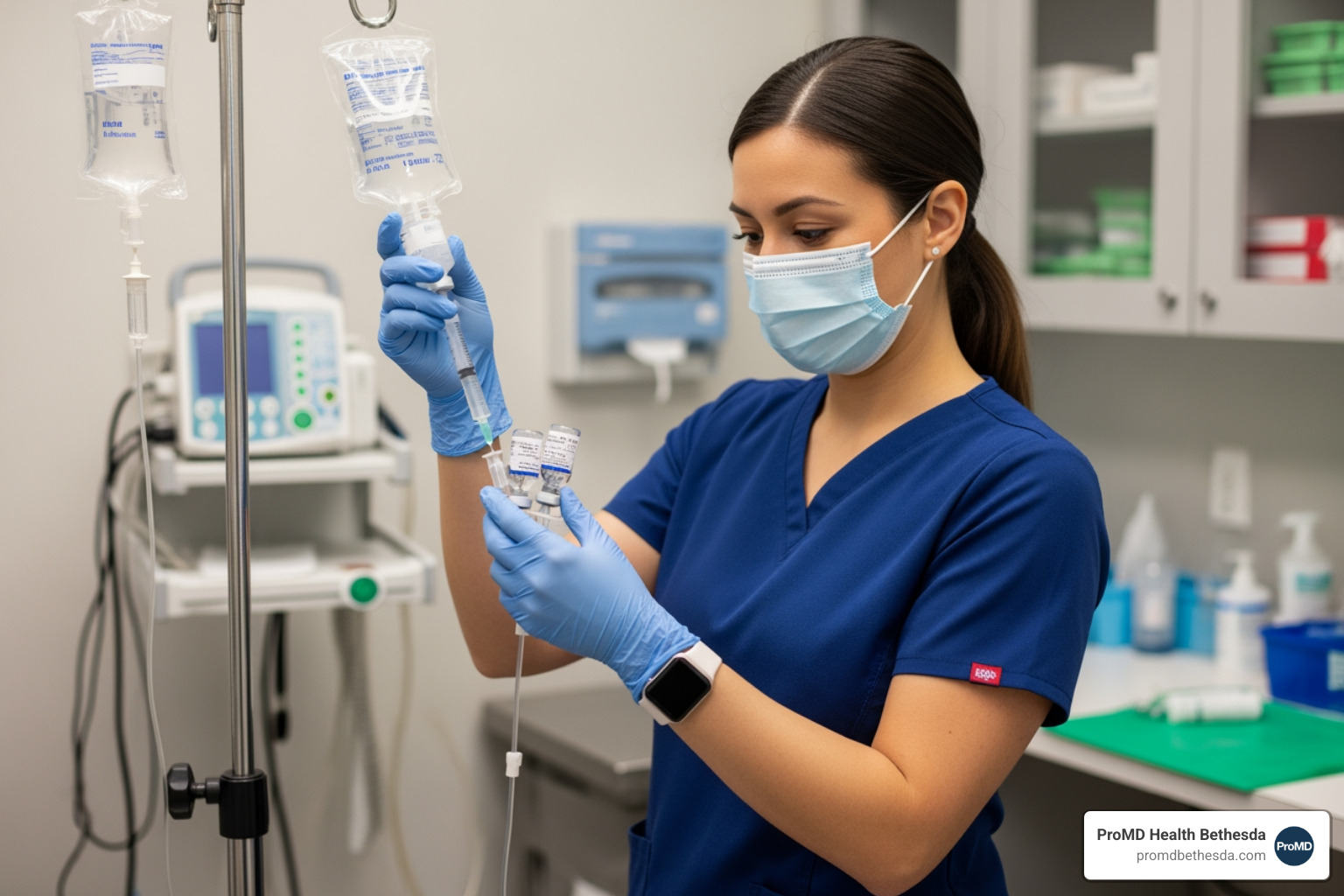
In our clinics in Bethesda and Rockville, RNs function as front-line experts. Their scope of practice includes:
- Assessing the patient’s vein health.
- Performing the venipuncture (the “stick”).
- Monitoring the patient for adverse reactions during the infusion.
- Providing patient advocacy and education on aftercare.
While RNs are highly skilled, they still operate under the standing orders or direct prescriptions of a high-level provider (MD, NP, or PA).
The Role of LPNs and LVNs in IV Administration
Licensed Practical Nurses (LPNs) and Licensed Vocational Nurses (LVNs) can also play a role, but their authority is much more restricted. In many jurisdictions, an LPN cannot simply graduate and start hanging IV bags. They often must complete a board-certified IV therapy course to validate their competency.
LPNs typically require onsite supervision by an RN or a physician. Furthermore, in states like New York, LPNs are expressly prohibited from administering the “first dose” of any medication or handling complex lines like PICC lines. They are valuable team members, but they operate within a narrower “safety lane” than RNs.
State-Specific Regulations and the Role of Medical Assistants
The question of who can administer iv therapy gets complicated because every state has its own Board of Nursing and Board of Medicine. What is legal in Florida might be a felony in New York.
| State | Medical Assistants (MAs) | RN/LPN Requirements |
|---|---|---|
| Maryland | Highly restricted; requires specific delegatory oversight | RNs and trained LPNs under supervision |
| California | Prohibited from IV administration | 51% Physician ownership required for clinics |
| New York | Prohibited from IV administration | LPNs require annual competency checks |
| Texas | Prohibited from IV administration | Requires written standing delegation orders |
Can medical assistants legally administer IV therapy?
This is a major point of confusion for many new wellness clinics. In states like California, New York, and South Dakota, Medical Assistants (MAs) are strictly prohibited from performing IV therapy. Even in states where the rules are more “grey,” MAs generally lack the license to “pierce the epidermis” for the purpose of administering fluids or medications.
While an MA might be trained to draw blood for a lab test, administering a 1,000mL bag of fluid is a different legal category. Most compliant clinics, including our locations in Kensington and Chevy Chase, choose to use RNs to ensure the highest level of safety and legal compliance.
Emergency Personnel in Wellness Settings
We are often asked if EMTs or Paramedics can work in IV lounges. While Paramedics have incredible IV skills, their license is usually tied to “emergency contexts.” In many states, a Paramedic’s scope of practice does not extend to elective wellness treatments in a clinic setting unless the clinic has specific “community paramedicine” or “outpatient” protocols approved by the state board. In a wellness clinic, an RN is almost always the safer legal choice for the business and the patient.
Training, Certification, and the Mandatory Good-Faith Exam
Beyond a basic nursing or medical degree, top-tier IV providers often seek specialized certifications.
- CRNI (Certified Registered Nurse Infusion): This is the gold standard for infusion nurses, requiring 1,600 hours of experience.
- VA-BC (Vascular Access Board Certified): A credential focused on the technical mastery of gaining vein access.
At ProMD Health Bethesda, we believe in the “Good-Faith Exam.” This is a mandatory medical evaluation performed by a Physician, NP, or PA before the patient ever sees a needle. During this exam, we check your vitals, review your medical history, and ensure you don’t have contraindications like congestive heart failure or kidney disease, which could make IV fluids dangerous. To learn more about our commitment to these standards, you can read who we are.
Preventing Common Complications of IV Therapy
Safety isn’t just about the “stick”; it’s about the monitoring. We watch closely for:
- Infiltration: When the IV fluid leaks into the surrounding tissue instead of the vein.
- Phlebitis: Inflammation of the vein wall.
- Fluid Overload: Giving too much fluid too fast, which can strain the heart.
Proper scientific research on IV infiltration shows that immediate detection and treatment (like elevating the limb and stopping the drip) are essential to prevent tissue damage. This is why having a licensed professional in the room is non-negotiable.
Compliance, Ownership, and the Corporate Practice of Medicine
If you are looking to open a clinic or just want to know if the one you visit is legitimate, you need to understand the Corporate Practice of Medicine (CPOM). This doctrine states that only licensed physicians (or physician-owned corporations) can practice medicine.
Because IV therapy is the practice of medicine, a regular business owner cannot simply hire a nurse and start a “Drip Bar.” In states like California, 51% of the clinic must be owned by a physician. In New York, it’s 100%. In Maryland, we follow strict ownership and medical direction rules to ensure that medical decisions are made by medical professionals, not business managers focused only on that $2.1 billion revenue stream.
Documentation and Supervision Standards
A compliant clinic must act like a doctor’s office. This means:
- HIPAA Compliance: Your medical records and “hangover cure” history must be kept private and secure.
- Standing Orders: Clear, written protocols that tell the nurse exactly what to do.
- Adverse Event Reporting: A system to track and report any complications.
Frequently Asked Questions about Who Can Administer IV Therapy
Who can administer iv therapy in a mobile setting?
In a mobile setting (like your home), the rules are even stricter. Most reputable companies only send Registered Nurses for mobile visits. This is because the nurse must be able to work independently and handle any complications without a doctor in the next room.
Do all states allow RNs to start drips without a doctor on site?
Most states allow an RN to start a drip as long as a doctor (or NP/PA) has performed the initial good-faith exam and “ordered” the treatment. The doctor doesn’t have to be in the room, but they must be available via phone or video if the nurse has a question.
What should patients look for to ensure their provider is compliant?
Always ask:
- “Who performed my initial medical clearance?” (It should be an MD, NP, or PA).
- “Is the person sticking me an RN or LPN?”
- “Is there a medical director overseeing this facility?” If they can’t answer these, it’s time to find a new clinic.
Conclusion
Navigating IV therapy doesn’t have to be confusing. Whether you are visiting us in Garrett Park or Rockville, our goal is to provide a “natural-looking” boost to your health that is as safe as it is effective.
At ProMD Health Bethesda, we combine expert care with technology. Our AI Simulator allows patients to preview their results and feel confident in their treatment plan. When you choose us, you aren’t just getting a vitamin boost; you’re getting a medically supervised experience designed by professionals who understand the law and the science of wellness.
Ready to optimize your health? More info about IV Therapy is just a click away. Come see why we are the trusted choice for wellness in the Bethesda area.

