

Units, Lines, and Smooth Times: A Guide to Your Dysport Dosage
How Many Units of Dysport Do I Need? Here’s What to Expect
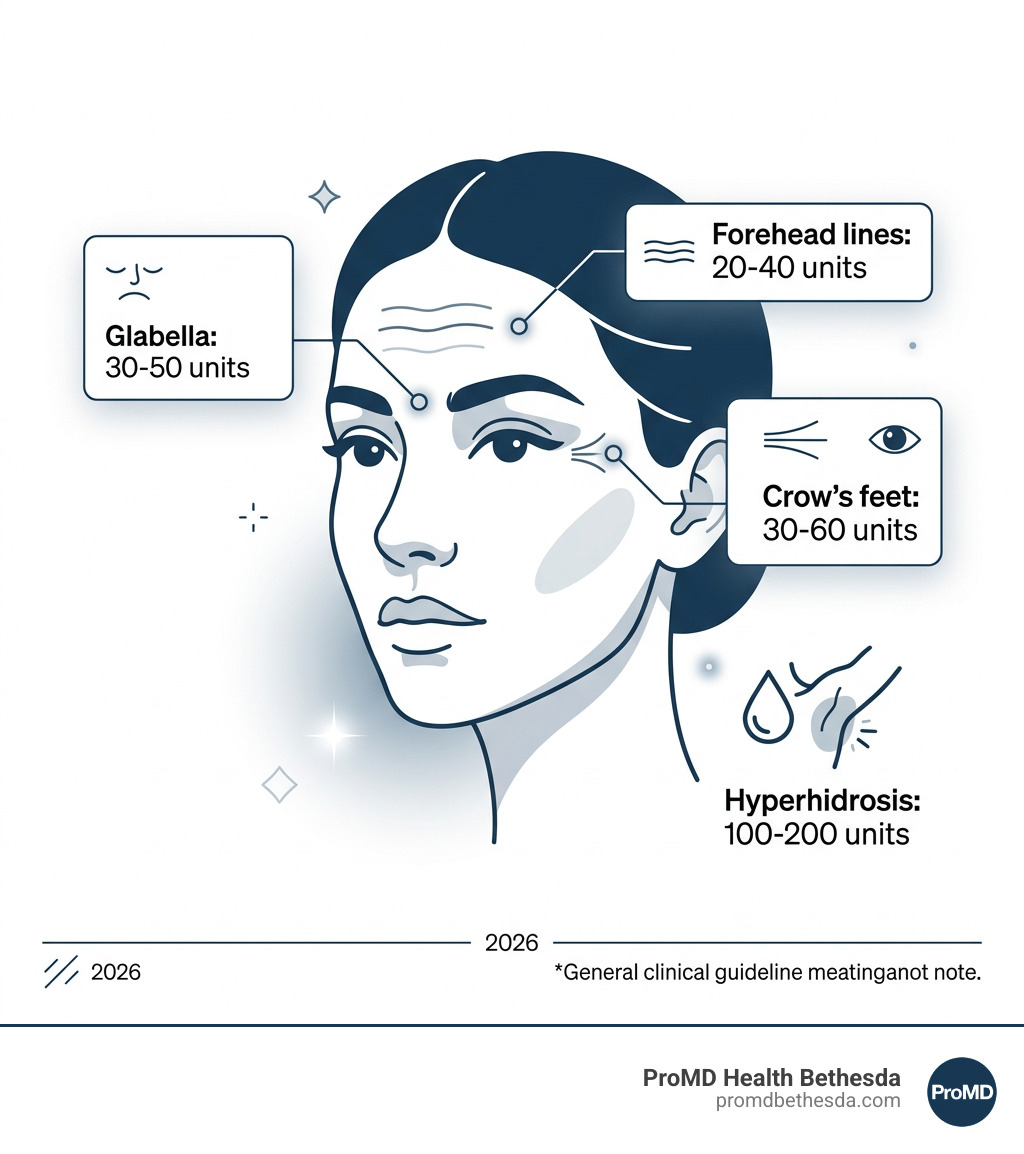
If you’re wondering how many units of dysport do i need, here’s a quick reference based on clinical guidelines and real-world averages:
| Treatment Area | Typical Range | Average |
|---|---|---|
| Glabella (“11s”) | 30-50 units | 52 units |
| Forehead lines | 20-40 units | 18 units |
| Crow’s feet | 30-60 units (per side) | 36 units |
| Hyperhidrosis | 100-200 units | varies |
Note: These are starting points. Your actual dose depends on your muscle strength, age, gender, and treatment goals.
Most people come in with a simple goal: softer lines, a refreshed look — nothing overdone. But the moment the conversation turns to units, things can get confusing fast. How much is too much? How much is too little? And why does your friend need 80 units when you only need 40?
The truth is, there is no single correct answer for everyone. Dysport dosing is personal. It depends on the size and strength of your facial muscles, how your body metabolizes the product, and what results you’re actually after.
That’s exactly why this guide exists — to cut through the confusion and give you clear, honest information before you walk into your appointment.
I’m Mandy Fawcett, PA-C, a Board-Certified Physician Assistant with over 8 years of clinical experience and specialized training in aesthetic procedures, including helping patients in the Bethesda area determine exactly how many units of dysport do i need based on their unique facial anatomy and goals. I’ll walk you through everything you need to know so you can have a confident, informed conversation with your injector.
What is Dysport and How Does It Work?
Dysport, scientifically known as abobotulinumtoxinA, belongs to a class of injectables called neuromodulators. While it shares a common goal with other famous toxins, its unique formulation sets it apart. At its core, Dysport works by temporarily blocking the nerve signals that tell your muscles to contract. When those muscles relax, the skin above them smooths out, significantly reducing the appearance of “dynamic wrinkles”—the lines that form when you frown, smile, or squint.
One of the standout features of Dysport is its molecular structure. It has a slightly smaller molecular weight and a different protein structure than some of its counterparts, which often allows it to spread or “diffuse” a bit more easily across the treatment area. This can be a major advantage when treating broader areas like the forehead, as it often results in a very soft, natural-looking transition between treated and untreated zones.
Safety is always our top priority. According to official Prescribing Information and Safety Data, Dysport is FDA-approved for the temporary improvement in the appearance of moderate to severe glabellar lines (those pesky “11s” between the eyebrows). It has been used safely for decades, both for cosmetic purposes and medical conditions like muscle spasticity. If you are curious about how it stacks up against other options on the market, you can explore our detailed breakdown of Botox vs Dysport vs Daxxify.
How Many Units of Dysport Do I Need?
Determining the right dosage is a blend of science and art. When you ask, “how many units of dysport do i need,” you are essentially asking how much “power” is required to soften your specific muscle movements. Because Dysport is diluted differently than Botox, the unit numbers look much higher on paper, but the actual relaxing effect is comparable when dosed correctly.
The FDA-approved dose for glabellar lines is 50 units, typically divided into five injection points. However, in a clinical setting, we often adjust this based on the patient’s unique anatomy. For example, some patients may require up to 80 units for the frown lines if their muscles are particularly strong.
Below is a table showing common ranges we see at ProMD Health:
| Treatment Area | Dysport Unit Range | Botox Equivalent (Approx.) |
|---|---|---|
| Forehead Lines | 20 – 80 Units | 10 – 30 Units |
| Frown Lines (Glabella) | 40 – 80 Units | 20 – 30 Units |
| Crow’s Feet | 30 – 60 Units | 15 – 40 Units |
Understanding these numbers helps set expectations, but Botox, Dysport, Daxxify all have different “potencies” per unit. You cannot simply take your Botox dose and use the same number for Dysport; you would be significantly undertreated!
Average Dysport Unit Recommendations for the Face
Let’s dive deeper into the most popular treatment zones. At ProMD Health, we pride ourselves on being among The Best Botox Providers in Bethesda, and that expertise extends directly into our Dysport precision.
- Glabella (The “11s”): This is the most common area treated. The goal is to stop that “angry” or “stressed” look. While the FDA suggests 50 units, we find the average patient lands between 40-60 units. If you have very deep furrows, we might lean toward the higher end of that range.
- Forehead Lines: These are the horizontal lines that appear when you raise your eyebrows. We typically recommend 20-40 units. We have to be careful here—if we use too much, your eyebrows might feel “heavy.” If we use too little, you’ll still see those ripples when you’re expressive.
- Crow’s Feet: These are the “smile lines” around the eyes. Because this skin is thin and the muscle (orbicularis oculi) is delicate, we usually use 15-30 units per side, totaling 30-60 units.
Determining How Many Units of Dysport Do I Need for Specialized Areas
Beyond the “big three” areas, Dysport is incredibly versatile for “off-label” cosmetic uses and medical needs.
- Bunny Lines: Those little crinkles on the bridge of the nose usually only need about 10-20 units.
- Dimpled Chin: To smooth out a “peach pit” chin, we often use 10-20 units.
- Neck Bands: Vertical platysmal bands can be softened with 20-50 units per band, helping to sharpen the jawline.
- Hyperhidrosis (Excessive Sweating): This is a game-changer for many of our Kensington and Rockville patients. Treating the underarms typically requires a much higher dose, often 100-200 units total, to effectively block the sweat glands.
For more technical details on how these doses are calculated for medical conditions, you can reference the Dysport Dosing and Administration Data.
Dysport vs. Botox: Understanding the Unit and Cost Difference
One of the biggest hurdles for patients is understanding the conversion. If you’ve had 20 units of Botox before and your injector suggests 60 units of Dysport, you might feel like you’re being overcharged or over-injected.
Actually, the “potency ratio” is generally accepted as 3:1. This means it takes roughly 3 units of Dysport to get the same muscle-relaxing “oomph” as 1 unit of Botox.
- Why the difference? It comes down to how the manufacturer measures a “unit.” It’s like measuring distance in miles versus kilometers; the distance is the same, but the number is different.
- The Spread Factor: Dysport tends to spread slightly more. This makes it fantastic for the forehead but requires a skilled hand around the eyes to ensure it stays exactly where we want it.
- Cost: Because you need more units of Dysport, the price per unit is significantly lower than Botox. Generally, the total cost for the treatment area ends up being very similar.
If you want to learn more about how we use these tools to create a glow, check out our guide on Unlocking Youthful Radiance with Botox in Bethesda.
Factors That Influence Your Personalized Dysport Dosage
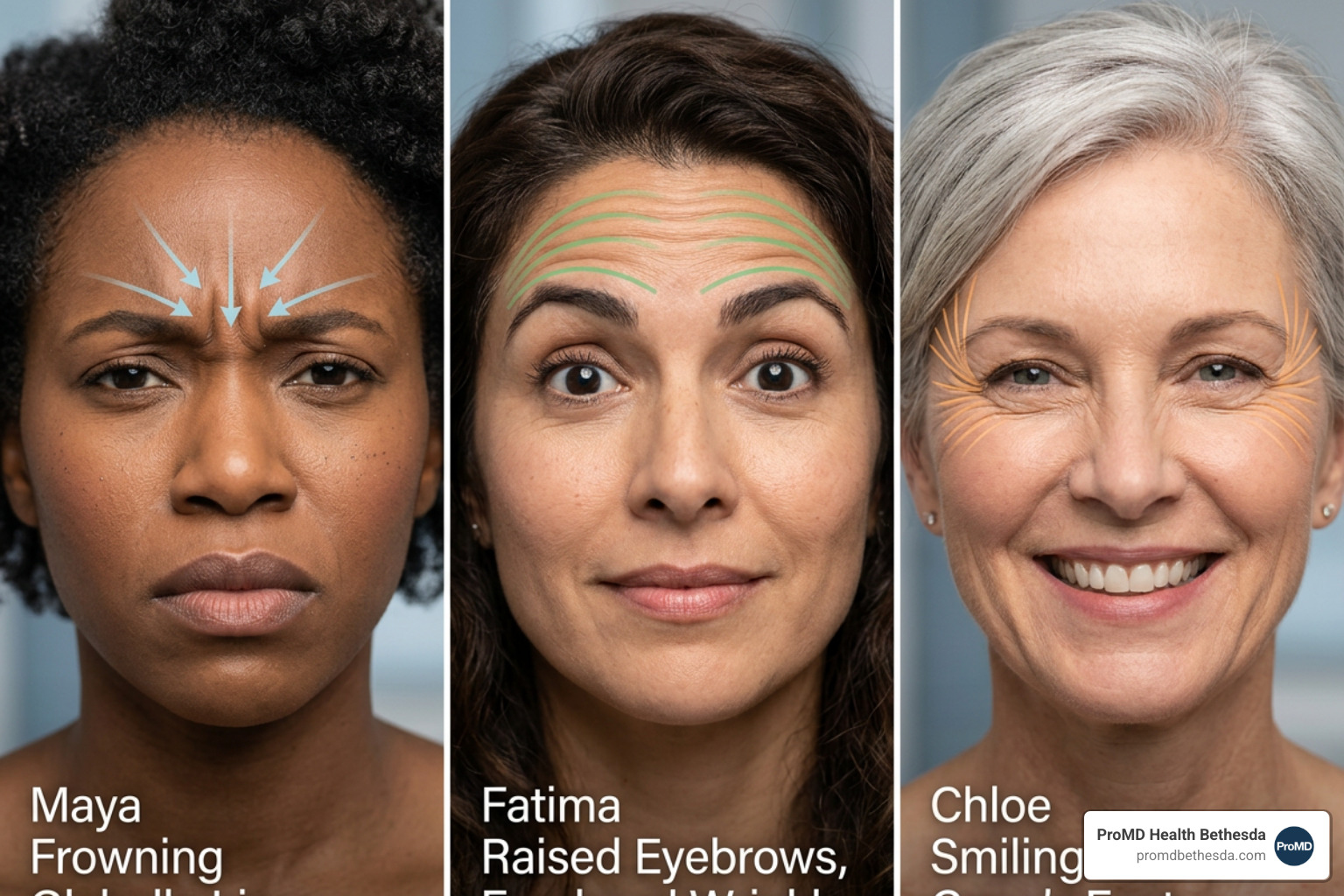
Why is it that two people of the same age might need vastly different amounts? When we evaluate you at ProMD Health, we look at several biological and lifestyle factors.
- Muscle Strength: Just like some people have stronger biceps, some people have stronger “frown muscles.” If you are very expressive or have thick muscle tissue, you will need more units to achieve relaxation.
- Metabolism: If you are an endurance athlete or just have a naturally high metabolic rate, your body may process the toxin faster, or you may require a higher initial dose to see the desired effect.
- Age and Skin Elasticity: Younger patients often use Dysport as “preventative,” requiring fewer units. Older patients with deeper “static” lines (lines present even when the face is at rest) may need a higher dose combined with other treatments like fillers.
- Treatment History: Interestingly, if you get treated regularly, your muscles can “learn” to relax, sometimes allowing us to use slightly fewer units over time.
You can find more general information on how these neurotoxins behave in our Botox category.
Why Gender and Muscle Mass Matter for How Many Units of Dysport Do I Need
Gender plays a significant role in dosing. Generally speaking, men have higher muscle mass and greater muscle density in the face than women. The “glabellar complex” in men is often much stronger, meaning the standard 50 units might not be enough.
For our male patients in Chevy Chase and Bethesda, we often find that they require 1.5 to 2 times the “standard” dose to achieve a natural, smooth result without looking “frozen.” We use customized mapping to ensure we are hitting the bulk of the muscle while maintaining the masculine character of the face.
What to Expect: Results, Longevity, and Your Consultation
One of the reasons our patients love Dysport is the speed. While Botox can take 5 to 7 days to start working, many Dysport users report seeing a difference in as little as 2 to 3 days, with full results peaking at the 2-week mark.
At ProMD Health Bethesda, we’ve taken the guesswork out of the process. We use an AI Simulator that allows you to preview your natural-looking results before we even pick up a needle. This technology helps us have a transparent conversation about how many units of dysport do i need to reach your specific aesthetic goal.
- Longevity: Results typically last 3 to 4 months. We recommend scheduling maintenance every 12 weeks to keep the lines from returning.
- Side Effects: Most patients experience nothing more than slight redness or a tiny bruise at the injection site that fades within hours.
- Contraindications: You should avoid Dysport if you are pregnant, breastfeeding, have a known allergy to cow’s milk protein (Dysport contains a trace amount), or have a neuromuscular disorder like Myasthenia Gravis.
Frequently Asked Questions about Dysport Dosing
How long does it take for Dysport to work?
Most patients notice the “kick-in” within 2 to 3 days. It is one of the fastest-acting neuromodulators on the market. However, you should wait the full 14 days before deciding if you need a touch-up, as the product continues to settle during that time.
Can I get too many units of Dysport?
Yes. Over-treating can lead to a “frozen” look, drooping eyelids (ptosis), or a heavy brow. This is why it is vital to see an experienced injector who understands facial anatomy. At ProMD, we believe in a “conservative start”—we can always add more, but we can’t take it away!
How often should I go back for re-treatment?
To maintain a consistent, smooth appearance, most patients return every 3 to 4 months. If you wait until the movement has fully returned and the lines are deep again, you are essentially starting from scratch. Regular maintenance can actually help the treatment last longer over time.
Conclusion
Finding the perfect balance for your face shouldn’t feel like a math problem. While the question of “how many units of dysport do i need” has average answers—like 50 for the frown and 30 for the forehead—the best result always comes from a personalized assessment.
Whether you are in Garrett Park, Rockville, or right here in Bethesda, our team is dedicated to providing an expert facial evaluation that respects your unique beauty. By combining our clinical expertise with our advanced AI Simulator, we ensure that you leave our clinic feeling refreshed, confident, and like the best version of yourself.
Ready to see what Dysport can do for you? Experience the ProMD difference with our Dysport treatments and book your consultation today.

