

The Ultimate Guide to Upper Face Botox for a Youthful Look
Why Upper Face Botox is the Most Popular Cosmetic Treatment
Upper face Botox is the most frequently performed cosmetic procedure worldwide, with botulinum toxin representing nearly half (47.2%) of all minimally-invasive procedures performed in the United States. Whether you’re seeking to smooth forehead lines, soften crow’s feet, or reduce frown lines between your eyebrows, understanding how this treatment works can help you achieve natural-looking, youthful results.
Quick Answer: What You Need to Know About Upper Face Botox
- What it treats: Horizontal forehead lines, frown lines (glabellar lines), crow’s feet, and bunny lines
- How it works: Temporarily blocks nerve signals to facial muscles, preventing contractions that cause wrinkles
- Treatment time: Less than 30 minutes with no downtime
- Results appear: 3-7 days, with full effect at 2 weeks
- Duration: Typically 3-4 months
- Best for: Dynamic wrinkles (those visible during facial expressions)
The desire to maintain a youthful appearance has driven remarkable advances in aesthetic medicine. Botulinum toxin was first approved by the FDA for cosmetic use in 2002, and since then, Americans have spent over $16.7 billion annually on cosmetic procedures, with minimally-invasive treatments like Botox leading the way.
What makes upper face Botox particularly appealing is its precision. By targeting specific muscles—the frontalis (forehead), corrugator supercilii and procerus (between brows), and orbicularis oculi (around eyes)—skilled injectors can soften lines while preserving natural facial movement. This isn’t about creating a “frozen” look; it’s about achieving a refreshed, rested appearance that reflects how you feel inside.
Research consistently shows that Botox treatment is associated with increased satisfaction, improved quality of life, and even potential antidepressant effects when used for glabellar lines. For many patients, the psychological benefits extend far beyond the physical improvements.
Similar topics to Upper face Botox:
Understanding the Anatomy of Upper Face Botox
To appreciate how Upper face Botox works its magic, we have to look beneath the surface. Our facial expressions are powered by a complex network of muscles that attach directly to the skin. Every time we laugh, frown, or look surprised, these muscles contract, pulling the skin into folds. Over time, these repeated movements lead to “dynamic wrinkles”—lines that appear when you move—which eventually become “static wrinkles” that stay visible even when your face is at rest.
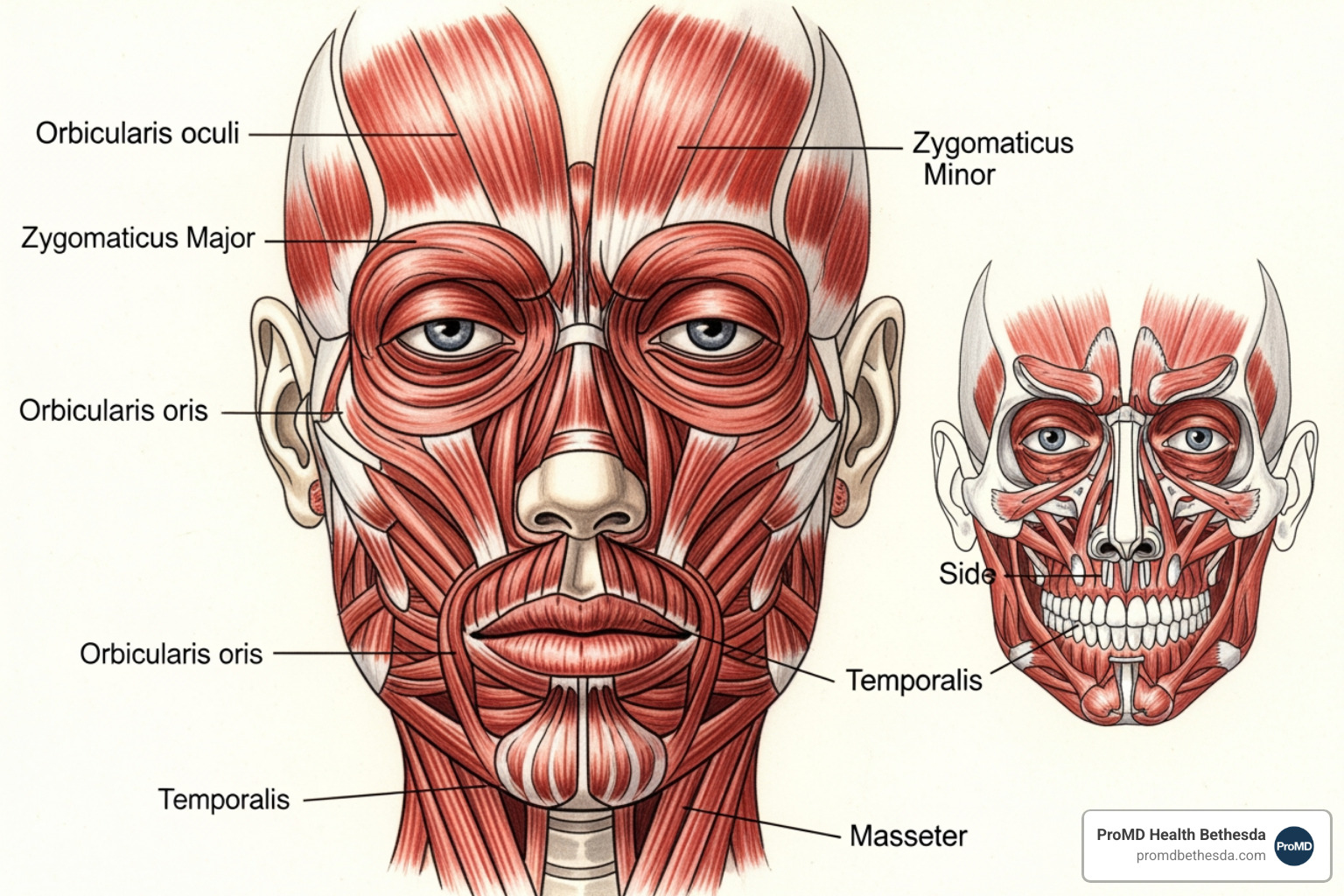
The primary muscles we target in the upper face include:
- Frontalis: This is the large muscle covering your forehead. It is responsible for raising your eyebrows and creating those horizontal “surprise” lines.
- Glabellar Complex: This group includes the Procerus and Corrugator supercilii. These are the “frown muscles” located between your eyebrows. When they contract, they pull the brows together and down, creating the vertical “11” lines.
- Orbicularis Oculi: This circular muscle surrounds the eye. The lateral portion is what causes “crow’s feet” when we smile or squint.
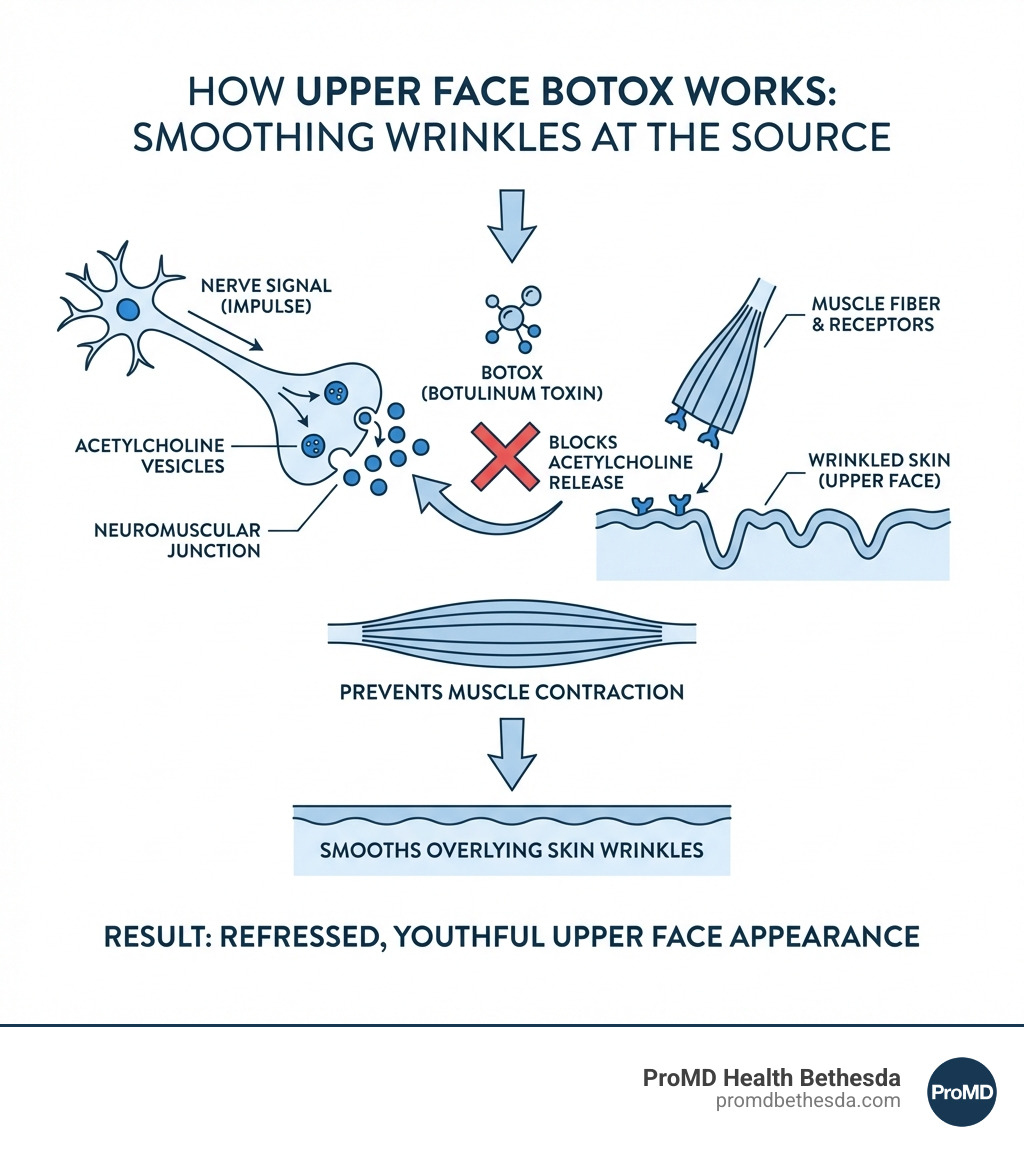
At the microscopic level, Botox works at the neuromuscular junction. It acts as an acetylcholine inhibition agent. Acetylcholine is the neurotransmitter (a chemical messenger) that tells your muscles to contract. When we inject Botox, it cleaves a protein called SNAP-25, which prevents the release of acetylcholine. Without that signal, the muscle stays in a relaxed state. According to scientific research on botulinum toxin for the upper face, this process is temporary because the body eventually recycles the blocked proteins and creates new receptors, which is why we usually see results last about three to four months.
If you are curious about how these treatments can be custom specifically for your needs in the Bethesda area, you can find more info about Botox services at our clinic.
Targeted Areas and Benefits for Rejuvenation
One of the biggest misconceptions about Upper face Botox is that it’s just for “freezing” the face. In reality, it is a highly versatile tool for facial “tweakments.” Beyond just smoothing skin, it can actually change the position and shape of your features for a more balanced look.
The benefits of upper face rejuvenation include:
- Softening Horizontal Forehead Lines: Relaxing the frontalis muscle to smooth the brow.
- Reducing Frown Lines: Softening the “angry” look caused by deep glabellar furrows.
- Smoothing Crow’s Feet: Opening up the eye area for a brighter, more “awake” appearance.
- Treating Bunny Lines: Softening the small crinkles on the bridge of the nose.
- Chemical Brow Lift: By strategically relaxing the muscles that pull the brow down, we allow the muscles that lift the brow to work unopposed, creating a subtle, non-surgical lift.
- Preventative Aging: Starting treatment before lines become static can prevent deep wrinkles from ever forming. Interestingly, some research suggests that by keeping the skin smooth, Botox allows regenerative cells called fibroblasts to rebuild collagen structure over time.
While “Botox” is the household name, there are several FDA-approved formulations available. We often get asked about the differences between them.
| Feature | Botox (OnabotulinumtoxinA) | Dysport (AbobotulinumtoxinA) | Xeomin (IncobotulinumtoxinA) |
|---|---|---|---|
| Formula | Concentrated, thicker | Thinner, spreads easier | “Naked” toxin (no complexing proteins) |
| Onset | 5-7 days | 2-5 days | 5-7 days |
| Best For | Precise, localized areas | Larger areas (like forehead) | Patients concerned about protein sensitivity |
| Duration | 3-4 months | 3-4 months | 3-4 months |
Smoothing Forehead Lines with Upper face Botox
The forehead is often the first place people notice signs of aging. Because the frontalis is a large, powerful muscle, it requires a delicate touch. Our goal is to find the Line of Convergence—a horizontal landmark that splits the muscle into zones that lift and zones that depress. By injecting above this line, we can smooth wrinkles without causing the eyebrows to feel “heavy” or drop.
For patients in Bethesda and Rockville who are dealing with deeper creases, we sometimes suggest a multi-modality approach. You can find more info about forehead treatments here, as deep static lines sometimes benefit from a combination of neurotoxins and dermal fillers.
Addressing Crow’s Feet and Glabella with Upper face Botox
The area between the eyes (the glabella) is perhaps the most satisfying to treat. Those vertical “11” lines can make us look stressed or upset even when we’re perfectly happy. Precision dosing is key here; we typically use 12 to 40 units of Botox in this region, depending on the patient’s muscle strength.
Crow’s feet, or lateral canthal lines, are treated by injecting the lateral fibers of the orbicularis oculi. Because the skin here is very thin, we keep the injections superficial. This treatment not only smooths smile lines but can also help alleviate “hooded” eyelids by providing a slight lateral lift. For those interested in the science, there is extensive clinical data on Botox for facial wrinkles that supports its safety and efficacy in these specific zones.
The Treatment Process: From Consultation to Results
At ProMD Health Bethesda, we believe the most important part of the journey happens before the needle even touches your skin. Every face is unique—your muscle depth, facial symmetry, and even your “expression style” dictate how we approach your treatment.
1. The Consultation We start by assessing your face both at rest and in motion. We’ll ask you to frown, squint, and raise your eyebrows. This helps us see exactly which muscles are overactive. We also use our unique AI Simulator, which allows you to preview your natural-looking results before we begin. This technology is a game-changer for our patients in Chevy Chase and Kensington, as it removes the guesswork and builds confidence.
2. The Injection Technique The actual procedure takes about 10 to 15 minutes. We use ultra-fine needles (often 30 to 33 gauge) to minimize discomfort. We often use “micro-dosing” techniques, especially in the lower forehead, to ensure you can still make natural expressions. You’ll feel a tiny pinch, similar to a mosquito bite.
3. Results and Maintenance You won’t walk out looking different immediately. It takes time for the neurotoxin to bind to the receptors. You’ll start to see a “softening” in 3 to 5 days, with the full “wow” factor appearing at the 2-week mark. To keep your look fresh, we recommend a maintenance schedule every 3 to 4 months. Interestingly, many of our long-term patients find that over time, they need slightly less product or can go longer between appointments because the muscles “learn” to stay relaxed.
If you’re looking for the best Botox providers in Bethesda, our team is dedicated to providing an experience that is as comfortable as it is effective.
Safety, Side Effects, and Contraindications
While Upper face Botox is incredibly safe when performed by experts, it is still a medical procedure. Understanding the potential side effects helps you prepare for your appointment.
Common Side Effects:
- Bruising: Small needle-point bruises can occur. We recommend avoiding blood thinners like aspirin, ibuprofen, and even certain supplements like Vitamin E or fish oil for a week before your visit.
- Headache: Some patients experience a “frontal headache” for a day or two after treatment. Ironically, many regular Botox users actually find that the treatment reduces their frequency of tension headaches!
- Swelling: Minor bumps at the injection site usually disappear within 20 minutes.
Rare Complications:
- Eyelid Ptosis (Droopy Eyelid): This occurs in less than 1-5% of cases and is usually due to the toxin diffusing into the levator muscle. It is temporary and can often be treated with special eye drops (like apraclonidine) until the Botox wears off.
- Brow Heaviness: This happens if the forehead is over-treated or if the injections are placed too low. This is why we are so conservative with dosing in the lower forehead.
Who Should Avoid Botox? According to FDA prescribing and safety information, you should not receive Botox if you:
- Have a skin infection at the injection site.
- Have a known allergy to any botulinum toxin product.
- Suffer from neuromuscular disorders like Myasthenia Gravis or ALS.
- Are currently pregnant or breastfeeding (while there is no direct evidence of harm, we always prioritize safety).
Post-Treatment Care: To ensure the best results, we ask that you stay upright for 4 hours after your treatment. Avoid intense exercise, saunas, or massaging the treated area for 24 hours. This prevents the product from migrating to muscles where it wasn’t intended to go.
Frequently Asked Questions about Upper Face Botox
How long do the results typically last?
For most of our patients in Rockville and Garrett Park, the results last between 3 and 4 months. Several factors influence this, including your metabolic rate (highly active people may metabolize it faster) and the strength of your facial muscles. If you are a “strong frowner,” you might find you need a touch-up a bit sooner than someone with finer lines.
At what age should I consider preventative Botox?
There is no “magic number,” but many people start considering “Baby Botox” in their late 20s or early 30s. The goal of preventative treatment is to stop dynamic lines from becoming permanent static lines. If you notice that your makeup is starting to “settle” into lines on your forehead even when your face is relaxed, it might be time for a consultation.
Can Botox fix hooded eyelids or brow asymmetry?
Yes! This is one of the most common requests we get. By performing a lateral lift, we can relax the muscles that pull the tail of the brow down. This “opens” the eye and can reduce the appearance of hooded lids. We can also use custom injection patterns to balance asymmetry—for example, if one eyebrow naturally sits higher than the other, we can relax the stronger side to bring them into harmony.
Conclusion
Reclaiming a youthful, refreshed appearance doesn’t require surgery or weeks of downtime. Upper face Botox offers a safe, effective, and scientifically-proven way to smooth away the signs of stress and aging while keeping your natural charm intact.
At ProMD Health Bethesda, we are proud to serve our community across Bethesda, Chevy Chase, Kensington, Garrett Park, and Rockville. Our combination of expert injectors and our state-of-the-art AI Simulator ensures that your results are never a surprise—just a better version of you. We focus on “artist-crafted” results that leave you looking rested, not frozen.
Ready to see what’s possible for your skin? Get started with your Botox treatment by scheduling a consultation with our expert team today!

