

Dermal Filler: Ultimate Guide 2026
Reclaim Your Radiance: An Introduction to Dermal Fillers
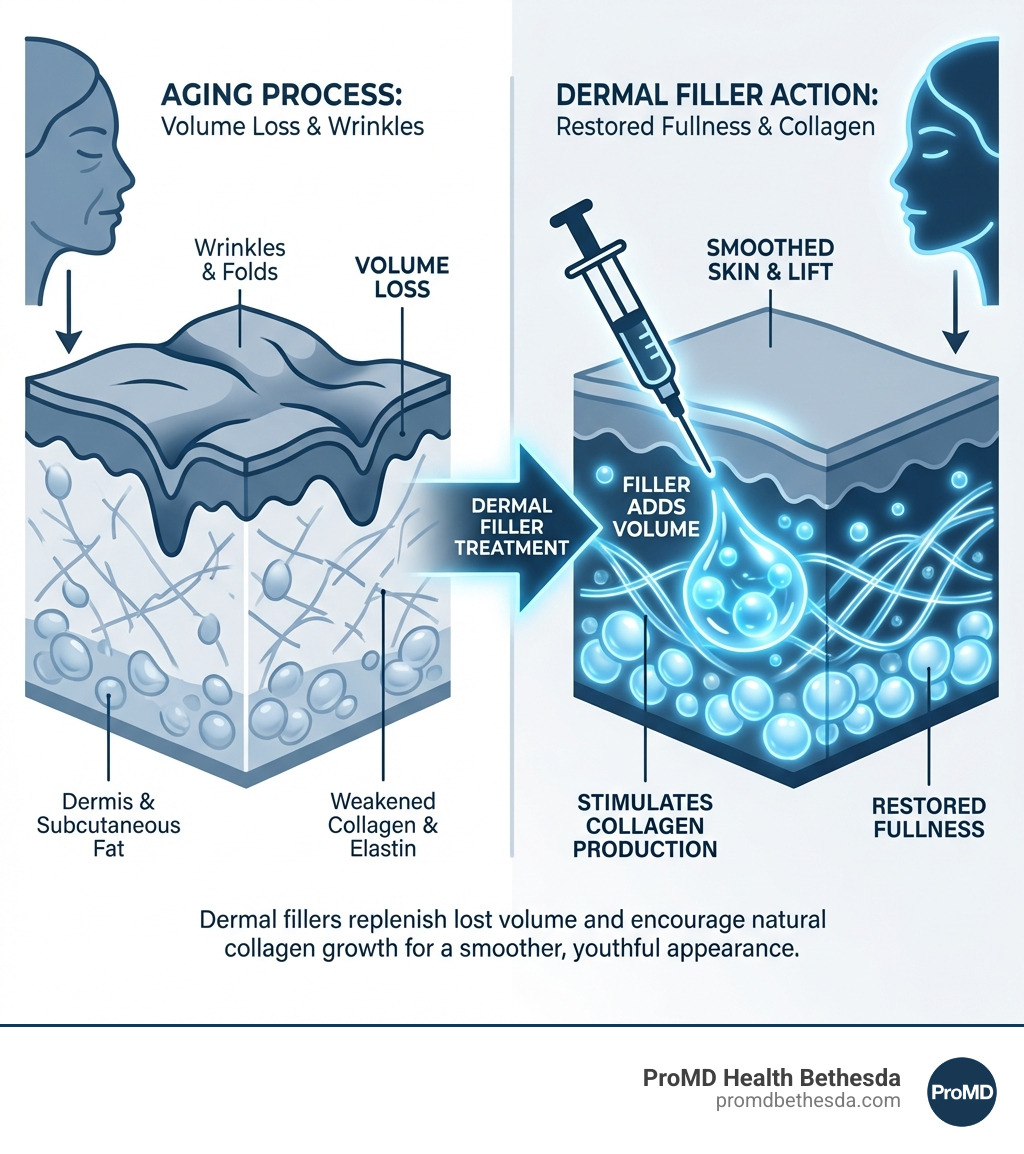
A dermal filler is a gel-like substance injected under your skin. Its purpose is to create a smoother or fuller appearance. These popular treatments work by adding volume beneath the skin’s surface, which plumps it up. This helps to reduce the look of wrinkles and improve facial contours.
- What are dermal fillers?
- Injectable, gel-like substances.
- Designed to restore volume and smooth lines.
- How do dermal fillers work?
- They add volume under the skin.
- This plumps up the skin, reducing wrinkles and folds.
- They address natural volume loss from aging.
More than 1 million people choose this facial rejuvenation treatment each year. In fact, it’s the second most common non-surgical cosmetic procedure in the United States.
As we age, our bodies naturally lose subcutaneous fat. Our skin also stretches over time. These changes lead to facial lines and a loss of fullness. Dermal fillers offer a way to diminish these lines and restore a youthful volume to your face. They can improve shallow contours and soften facial creases. This can improve the appearance of recessed scars and even decrease shadows under your eyes.
This guide will explain everything you need to know. You’ll learn how dermal fillers work and the different types available. We’ll also cover their benefits, risks, and how to choose a qualified provider. Understanding these details will help you make informed decisions for a refreshed, confident look.
Basic dermal filler glossary:
What is a Dermal Filler and How Does It Work?
At its core, a dermal filler is a medical device implant designed for soft tissue augmentation. But don’t let the clinical term scare you! Think of it as a way to “refill” the areas where time and gravity have taken a toll. As we age, our skin loses collagen and elastin—the proteins that provide structure and bounce. This leads to the stretching of facial skin and the loss of subcutaneous fat.
When we inject these gels into the connective tissues of the skin, they act like a supportive cushion. According to Scientific research on hyaluronic acid fillers, these substances provide immediate physical volume while often encouraging the body’s natural processes. They don’t just “fill” a hole; they integrate with your tissue to smooth out moderate-to-severe facial wrinkles and folds.
The beauty of modern fillers is their versatility. We use them for:
- Plumping thin lips that have lost their definition.
- Enhancing shallow contours in the cheeks or temples.
- Softening the look of recessed scars.
- Reconstructing contour deformities in the face.
- Decreasing the shadow of the lower eyelids (the dreaded “tear troughs”).
By following Standard guidelines for the use of dermal fillers, we ensure that the placement is precise, respecting your unique facial anatomy to maintain a look that is refreshed, never “overdone.”
Types of FDA-Approved Dermal Filler Materials
Not all fillers are created equal. Depending on your goals—whether you want to plump your lips for a date night or restore cheek volume that lasts for years—we choose the material that best fits your biology.
| Material | Type | Common Longevity | Best For |
|---|---|---|---|
| Hyaluronic Acid (HA) | Absorbable | 6–18 Months | Lips, lines, hydration |
| Calcium Hydroxylapatite | Biostimulatory | ~12–18 Months | Deep folds, jawline |
| Poly-L-lactic Acid | Biostimulatory | Up to 2 Years | Large scale volume loss |
| PMMA | Permanent | 5+ Years | Acne scars, deep folds |
For those in our community looking for more info about dermal fillers in Bethesda, it’s important to know that most of these are temporary. Your body eventually breaks down and absorbs the material, which is actually a safety feature! It allows us to adjust your treatment as your face continues to age naturally. To see how we achieve these subtle shifts, check out our more info about natural-looking fillers.
Hyaluronic Acid (HA) Dermal Filler
Hyaluronic Acid is the superstar of the cosmetic world. It is a polysaccharide—a sugar molecule—that occurs naturally in your skin and cartilage. Its primary job? Hydration. HA can hold up to 1,000 times its weight in water, making it perfect for creating that “dewy,” plump look.
According to the Rheology of hyaluronan fillers, the physical properties of HA gels (like their thickness and elasticity) can be custom. This is why we have specific formulas for different needs. For example, a soft, flexible HA is ideal for more info about vertical lip wrinkles, while a firmer version might be used to mimic bone along the jawline.
One of the biggest advantages of HA fillers is that they are reversible. If you decide the look isn’t for you, an enzyme called hyaluronidase can dissolve the filler almost instantly.
Biostimulatory Dermal Filler Options
If you’re looking for longevity and a “bottom-up” approach to rejuvenation, biostimulatory fillers are the answer. Instead of just sitting under the skin to provide volume, these materials trigger your body to produce its own new collagen.
- Calcium Hydroxylapatite (CaHA): Found naturally in human bones, this is a thicker filler. It’s excellent for deep nasolabial folds and contouring the jawline. It typically lasts about 18 months.
- Poly-L-lactic Acid (PLLA): This is a biodegradable synthetic substance that has been used for decades in dissolvable stitches. It acts as a collagen stimulator. Results aren’t immediate; they emerge over several months as your skin builds its own support structure, often lasting over 2 years.
- PMMA (Polymethylmethacrylate): These are tiny, permanent microspheres. This is the only FDA-approved “permanent” filler, often used for acne scars or deep furrows.
An Overview of deep dermal fillers highlights that these denser materials are placed deeper in the tissue to provide a structural foundation for the face.
The Procedure: Before, During, and After
We want your experience at ProMD Health Bethesda to be as comfortable as possible. Whether you are in Chevy Chase, Kensington, or Rockville, the process remains consistent and professional.
Before the Procedure:
Everything starts with a consultation. We’ll review your medical history, including any allergies or medications (especially blood thinners, which can increase bruising). This is where we use our AI Simulator—a unique tool that allows you to preview your potential results on a screen before a single needle is used. This ensures we are on the same page about your aesthetic goals.
During the Procedure:
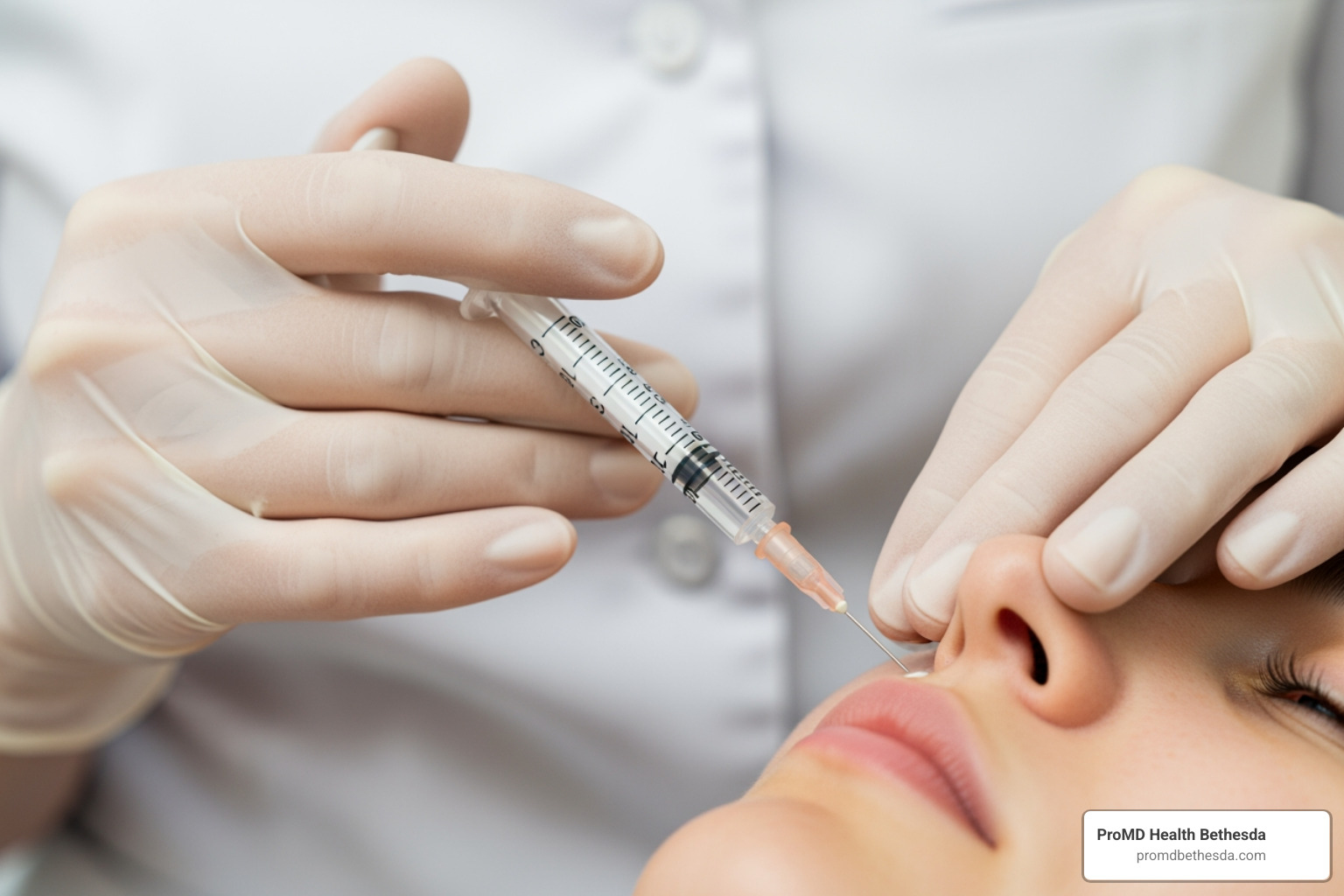
After cleaning the area, we may apply a topical anesthetic to numb the skin. Most of our fillers also contain lidocaine, a local anesthetic that numbs the area from the inside out as the gel is injected. We often use a blunt-tip microcannula rather than a sharp needle. This technique is much gentler, significantly reducing the risk of bruising and swelling.
Whether we are working on more info about marionette line transformations or providing more info about forehead line fillers, the actual injections usually take between 15 and 60 minutes.
After the Procedure:
You might see results immediately! However, don’t judge the final look by how you look in the car mirror right after. Initial swelling and minor bruising are common.
Post-Care and Longevity Factors
To get the most out of your dermal filler, follow these simple rules:
- Avoid strenuous physical activity for 24 to 48 hours. High blood pressure and heart rate can increase swelling and the risk of bruising.
- Hands off! Don’t massage or pressure the treated area unless specifically instructed.
- Ice is your friend. Apply a cold pack gently to manage any discomfort.
Longevity isn’t just about the product; it’s about you. Your metabolism plays a huge role. If you have a very high metabolism or are an “extreme” athlete, your body may break down the filler faster. Research on Minimizing bruising after cosmetic injectables suggests that following pre- and post-care instructions can significantly improve your recovery time.
Safety, Risks, and Dermal Filler Warnings
While dermal filler injections are incredibly common, they are still medical procedures. Safety should always be your top priority.
Common side effects include:
- Redness
- Swelling
- Bruising
- Tenderness
However, serious complications can occur if the provider is inexperienced. The most significant risk is accidental injection into a blood vessel (vascular occlusion). This can lead to skin necrosis (tissue death), stroke, or even blindness. This is why choosing a provider with deep anatomical knowledge—like our team in Bethesda—is non-negotiable.
FDA Warnings:
The FDA has issued a strong warning on needle-free devices. These “hyaluron pens” use high pressure to force filler into the skin. They are unapproved, dangerous, and provide zero control over where the filler actually goes. Never use these devices or buy fillers online to inject yourself.
Furthermore, Research on avoiding blindness from fillers emphasizes that certain areas, like the bridge of the nose or the space between the eyebrows (glabella), require extreme caution and expert-level skill due to the complex network of blood vessels.
Reversing a Dermal Filler
One of the reasons we love Hyaluronic Acid fillers is the “safety net.” If there is a complication or if a patient simply doesn’t like their new look, we can use hyaluronidase. This is an enzyme that breaks down the HA molecule almost instantly. Within 24 to 48 hours, the filler is gone, and the skin returns to its previous state. For more details on how we manage these treatments, see our more info about filler guides.
Frequently Asked Questions about Fillers
How long do results typically last?
Most HA fillers last between 6 and 18 months. However, this is a “temporary” effect because your body naturally absorbs the material. Maintenance is key! Most of our patients find that a small “top-up” once a year is enough to keep their results looking fresh without ever needing to start from scratch. You can find more details on the Longevity of HA fillers in recent clinical reviews.
What is the difference between fillers and botulinum toxin?
This is the most common question we get!
- Botulinum Toxin (Botox/Dysport): These are neurotoxins that temporarily relax the muscles. They are best for “dynamic” wrinkles—the ones that appear when you frown or squint.
- Dermal Fillers: These restore volume. They are for “static” wrinkles—the ones that are there even when your face is at rest—and for contouring the face.
Think of it this way: Botox “freezes” the movement, while filler “fills” the hollows. Our FDA guide on fillers vs botox explains how these two often work better as a team than alone.
Are there medical uses for fillers beyond cosmetics?
Yes! While we often focus on beauty, fillers have incredible medical applications. They are FDA-approved to treat HIV-associated lipodystrophy (facial fat loss). Research on fillers for HIV-associated lipoatrophy shows how these treatments can significantly improve a patient’s quality of life and self-esteem. Additionally, certain types of fillers are used to treat symptoms of osteoarthritis in joints or to aid in bone and gum regeneration.
Conclusion
At ProMD Health Bethesda, we believe that aesthetic treatments should empower you to feel like the best version of yourself. By combining advanced technology—like our AI Simulator—with the expert care of our highly trained injectors, we provide a safe, informed, and confident experience for every patient.
Whether you’re looking to smooth out a few lines or want a full facial refresh, we are here to guide you through every step of your journey. We proudly serve the communities of Bethesda, Chevy Chase, Kensington, Garrett Park, and Rockville, MD.
Ready to see what’s possible for your skin? Get Started Now and schedule your consultation today. Let’s work together to achieve natural-looking results that make you shine.

