

The Lowdown on Growth Hormone Peptide Therapy
Understanding Growth Hormone Peptide Therapy and How It Works
What is growth hormone peptide therapy? It’s a treatment that uses specific amino acid chains (peptides) to stimulate your body’s natural production of human growth hormone (HGH), rather than injecting synthetic HGH directly. These peptides signal your pituitary gland to release more of its own growth hormone, promoting benefits like improved muscle mass, better sleep quality, enhanced fat metabolism, and increased energy levels.
Quick Overview:
- What it is: Therapy using peptides like Sermorelin, Ipamorelin, and CJC-1295 to boost natural HGH production
- How it works: Peptides stimulate the pituitary gland to release more endogenous (your own) growth hormone
- Key difference from HGH: Encourages natural production instead of replacing it with synthetic hormone
- Primary benefits: Increased muscle mass, improved fat loss, better sleep, enhanced recovery, and more youthful energy
- Administration: Typically via subcutaneous injection, often daily or several times per week
If you’ve noticed declining energy, stubborn weight gain, poor sleep quality, or reduced muscle tone as you age, you’re experiencing the natural effects of declining growth hormone. Research shows HGH secretion declines by about 15% for every decade of adult life—a significant drop that affects everything from your metabolism to your recovery ability.
Growth hormone peptide therapy offers a way to address this decline by working with your body’s natural systems rather than overriding them. Unlike synthetic HGH replacement, which can suppress your pituitary gland’s function, peptides encourage your body to produce more of its own growth hormone in a regulated, physiological manner.
This approach has gained attention among health-conscious professionals seeking evidence-based wellness solutions that deliver natural-looking results without the risks associated with traditional hormone replacement.
What is Growth Hormone Peptide Therapy?
To truly grasp what is growth hormone peptide therapy, we first need to look at the “messenger” system of the human body. Peptides are short chains of amino acids—essentially tiny proteins—that act as signaling molecules. They tell your cells exactly how to behave. In this specific therapy, we use peptide hormones known as secretagogues.
A “secretagogue” is just a fancy medical term for a substance that induces secretion. Instead of dumping a bucket of synthetic hormones into your bloodstream, these peptides gently knock on the door of your pituitary gland (the master gland located at the base of your brain) and ask it to get back to work.
At ProMD Health Bethesda, we see many patients from Chevy Chase to Rockville who feel like their “inner battery” is draining. This therapy is designed to recharge that battery by restoring a more youthful hormonal rhythm. It’s not about turning you into a bodybuilder overnight; it’s about restoring the metabolic efficiency you had in your 20s. For more specialized insights, you can explore our detailed guide on Peptide Therapy.

How Growth Hormone Peptide Therapy Works
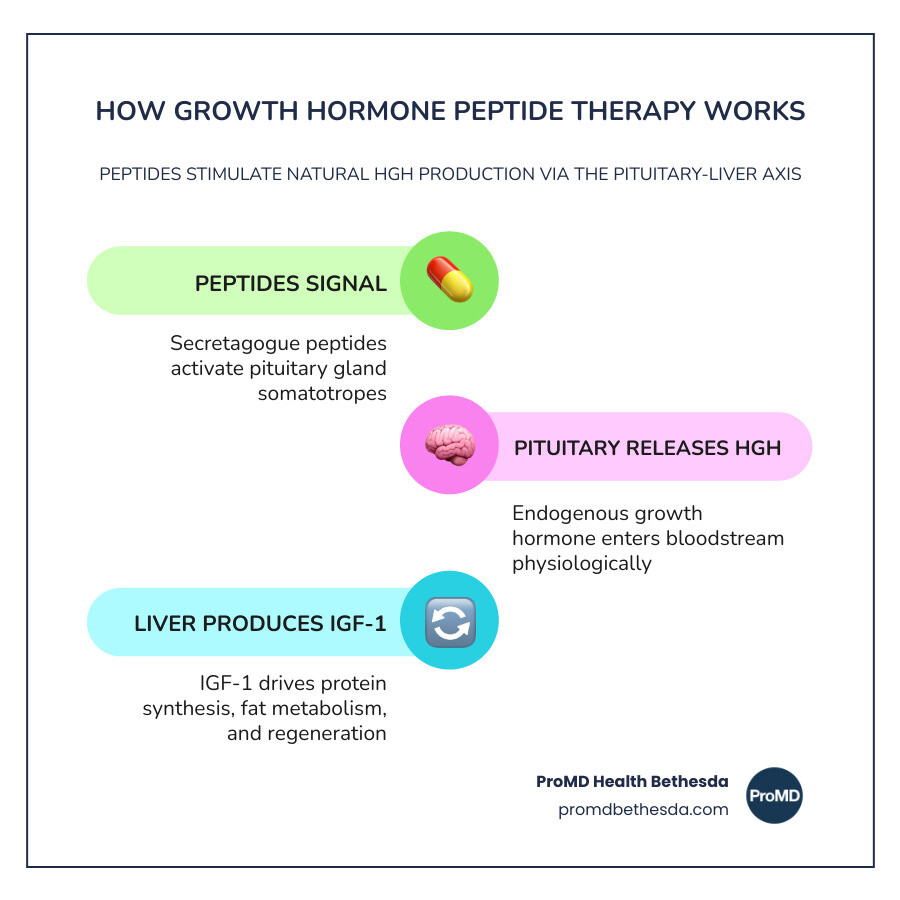
The magic happens through endogenous stimulation. When we administer these peptides, they mimic the actions of Growth Hormone Releasing Hormone (GHRH). They bind to specific receptors on somatotropes—the cells in the pituitary gland responsible for producing HGH.
Once the pituitary gland releases HGH into the bloodstream, it travels to the liver. This triggers the production of Insulin-like Growth Factor 1 (IGF-1). IGF-1 is the real workhorse here; it is responsible for the systemic effects of growth hormone, such as upregulating protein synthesis and inhibiting the breakdown of muscle tissue.
By stimulating this natural axis, we ensure that the body releases HGH in a “pulsatile” manner—meaning it follows the natural spikes and valleys your body expects, particularly during deep sleep. This is much safer than the constant, high levels associated with direct HGH injections.
Common Peptides Used in Growth Hormone Peptide Therapy
Not all peptides are created equal. Depending on your goals—whether it’s fat loss, muscle gain, or better sleep—we might recommend different HGH Peptide options. Here are the heavy hitters we often use in our Bethesda and Potomac area protocols:
- Sermorelin: The “OG” of growth hormone peptides. It is a GHRH analog that was one of the first used to stimulate the pituitary. It’s excellent for general anti-aging and improving sleep quality.
- Ipamorelin: Often called the “cleanest” peptide. It is a selective GH secretagogue that stimulates HGH release without significantly increasing hunger (unlike GHRP-6) or raising cortisol and prolactin levels.
- CJC-1295: This peptide is frequently paired with Ipamorelin. It has a longer half-life, meaning it stays in your system longer to provide a steady “pulse” of growth hormone.
- GHRP-6: A powerful stimulator that also interacts with ghrelin receptors. While effective, it can cause a significant increase in appetite, which may or may not be desirable depending on your weight loss goals.
- Ibutamoren (MK-0677): Unique because it is an oral secretagogue. It mimics the action of ghrelin and has been shown to increase both muscle mass and bone mineral density.
HGH Peptides vs. Traditional HGH Therapy
One of the most frequent questions we hear in our Bethesda clinic is: “Why not just take HGH?” It’s a valid question, but the differences are profound, especially regarding long-term health and safety.
Traditional HGH therapy uses exogenous (external) synthetic hormones like Somatropin. While effective for severe growth deficiencies, using it for wellness can be like using a sledgehammer to hang a picture frame. It can shut down your body’s natural production entirely.
| Feature | HGH Peptide Therapy | Traditional HGH (Somatropin) |
|---|---|---|
| Source | Stimulates your own pituitary gland | Synthetic hormone replacement |
| HGH Levels | Natural, pulsatile release | Constant, elevated levels |
| Pituitary Function | Preserves and strengthens function | Can cause pituitary suppression/shutdown |
| Side Effect Risk | Lower; regulated by body’s feedback loop | Higher; includes joint pain and edema |
| Legal Status | Prescribed for wellness/age-related decline | Highly restricted; specific medical uses only |
| Bethesda Availability | Available at ProMD Health Bethesda | Restricted to diagnosed deficiency |
Peptides are generally considered a “smarter” therapy because they respect the body’s natural feedback loops. If HGH levels get too high, the body has internal mechanisms to slow down production. With direct HGH injections, those safety valves are bypassed.
Safety and Side Effect Profiles
While we love the benefits of peptides, we believe in total transparency. Any therapy that alters your chemistry should be monitored by experts. Direct HGH abuse is often linked to uncertain athletic benefits and can even worsen exercise capacity if dosed incorrectly.
Common side effects of peptide therapy are usually mild and may include:
- Water Retention: Some patients notice slight swelling in the extremities.
- Increased Hunger: Particularly with GHRP-6 or Ibutamoren.
- Tingling in Hands/Feet: Often a sign that the dosage needs adjustment.
- Numbness/Carpal Tunnel Symptoms: Rare, but possible if HGH levels rise too quickly.
The beauty of working with our team in Bethesda is that we use personalized protocols. We don’t do “one size fits all.” We monitor your blood work to ensure your IGF-1 levels stay within a healthy, youthful range, avoiding the risks of acromegaly or insulin resistance.
Benefits and Expected Results of Therapy
Why do people seek out what is growth hormone peptide therapy? Because the benefits touch almost every aspect of “feeling young.” As HGH levels rise, you aren’t just getting a cosmetic boost; you’re improving your cellular health.
Key benefits include:
- Improved Sleep Quality: HGH is primarily secreted during Deep Slow Wave Sleep. Peptides can help you reach these restorative stages more easily.
- Increased Lean Muscle Mass: By improving protein synthesis, peptides help you maintain and build muscle even as you age.
- Fat Loss: HGH promotes lipolysis, the process of breaking down stored fat for energy, particularly around the midsection.
- Enhanced Recovery: Whether it’s a tough workout at a Bethesda gym or a minor injury, your body heals faster.
- Skin and Hair: Increased collagen production leads to better skin elasticity and thicker hair.
- Bone Density: Studies show that long-term GH replacement increases bone mineral density, reducing the risk of fractures later in life.
Timeline for Results
Patience is a virtue, especially with peptides. This isn’t a stimulant that kicks in 30 minutes later. It is a gradual optimization of your biology.
- Weeks 1-4: You’ll likely notice better sleep almost immediately. Your dreams might become more vivid, and you’ll wake up feeling more refreshed. Energy levels during the day start to stabilize.
- Months 2-3: This is where the physical changes begin. You might notice your clothes fitting differently as body composition shifts. Muscle tone becomes more apparent, and recovery from exercise improves.
- Month 6 and Beyond: This is the “peak” phase. Skin elasticity is noticeably better, hair and nails grow faster, and the full metabolic benefits are in full swing. Many of our patients describe this as “feeling like themselves again.”
For those interested in the broader scope of hormone optimization, our Hormone Therapy page covers how we balance these peptides with other essential hormones.
Getting Started: Consultations and Administration
Starting your journey at ProMD Health Bethesda is a streamlined, medically supervised process. We serve the entire local region, including Kensington and Garrett Park, ensuring that world-class longevity medicine is right in your backyard.
- Initial Consultation: We start with a deep dive into your symptoms, medical history, and goals. This is where we use our USP: the AI Simulator. You can preview natural-looking results and understand the potential impact on your physique and wellness, giving you a confident starting point.
- Comprehensive Blood Work: We don’t guess; we test. We look at IGF-1 levels, fasting insulin, thyroid function, and testosterone levels, which can decline by 2% annually after age 30.
- Personalized Protocol: Based on your labs, we select the specific peptide blend and dosage that fits your biology.
- Administration: Most peptides are administered via a tiny subcutaneous injection (using a very small insulin-sized needle) into the fatty tissue around the stomach. This is typically done at night to mimic the body’s natural HGH surge during sleep.
We also offer telehealth options for follow-ups, making it easy for busy professionals in the DC metro area to stay on track with their wellness plans.
Frequently Asked Questions about HGH Peptides
Is growth hormone peptide therapy FDA-approved?
This is a nuanced area. While many individual peptides are FDA-approved for specific medical conditions (like Sermorelin for growth hormone deficiency), their use for general “wellness” or “anti-aging” is often considered “off-label.” This means a licensed physician can prescribe them if they believe it is in the patient’s best interest. We source our peptides from high-quality, 503B accredited compounding pharmacies to ensure purity and potency. For competitive athletes, these substances are on the WADA Prohibited List.
Who is a good candidate for this treatment?
A good candidate is typically an adult (30+) experiencing symptoms of age-related hormonal decline, such as fatigue, muscle loss, and poor sleep. It is also excellent for those with a diagnosed growth hormone deficiency.
Who should avoid it?
- Individuals with active malignancy or a history of certain cancers (as HGH promotes cell growth).
- Pregnant or nursing women.
- Those with severe uncontrolled diabetes (as GH can affect insulin sensitivity).
How is the therapy administered?
As mentioned, subcutaneous injection is the gold standard. It’s nearly painless and allows for the best absorption. Most protocols involve a “5 days on, 2 days off” cycle to prevent the pituitary gland from becoming desensitized. Most peptides require refrigeration once reconstituted to maintain their delicate molecular structure.
Conclusion
Understanding what is growth hormone peptide therapy is the first step toward reclaiming your vitality. By stimulating your body’s natural ability to produce HGH, you can enjoy deeper sleep, a leaner physique, and the energy required to live your life to the fullest in Bethesda and beyond.
At ProMD Health Bethesda, we combine this advanced science with our unique AI Simulator technology, allowing you to move forward with your treatment plan with total confidence in the natural-looking results you’ll achieve. Whether you are in Rockville, Chevy Chase, or right here in Bethesda, we are ready to help you optimize your health.
Ready to see the difference for yourself? Start your journey with Peptide Therapy today and book a consultation with our expert team.

