

Acne scar treatment: Reclaim Skin 2026
Why Addressing Acne Scars Matters for Your Confidence
Acne scar treatment has become one of the most sought-after solutions in modern dermatology, and for good reason. The marks left behind by acne can persist long after breakouts clear, affecting how you see yourself and how you show up in both personal and professional settings.
Quick Answer: Most Effective Acne Scar Treatments
| Treatment Type | Best For | Sessions Needed | Results Timeline |
|---|---|---|---|
| Fractional CO2 Laser | Deep atrophic scars | 3-6 treatments | 3-6 months |
| Subcision + Fillers | Rolling, boxcar scars | 1-3 treatments | Immediate + 3 months |
| TCA CROSS | Ice pick scars | 3-5 treatments | 2-4 months |
| Microneedling + PRP | Mild to moderate scars | 4-6 treatments | 3-6 months |
| Dermal Fillers | Volume loss, rolling scars | 1-2 treatments | 6-18 months |
Here’s what you need to know: acne scars rarely fade on their own. While some people see no need to address them, research shows that over 70% of individuals feel their acne scars negatively impact self-confidence, and 92% believe their confidence would improve if those scars were healed.
The good news? Today’s treatments offer remarkable results. Modern technology can achieve up to 90% improvement in atrophic scars through advanced laser treatments, and combination approaches are proving even more effective.
But not all scars are the same. Atrophic scars (those pitted depressions in your skin) account for 75-90% of acne scarring cases. Then there are hypertrophic scars (raised, thick scars) and keloid scars (overgrowth of scar tissue). Each type responds differently to treatment.
The challenge many people face is understanding which treatment path makes sense for their specific concerns. Some wonder if at-home products can truly make a difference. Others worry about downtime, cost, or whether results will look natural.
This guide will walk you through the science behind skin scarring, the most effective professional treatments available today, and how to choose the right approach for your skin. We’ll also show you how advanced technology at ProMD Health Bethesda can help you preview your potential results before committing to treatment.
Whether you’re dealing with ice pick scars, stretch marks, or sun damage, there are proven solutions that work. The key is matching the right treatment to your specific skin concerns and working with providers who understand the nuances of skin healing and regeneration.
Understanding the Science of Skin Damage and Scarring
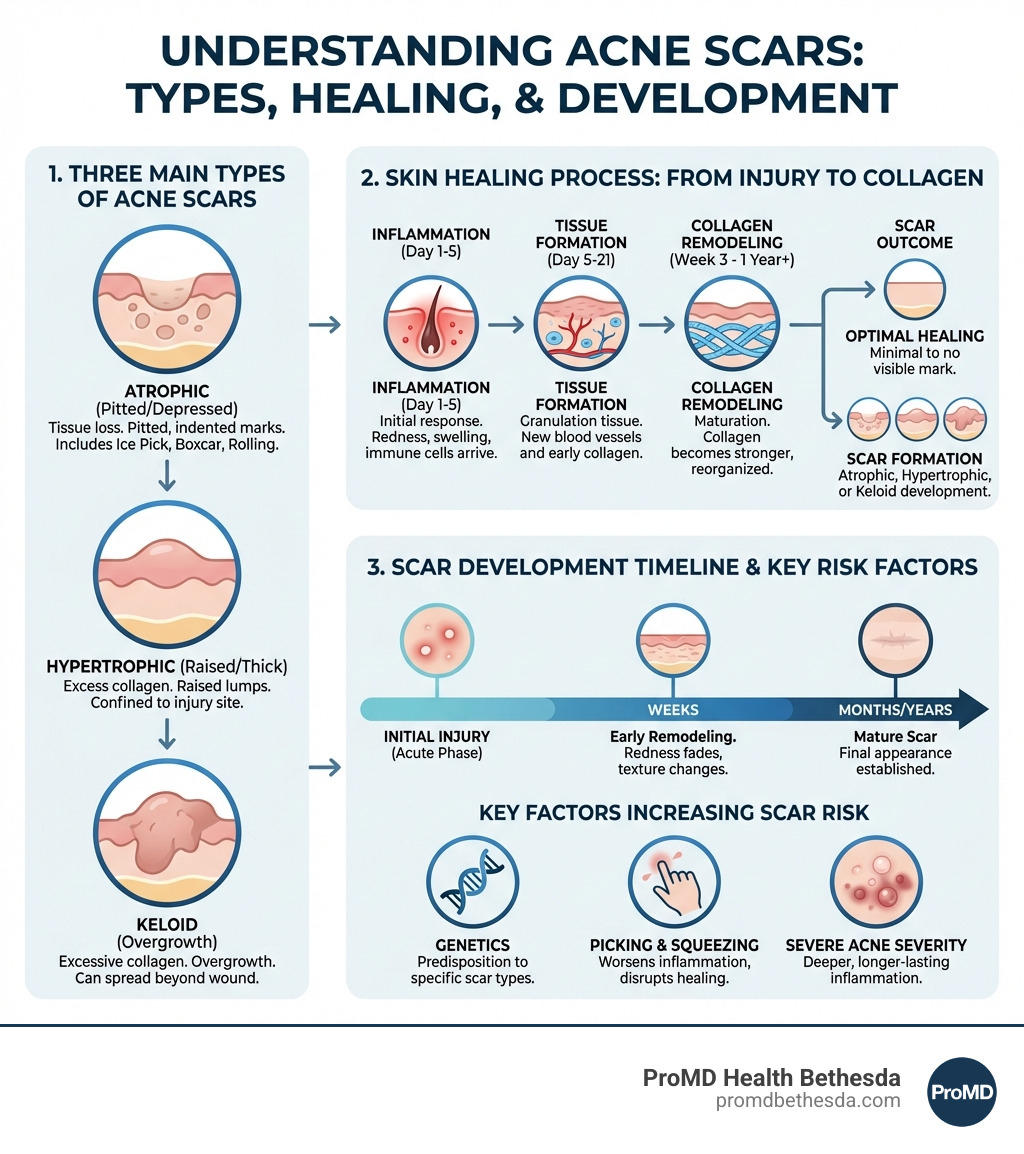
To effectively treat a scar, we first have to understand what it is. Essentially, a scar is the body’s “Plan B.” When your skin is damaged by a deep, inflammatory acne cyst, the body rushes to repair the site. If it produces too little collagen, you get a “pitted” or depressed scar. If it produces too much, you get a raised scar.
According to the Acne scars: Overview provided by the American Academy of Dermatology, these marks are more than just surface blemishes; they are changes in the actual structure of your dermis.
Atrophic Scars (The Depressions)
Atrophic scars are the most common, accounting for up to 90% of cases. We further categorize these into three subtypes based on their shape:
- Ice Pick Scars: These are narrow (less than 2mm), deep, V-shaped pits that look like the skin was punctured by a tiny ice pick. They account for 60-70% of atrophic scars.
- Boxcar Scars: These are round or oval depressions with sharp, vertical edges, similar to chickenpox scars. They make up about 20-30% of cases.
- Rolling Scars: These create a wave-like or undulating appearance on the skin because they are tethered to the deeper tissue by fibrous bands. These account for 15-25% of cases.
Hypertrophic and Keloid Scars (The Elevations)
While less common in facial acne, hypertrophic scars are raised, firm lumps that stay within the boundary of the original wound. Keloids, however, are more aggressive and grow beyond the original site of the acne. Both are the result of an overenthusiastic collagen response during the healing process.
Why Some Skin Scars While Others Heal
Have you ever wondered why your friend can pop a pimple and have clear skin three days later, while you’re left with a mark for months? It’s not just bad luck. Several factors influence your “scarring profile”:
- Genetics: If a close blood relative has acne scars, your risk is significantly higher.
- Inflammation Severity: Deep, painful cysts (acne vulgaris) are much more likely to scar than surface whiteheads.
- Picking and Squeezing: This is the big one. When you “pop” a pimple, you often push the infection deeper into the dermis, causing more trauma and increasing the likelihood of a permanent scar.
- Delayed Treatment: The longer you have active, inflammatory acne, the higher the risk of scarring. This is why we always recommend treating active breakouts early.
- Post-Inflammatory Hyperpigmentation (PIH): Sometimes, what looks like a scar is actually just a flat spot of color. While PIH usually fades over time, true textural scars rarely do.
Advanced Acne Scar Treatment for Depressed Scars
When we talk about acne scar treatment for depressions, the goal is “neocollagenesis”—a fancy word for making your skin grow new collagen to fill in the holes.
Laser Resurfacing: The Heavy Hitters
Ablative lasers, such as Fractional CO2 and Er:YAG lasers, are often considered the gold standard for atrophic scars, with efficacy rates reaching up to 90%. They work by vaporizing thin layers of skin and heating the deeper dermis to trigger a massive healing response.
For those worried about the downtime of traditional CO2, picosecond lasers are a fantastic alternative. They use “laser-induced optical breakdown” to create tiny vacuoles in the skin without damaging the surface, leading to faster recovery and a lower risk of pigmentation issues.
Microneedling: Collagen Induction Therapy
Microneedling is one of our favorite versatile tools. By creating thousands of microscopic “channels” in the skin, we jumpstart the repair process. It is safe for all skin tones and is often combined with other modalities for a synergistic effect.
Dermal Fillers: Instant Gratification
Dermal Fillers are excellent for “lifting” depressed scars, particularly rolling and boxcar types. While some fillers are temporary, they provide an immediate smoothing effect that can last anywhere from 6 months to 2 years.
Ablative Lasers vs. Microneedling
| Feature | Ablative Lasers (CO2/Er:YAG) | Microneedling |
|---|---|---|
| Mechanism | Thermal vaporization | Mechanical micro-injury |
| Downtime | 7-14 days | 1-3 days |
| Pain Level | Moderate (requires numbing) | Mild (requires numbing) |
| Skin Tone Safety | Best for lighter tones | Safe for all skin tones |
| Primary Goal | Deep resurfacing | Collagen induction |
The Role of Subcision and Volume Restoration
For rolling scars, the “tether” is the problem. Fibrous bands of tissue pull the skin down, creating that wavy texture. Subcision is a surgical technique where we use a small needle to break those bands, allowing the skin to “pop” back up.
To keep the scar from re-tethering, we often follow subcision with volume restoration. As we discuss in our Smooth Sculpt: A Guide to Dermal Fillers in Bethesda, using fillers like Hyaluronic Acid or Bellafill (the only FDA-approved filler specifically for acne scars) provides the structural support needed to keep the skin smooth. Bellafill is particularly impressive; in clinical studies, 90% of patients were still satisfied with their scar correction at the 12-month mark.
Chemical Peels and TCA CROSS for Deep Pits
Not all Peels are created equal. While a light glycolic peel is great for glow, we use TCA CROSS (Chemical Reconstruction of Skin Scars) for those stubborn ice pick scars. We apply a high concentration of Trichloroacetic acid directly into the pit. This causes a local inflammatory response that eventually “closes” the hole from the bottom up.
As the Mayoclinic notes, the best acne scar treatment often involves a “multi-modal” approach—meaning we might use a laser for texture, subcision for lifting, and a peel for the deep pits.
Managing Hypertrophic Scars, Stretch Marks, and Sun Damage
Raised scars and sun damage require a completely different strategy. Instead of building collagen up, we often need to flatten it out or even out the pigment.
- Raised Scars: Hypertrophic scars often respond well to corticosteroid injections, which help soften and flatten the firm tissue. We may also use silicone dressings or cryotherapy (freezing the tissue) to reduce the scar’s size.
- Stretch Marks: These are essentially scars that form when the skin stretches rapidly. We treat these similarly to atrophic scars, using microneedling and lasers to thicken the skin and improve the color.
- Sun Damage: Years of sun exposure in the Maryland sun can lead to “solar elastosis” (yellowed, thickened skin) and dark spots.
Addressing Sun Damage and Pigmentation
While professional Facials can help maintain skin health, reversing deep sun damage requires active ingredients and sun protection.
- Vitamin C: A powerful antioxidant that brightens skin and protects against further UV damage.
- Alpha Arbutin & Niacinamide: These help fade dark spots left by both acne and the sun.
- Inside-Out Care: We often recommend Skincare Supplements in Bethesda to provide your body with the building blocks (like collagen peptides and antioxidants) it needs to repair itself from the inside out.
The ProMD Difference: Technology and Regenerative Medicine
At ProMD Health Bethesda, we don’t believe in “guesswork.” One of the biggest problems for patients is the fear of the unknown. Will I look like myself? Will the results be worth it?
Our USP is our AI Simulator. During your consultation, we use advanced imaging to show you a preview of your potential results. This allows us to have a transparent, informed conversation about your goals before we ever start a procedure. Whether you are visiting us from Chevy Chase, Kensington, or Rockville, we ensure your journey is backed by both expert care and advanced technology.
Acne Scar Treatment with PRP and PRF
We are big believers in the power of your own body to heal itself. Platelet-Rich Plasma (PRP) and the even more advanced Platelet-Rich Fibrin (PRF) are game-changers for scar remodeling.
We draw a small amount of your blood, spin it in a centrifuge to concentrate the platelets, and then re-introduce it to your skin (often via injection or microneedling).
- PRP: Provides a quick “burst” of growth factors.
- PRF EZ Gel: Creates a fibrin matrix that stays in the skin longer, releasing growth factors over 7-14 days for sustained neocollagenesis.
Maximizing Results from Your Acne Scar Treatment
Your job doesn’t end when you leave our clinic in Bethesda. Post-treatment care is vital.
- Strict Sun Protection: Your skin is incredibly vulnerable after a laser or peel. We recommend a broad-spectrum SPF 30+ every single day. The sun can darken treated skin, leading to permanent discoloration.
- Gentle Cleansing: Avoid harsh scrubs or retinoids for at least a week after treatment.
- Patience: As the AAD Aftercare Guide points out, skin needs 6 to 8 weeks to heal between sessions. You likely won’t see the full result of a laser treatment for 3 to 6 months.
- The Gallery: Take a look at our Before & After Gallery to see the realistic timelines and changes of our actual patients.
Frequently Asked Questions about Acne Scars
How long does it take to see results from professional treatments?
For mild scars, you might see improvements in 6 weeks. However, for deep textural changes, it’s a marathon, not a sprint. Most patients require 3 or more sessions, and full collagen remodeling takes 3 to 6 months to reach its peak.
Can at-home products effectively remove deep acne scars?
In a word: No. While over-the-counter retinoids and AHAs can improve skin texture and fade pigmentation, they cannot “fill in” a deep boxcar or ice pick scar. These require medical-grade interventions that reach the deeper layers of the dermis.
Are the results of laser and filler treatments permanent?
Laser resurfacing and subcision results are generally permanent because they change the actual structure of the skin. However, your skin will continue to age. Dermal fillers are usually temporary (lasting 6-24 months), though some, like Bellafill, provide very long-lasting correction.
Conclusion
Reclaiming your skin from years of acne, sun damage, or stretch marks is entirely possible with the right tools. From the precision of Fractional CO2 lasers to the regenerative power of PRF EZ Gel, we have more options today than ever before.
If you’re ready to stop hiding behind makeup and start feeling confident in your own skin, the first step is a professional consultation. We serve patients across the Bethesda, Kensington, and Garrett Park areas, helping them steer the complex world of skin restoration with honesty and high-tech tools like our AI Simulator.
Don’t let your past breakouts dictate your future confidence. Explore non-surgical rejuvenation options with us and find what your skin is truly capable of.

