

Plump It Up with This Guide to Dermal Filler Treatments
Why Understanding Dermal Filler Uses Matters for Your Aesthetic Goals
What are dermal fillers used for? Dermal fillers are injectable gels used to restore facial volume, smooth wrinkles and folds, enhance lips and cheeks, fill hollow areas under the eyes, define the jawline, and improve the appearance of acne scars. These FDA-approved treatments address the natural volume loss that occurs as we age, when collagen and hyaluronic acid in our skin break down over time.
Common uses for dermal fillers include:
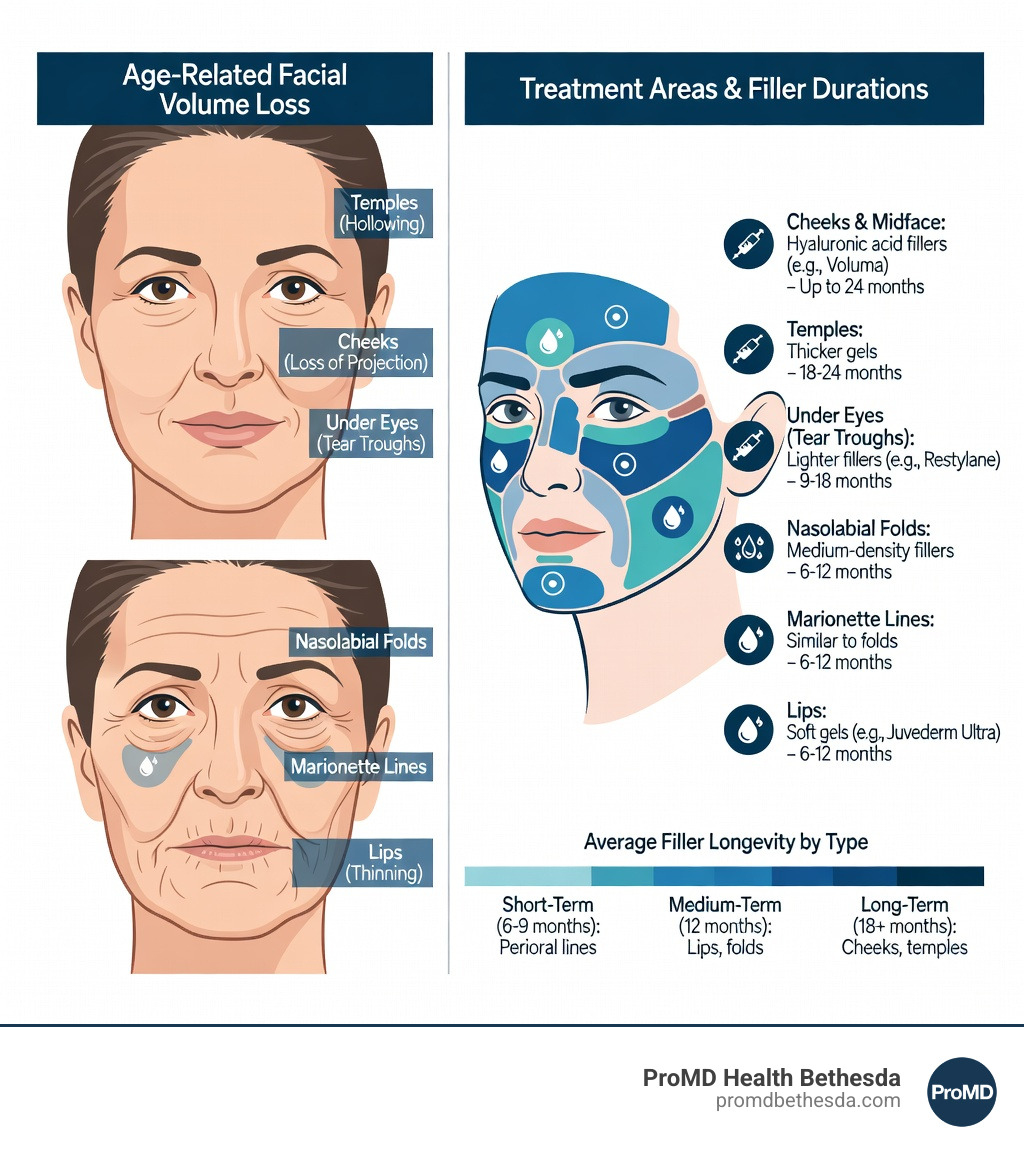
- Smoothing wrinkles and lines – Nasolabial folds, marionette lines, and perioral wrinkles
- Restoring facial volume – Cheeks, temples, and midface hollowing
- Enhancing facial features – Lip augmentation, chin definition, and jawline contouring
- Correcting under-eye hollows – Tear troughs and dark circles
- Improving skin texture – Acne scars and facial contour irregularities
- Hand rejuvenation – Restoring volume to the back of hands
One of the most common concerns we hear at ProMD Health Bethesda is how to address visible signs of aging without surgery or extended downtime. The good news? Modern dermal fillers offer a minimally invasive solution that delivers natural-looking results you can see immediately.
These treatments work by replenishing the hyaluronic acid your body naturally produces but loses with age. This substance attracts water molecules to plump and hydrate your skin from within. The result is smoother, more youthful-looking skin that maintains your natural facial expressions and movements.
Most filler procedures take just 15 to 45 minutes in a comfortable office setting, with results lasting anywhere from six months to two years depending on the type of filler used and the treatment area.
What Are Dermal Fillers and How Do They Work?
At their core, dermal fillers are injectable implants classified as medical devices by the FDA. Most modern fillers are composed of hyaluronic acid (HA), a sugar molecule naturally found in your skin, eyes, and joints. According to this Fillers: Overview, these substances act like a cushion to support facial structures and tissues that may have lost elasticity or volume.
When we inject these gels beneath the skin’s surface, they provide immediate physical volume. However, they do more than just “fill” a hole. Because HA is hydrophilic (water-loving), it attracts and binds water molecules, which helps to hydrate the skin from the inside out. For those interested in the science, more info about dermal fillers reveals that certain types also stimulate your body’s natural collagen production over time, providing a dual-action rejuvenation effect.
| Filler Type | Primary Ingredient | Best For | Typical Longevity |
|---|---|---|---|
| Hyaluronic Acid (HA) | Hyaluronic Acid | Lips, cheeks, fine lines | 6–18 months |
| Calcium Hydroxylapatite | Calcium-based microspheres | Deep wrinkles, jawline | 12–15 months |
| Poly-L-lactic Acid | Synthetic biodegradable polymer | Deep volume loss, hollows | Up to 2 years |
| PMMA | Synthetic beads in collagen | Permanent correction | Semi-permanent |
Understanding What Are Dermal Fillers Used For
The primary goal of dermal filler therapy is to address “static” wrinkles. These are the lines that remain visible even when your face is completely at rest. As we age, our faces lose fat, bone mass, and collagen—a triple threat that leads to sagging and hollowing.
In our Smooth Sculpt: A Guide to Dermal Fillers in Bethesda, we emphasize that fillers are used for soft tissue augmentation. This means we aren’t just erasing a line; we are rebuilding the structural support of the face. By strategically placing filler, we can lift sagging tissues and restore the “triangle of youth”—a term used to describe the high cheekbones and defined jawline associated with a younger appearance.
Dermal Fillers vs. Botox and Other Injectables
A common point of confusion for our patients in Bethesda and Chevy Chase is the difference between fillers and neuromodulators like Botox. It helps to think of it this way: Botox is for the top half of the face, and fillers are primarily for the bottom half (though there is certainly overlap!).
Botox and similar Injectibles and Wrinkle Treatment options are muscle relaxants. They treat “dynamic” wrinkles—the ones caused by movement, like crow’s feet or forehead furrows—by temporarily blocking nerve signals to the muscles. Fillers, on the other hand, do not affect muscle movement. They simply add volume where it has been lost. Using both in a “liquid facelift” approach often yields the most comprehensive results.
Common Treatment Areas: What Are Dermal Fillers Used For?

The versatility of dermal fillers is truly remarkable. While most people immediately think of lips, the applications extend far beyond a perfect pout.
- Nasolabial Folds: These are the “smile lines” that run from the nose to the corners of the mouth.
- Marionette Lines: In our guide to Unmasking Marionette Lines, we show how fillers can turn a “frown” upside down by supporting the corners of the mouth.
- Cheek Augmentation: Restoring volume to the midface can actually lift the lower face, reducing the appearance of jowls.
- Lip Enhancement: Whether you want a subtle “swoop” or significant volume, fillers can redefine the lip border and add fullness. Check out our Cheat Sheet to Natural-Looking Fillers for tips on avoiding the “overdone” look.
- Tear Troughs: Filling the hollows under the eyes can make you look rested and alert, eliminating the “perpetually tired” look.
- Hand Rejuvenation: The back of the hands often betrays our age; fillers can hide prominent veins and tendons.
When considering these areas, it is vital to follow the Dermal Filler Do’s and Don’ts provided by the FDA, such as avoiding unapproved “needle-free” pens and only working with licensed professionals.
Facial Contouring and What Are Dermal Fillers Used For
Beyond simple wrinkle-filling, we use fillers for advanced facial contouring. This includes jawline definition for those who feel their lower face is “blending” into their neck, and chin augmentation to balance a profile.
According to the FDA’s overview of Dermal Fillers (Soft Tissue Fillers), fillers are also approved for correcting acne scars on the cheek and treating facial fat loss (lipoatrophy) in patients with HIV. We even perform “liquid rhinoplasty,” using small amounts of filler to smooth out bumps on the bridge of the nose or lift the tip without the need for surgery.
Comparing Filler Types and Popular Brands
Not all fillers are created equal. The “best” filler for your lips might be a terrible choice for your cheeks. This is because fillers vary in their “G-prime” (firmness), particle size, and cross-linking technology.
Here is a list of some of the most popular FDA-approved brands we may use:
- Juvéderm: A massive family of fillers including Voluma (for cheeks), Volbella (for fine lip lines), and Vollure (for deep folds). Juvéderm is famous for being the first HA filler FDA-approved to last up to one year.
- Restylane: Known for its XpresHAn technology, which allows the filler to move naturally with your facial expressions. Variants like Kysse are specifically designed for the lips.
- RHA (Resilient Hyaluronic Acid): These are designed to be more like the natural HA in your skin, making them excellent for high-movement areas like the mouth.
- Radiesse: A calcium hydroxylapatite filler that provides immediate volume and stimulates long-term collagen growth.
- Sculptra: A poly-L-lactic acid filler that works gradually over several months to rebuild the skin’s foundation.
Choosing the right brand requires a deep understanding of facial anatomy. If you are unsure where to start, you can Find a Dermatologist or a qualified specialist to discuss which product matches your skin’s density and your aesthetic goals.
The Treatment Experience: Safety, Procedure, and Results
What can you expect when you walk into our Bethesda clinic? First, we conduct a thorough consultation. We look at your face in motion and at rest, and we use our exclusive AI Simulator to show you a preview of your results. This helps ensure we are on the same page before a single needle is touched.
During the procedure, the skin is cleansed and a topical anesthetic is applied. We often use blunt-tip microcannulas instead of traditional sharp needles. Why? Cannulas are flexible and have a rounded end, which reduces the risk of hitting blood vessels or nerves. This leads to significantly less bruising, less pain, and a safer overall experience.
A Note on Safety
The FDA has issued a stern FDA Warning on Needle-Free Devices. These “hyaluron pens” use high pressure to force filler through the skin. They are unapproved, dangerous, and can cause permanent skin damage or even blindness. Always ensure your provider uses FDA-approved, sealed vials and traditional injection methods.
While side effects like mild swelling and bruising are common and usually resolve in a few days, serious risks like vascular occlusion (filler blocking a blood vessel) are rare but possible. It is critical to know the signs of a stroke or vascular occlusion, such as unusual pain or skin discoloration, and seek immediate medical attention if they occur.
Frequently Asked Questions about Dermal Fillers
How long do dermal fillers typically last?
Most hyaluronic acid fillers last between 6 and 18 months. However, this depends on several factors:
- The Area: Fillers in high-movement areas like the lips tend to break down faster (6-9 months) than fillers in the cheeks or under-eyes (12-24 months).
- Your Metabolism: If you have a very high metabolic rate, your body may “digest” the filler more quickly.
- Product Choice: Products like Voluma XC are specifically engineered for longevity and can last up to two years.
Who is the ideal candidate for filler treatments?
The FDA approves dermal fillers for adults aged 22 and older. The ideal candidate is in good general health, does not smoke, and has realistic expectations about what fillers can achieve. You should avoid fillers if:
- You are pregnant or breastfeeding.
- You have a skin infection or inflammation near the injection site.
- You have a known allergy to filler ingredients or lidocaine.
- You have a history of severe allergies or anaphylaxis.
What are the costs and training requirements for providers?
Dermal filler pricing is typically per syringe. While it might be tempting to look for the “cheapest” deal, you are paying for the skill of the injector, not just the gel. A “discount” filler could lead to expensive complications.
In Maryland, fillers should be administered by licensed healthcare providers who have extensive Facial Cosmetic Surgery expertise. This includes board-certified dermatologists, plastic surgeons, or highly trained nurse injectors working under medical supervision. Proper training in facial anatomy is the only way to minimize risks and ensure that “natural” look everyone craves.
Conclusion
Dermal fillers are a powerful tool in the modern aesthetic toolkit. Whether you want to smooth out a few lines, restore the volume of your youth, or subtly enhance your natural features, these treatments offer a safe and effective path to feeling more confident in your skin.
At ProMD Health Bethesda, we pride ourselves on combining advanced technology with artistic expertise. Our AI Simulator allows you to see your potential results before the treatment begins, taking the guesswork out of your journey. We serve patients across Bethesda, Chevy Chase, Kensington, Garrett Park, and Rockville with a commitment to natural-looking, beautiful outcomes.
Ready to see what fillers can do for you? Schedule a Dermal Filler Consultation with our team today and take the first step toward a refreshed, rejuvenated you.

