
You wake up with shoulder pain again. Reaching for a coffee mug hurts. Pulling on a shirt feels awkward. Sleeping on that side is frustrating, and the MRI report has left you staring at the words rotator cuff tear and wondering whether surgery is now unavoidable.
In many cases, it isn't.
A torn rotator cuff can be painful, limiting, and scary to read about on an imaging report. But modern care no longer treats every tear the same way. For many people, the best path starts with a progressive, stepped approach that begins with symptom control and targeted rehabilitation, then moves to more advanced options only if they're needed. That approach matters because shoulder pain isn't just about what shows up on a scan. It's about strength, movement, daily function, and how your symptoms respond over time.
If you're looking for a practical guide to non surgical treatment torn rotator cuff care, the goal is to understand what each option does, where it fits, and what questions to ask before moving to the next step.
Table of Contents
- Your Guide to Healing a Torn Rotator Cuff Without Surgery
- Understanding Your Shoulder and the Rotator Cuff Tear
- The Foundation of Conservative Care
- Physical Therapy The Cornerstone of Recovery
- A Guide to Injection Therapies
- When Is Surgery the Right Answer
- Frequently Asked Questions About Rotator Cuff Recovery
Your Guide to Healing a Torn Rotator Cuff Without Surgery
You reach into a cabinet, feel a sharp pull in your shoulder, and the next thought is often immediate. Do I need surgery?
For many people, the answer is no, at least not as a first step. A torn rotator cuff does not automatically mean the shoulder needs an operation. The better starting question is usually simpler and more useful: how much pain relief, movement, and strength can you get back with a structured non-surgical plan?
That approach reflects how shoulder specialists often manage rotator cuff problems in real life. Care usually works best in stages, not all at once. You start with the basics that calm the shoulder and restore function. If progress stalls, you move to the next option. If the shoulder improves, you may avoid procedures that add cost, recovery time, and risk without adding much benefit.
A helpful way to view treatment is as a stepped-care pathway, similar to rebuilding a house after part of the roof starts leaking. You do not begin by replacing every beam. First you control the leak, check what is still strong, and repair what is limiting the structure from working well. The shoulder often responds the same way.
Why stepped care makes sense
Each step has a different job.
- Settle the irritated shoulder. Reduce pain triggers, modify activity, and stop repeated overload.
- Restore motion. A shoulder that is stiff or guarded cannot move in a healthy pattern.
- Build support around the tear. Strengthening the rotator cuff, shoulder blade muscles, and upper back can improve how the joint works.
- Add targeted treatments if needed. Injection options may help with pain or support healing, but they do not all serve the same purpose.
- Reassess based on function. The main question is whether you can sleep, reach, lift, and use the arm better than before.
This point matters. MRI findings can look dramatic, yet the scan is only one part of the story. If pain is settling, strength is returning, and day-to-day function is improving, a non-surgical plan may be doing exactly what it should.
Patients often get stuck between two oversimplified messages. One is that any tear must be fixed surgically. The other is that therapy alone is always enough. Real treatment decisions fall in the middle. Some tears need earlier surgical evaluation. Many others respond well to a thoughtful progression from foundational care to more advanced options, with the strength of evidence becoming more limited as you move from standard treatments to newer regenerative therapies.
That is the path this guide will follow. Start with what is well established. Reassess your response. Then consider whether the next step fits your symptoms, goals, and the kind of tear you have.
Understanding Your Shoulder and the Rotator Cuff Tear
You reach into the back seat for a bag, and a sharp catch runs across the outside of your shoulder. Later that night, rolling onto that side wakes you up. By morning, the question starts to feel bigger than the pain itself. What exactly is torn, and does a tear always mean surgery?
Why the rotator cuff matters
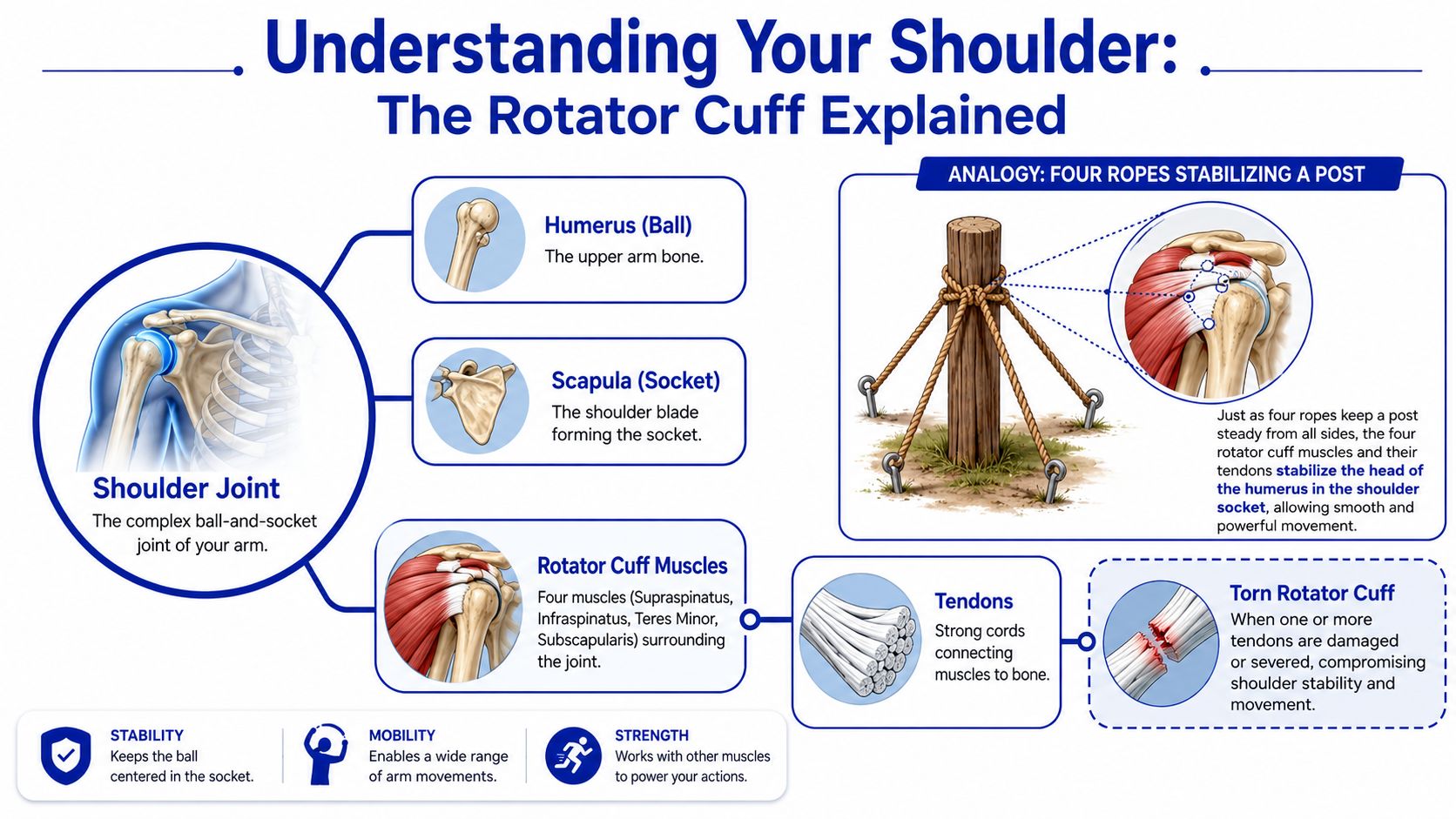
The shoulder is a shallow ball-and-socket joint. That design gives you reach and rotation, but it also means the joint depends on muscles and tendons to keep motion controlled. The rotator cuff is the group of four muscles and their tendons that wrap around the top of the upper arm bone.
A clear way to picture it is four ropes stabilizing a post. The post is the top of your arm bone. The ropes are the rotator cuff tendons. As you lift, reach, or rotate, those tendons do more than create movement. They keep the ball of the shoulder centered in the socket so larger muscles, like the deltoid, can move the arm without the joint drifting out of position.
That centering job explains a lot of symptoms.
If part of the cuff is irritated or torn, the shoulder can become painful, weak, or rough in its movement. Some people describe a painful arc when lifting the arm. Others notice that reaching overhead, fastening a seat belt, or lowering a heavy object feels less controlled than it used to.
A tear on an MRI also does not automatically tell you how disabled the shoulder will feel. Some tears cause little trouble. Others create major weakness or night pain. Recovery decisions work best when the scan, physical exam, symptom pattern, and daily function are considered together. That step-by-step approach matters in a treatment pathway that starts with standard care and only moves to more advanced options if progress stalls.
The tear types that change treatment decisions
The word tear sounds like one single injury, but rotator cuff tears vary in depth, timing, and cause. Those details shape what doctors watch for and how strongly non-surgical care is considered first.
| Tear type | What it means | Why it matters |
|---|---|---|
| Partial-thickness tear | The tendon is damaged but not completely through | Often responds well to structured rehabilitation, especially when strength is still fairly preserved |
| Full-thickness tear | The tendon goes fully through, creating a complete defect | Raises more concern when there is clear weakness, loss of function, or tendon retraction |
| Degenerative tear | Develops gradually from age-related wear or repeated strain | Commonly enters a stepped-care plan that begins with symptom control and movement restoration |
| Acute traumatic tear | Happens after a specific injury | Needs closer attention if the arm became weak soon after the injury or function dropped suddenly |
A partial tear works like a frayed rope that still has fibers attached. A full-thickness tear is closer to a rope that has separated completely. Both can hurt, but they do not behave the same way, and they should not be treated as if they are the same problem.
Cause matters too. A gradual tear in an older adult with manageable pain is different from a sudden tear after a fall in someone who cannot lift the arm. That is one reason treatment should be matched to the person in front of you, not just to the wording on a report.
A scan shows tendon structure. Your symptoms, strength, and day-to-day ability show how much that finding matters right now.
Patients also often mix up pain and severity. A very painful shoulder may have only limited structural damage, especially if the bursa is inflamed or the joint is stiff. A shoulder that is not extremely painful but suddenly weak after trauma can be more concerning. Good evaluation sorts out that difference.
General health plays a role as well. Sleep quality, blood sugar control, smoking history, and even habits that support better daily energy and recovery capacity can affect how well tissues tolerate rehab and healing over time. Small factors add up, especially in a shoulder problem that often improves gradually rather than all at once.
The Foundation of Conservative Care
The first phase of treatment is often the least dramatic and the most important. When shoulder pain is active and easily provoked, the goal is to decrease load on the injured tissue without letting the shoulder become completely deconditioned.
Authoritative orthopedic guidance emphasizes rest or activity modification, NSAIDs when appropriate, corticosteroid injections for severe pain, and physical or occupational therapy to rebuild strength and flexibility in the shoulder, arm, and back, especially for partial tears (NYU Langone guidance on non-surgical torn rotator cuff care).
What active rest actually means
Rest doesn't mean immobilizing the shoulder and doing nothing for weeks. In fact, that approach can leave the joint stiffer and the muscles weaker.
Active rest usually means changing the activities that keep re-irritating the cuff, such as:
- Repeated overhead reaching: putting dishes away, painting, stocking shelves
- Heavy lifting away from the body: especially with the elbow straight
- Forceful reaching behind your back: like tucking in a shirt or fastening a bra
- Painful gym movements: presses, upright rows, deep dips, or kipping motions
The point is to reduce mechanical stress while keeping safe motion in the joint. If a movement causes a sharp pain every time, that movement is probably not helping the tissue calm down.
How pain control supports healing
Pain relief isn't just about comfort. It's often what allows effective rehab to begin.
Over-the-counter anti-inflammatory medication may be appropriate for some people, depending on their overall health and what their clinician advises. Ice, position changes, and temporary load reduction can also make a real difference. If your shoulder hurts so much that you can't sleep, move, or participate in therapy, the entire recovery process stalls.
Some patients also find it helps to improve general recovery habits such as sleep quality, hydration, and daily energy management. Broader wellness factors can affect how consistently you participate in rehab, and this practical guide on ways to improve energy levels naturally gives a useful overview of those basics.
A common mistake is doing too much on “good” days and then flaring the shoulder for the next several days. Recovery usually goes better when load increases gradually, not in bursts.
Physical Therapy The Cornerstone of Recovery
You finally get a diagnosis, start resting the shoulder, and expect the pain to fade. Then you reach for a cup, pull on a shirt, or turn the steering wheel, and the same pain returns. That happens because a torn rotator cuff is not only a tissue problem. It is also a movement problem.
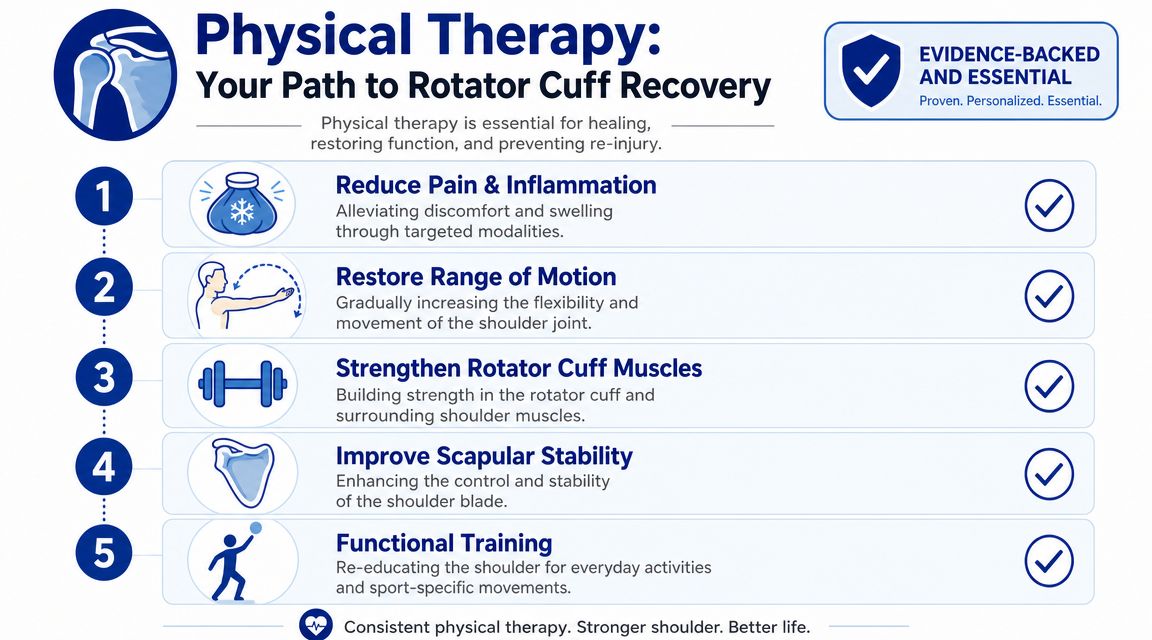
Physical therapy sits at the center of stepped, non-surgical care because it addresses the problems that often keep symptoms going. A tear can change how the ball of the shoulder stays centered in the socket. Pain can make nearby muscles shut down or overwork. The shoulder blade may stop gliding well. Over time, the body starts borrowing motion from the neck, upper back, or trunk.
That is why PT often helps even when the tendon itself is not “fixed” in the surgical sense. For many small and medium tears, function can improve substantially when the shoulder starts moving more efficiently and the surrounding muscles share load better.
What a good PT plan is trying to fix
The shoulder works like a crane mounted on a moving base. Your arm is the crane. Your shoulder blade is the base. If the base tilts or rotates poorly, the arm has to work from a bad starting position, and the injured cuff can get overloaded quickly.
A thoughtful therapy program usually works on several layers at once:
- Pain-free range of motion: Gentle motion helps prevent stiffness and reduces guarding.
- Scapular control: The shoulder blade needs to rotate and settle well against the rib cage during reaching.
- Strength balance: The rotator cuff does not work alone. The upper back, chest, and trunk all influence shoulder mechanics.
- Movement retraining: Many patients start shrugging, arching the low back, or twisting the torso to avoid pain. Those patterns can keep the shoulder irritated.
Patients are often surprised when therapy includes the upper back and core. That choice is intentional. A stable trunk and well-positioned shoulder blade give the cuff a better platform, which can reduce strain during everyday tasks.
Here is a short demonstration that helps many patients visualize shoulder-friendly movement and exercise progression:
Examples of exercises and why they matter
The right exercise depends on how irritated the shoulder is, how large the tear is, and what motions are limited. The goal is not to do a standard list. The goal is to match the exercise to the stage of recovery.
- Pendulum swings: Often used early. They let the joint move gently with very little cuff demand.
- Wall slides: Help restore overhead motion while teaching the shoulder blade to rotate more normally.
- Band external rotations: Strengthen muscles that help control the upper arm and support the torn tendon.
- Scapular retraction drills: Improve the muscles that steady the shoulder blade during arm use.
- Thoracic mobility and posture work: A stiff upper back can force the shoulder to compensate during reaching.
Recovery improves when the shoulder sees the right amount of stress, not the maximum amount you can tolerate on a good day.
That dosage piece matters. A strong PT plan includes clear progression rules. If soreness settles within a reasonable time and function is improving, the program can advance. If pain lingers into the night, range of motion drops, or the shoulder feels weaker after sessions, the program may need to scale back.
This is also where the stepped-care model becomes useful. Physical therapy has the strongest track record as first-line treatment because it builds function, improves mechanics, and helps you test how the shoulder responds over time. If progress stalls because pain is still too limiting, some patients then discuss options that may support the next phase of recovery, including PRF EZ Gel treatment for shoulder healing support. The sequence matters. Foundational care comes first, then more advanced options are considered if the basics alone are not enough.
A home exercise sheet by itself is rarely enough. The primary value of therapy is the adjustment process. Your clinician watches how you move, spots compensation patterns you may not feel, and changes the plan as the shoulder calms down and gets stronger.
A Guide to Injection Therapies
When pain is blocking sleep, daily activity, or progress in therapy, injection treatment may enter the conversation. However, many patients become confused because all injections tend to get lumped together, even though they aim to do very different things.
The most helpful way to compare them is by asking three questions: What is the goal? How fast might it help? What kind of evidence supports it?
Steroid injections for pain relief
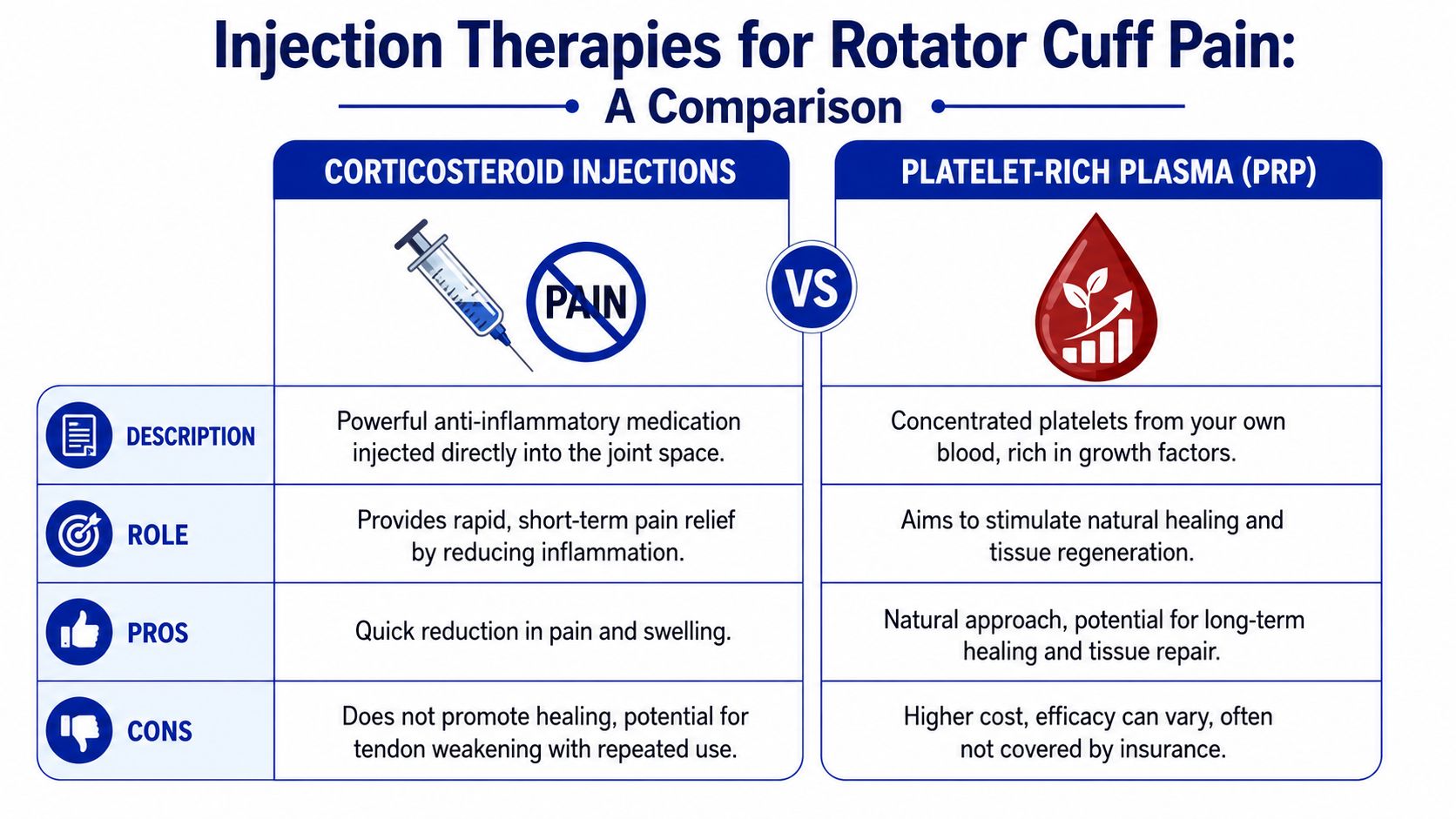
A corticosteroid injection is mainly a pain-control tool. Its purpose is to reduce inflammation and calm the area enough that you can move more comfortably and participate in rehab.
That can be very useful when pain is dominating the picture. If someone can't lift the arm, can't sleep, and can't tolerate PT, reducing inflammation may create an opening for progress. But it's important to understand the trade-off. A steroid injection doesn't repair the tendon itself. It's aimed at symptoms, not structural healing.
In plain terms, this option often fits patients who need short-term relief to restart function.
PRP and PRF for a regenerative approach
Regenerative injections are discussed differently because their intended role is different. Instead of mainly suppressing inflammation, they aim to create a local environment that may support tissue repair.
Platelet-Rich Plasma (PRP) is made from a patient's own blood and concentrates platelets, which contain growth factors. Platelet-Rich Fibrin (PRF) is another autologous blood-based option that forms a fibrin matrix and is often discussed as a longer-lasting scaffold-like preparation compared with liquid platelet products. In aesthetic and regenerative settings, some practices also offer formulations such as PRF EZ Gel, which patients may already have seen mentioned in other contexts.
The key point is not that every regenerative injection works the same way, or works equally well for every shoulder problem. It doesn't.
A useful background review notes that while many clinics offer options such as PRP, laser therapy, and stem cells, the evidence is uneven, and patients need a more nuanced comparison of who may benefit, whether an add-on is worth considering, and how durable relief may be (discussion of uneven evidence across non-surgical add-on therapies).
Key question: Are you trying to quiet pain fast, or are you considering an add-on intended to support a healing response over time?
That question changes the conversation.
How to compare your options
A side-by-side view is often easier than a long explanation.
| Option | Main goal | Best thought of as | What patients should understand |
|---|---|---|---|
| Corticosteroid | Reduce inflammation and pain | Symptom management | Can be useful when pain is blocking rehab |
| PRP | Support a healing environment using platelets from your own blood | Regenerative add-on | Evidence is mixed and patient selection matters |
| PRF | Similar regenerative concept with a fibrin-based matrix | Regenerative add-on | Often discussed as a more advanced biologic option, but expectations should stay realistic |
| Hyaluronic acid | Lubrication-focused approach in some joint conditions | Context-specific option | Not typically the first thing people think of for cuff pathology |
The decision isn't just “Which injection is best?” It is “Which injection, if any, fits the stage of your problem?”
Some patients need pain relief to enable therapy. Others have already done the basics and want to discuss a biologic add-on. Some may not need an injection at all.
A careful clinician should also be honest about uncertainty. If evidence is uneven, that doesn't mean a treatment is useless. It means the treatment deserves a targeted discussion rather than a sales pitch.
When Is Surgery the Right Answer
You finish weeks of therapy, you are more careful with sleep and daily use, and you may even have tried an injection. Yet lifting a pan, reaching into a cabinet, or raising your arm to get dressed still feels weak or unreliable. That is usually the point when the question changes. It is no longer just, “How do I avoid surgery?” It becomes, “Have I reached the end of the non-surgical pathway, or is there still a reasonable next step?”
That is an important distinction.
This article takes a stepped-care view of treatment. You start with the foundation, then build upward only if the shoulder is not responding well enough. Surgery fits into that same logic. It is usually considered after a real trial of conservative care, not before, unless the injury pattern or the loss of function makes earlier surgical input more sensible.
Signs that the next step may be a surgical evaluation
A surgical conversation becomes more appropriate when the shoulder, though painful, is also persistently limited despite a well-executed plan. Common examples include:
- Ongoing pain and loss of function after structured rehabilitation: If you have given physical therapy and activity modification enough time and the shoulder still cannot do what daily life requires, the strategy may need to change.
- A sudden injury followed by obvious weakness: This matters most when the shoulder was functioning well before a fall, lift, or other clear event, and then strength dropped sharply afterward.
- Strength that continues to decline: Pain can make a shoulder feel guarded. True worsening strength is different. It suggests the tendon and muscle unit may not be keeping up.
- A full-thickness tear with meaningful disability: Some tears can be managed without surgery, but a larger structural problem paired with poor function deserves closer review from a surgeon.
A useful way to think about it is this. Non-surgical care often works like building better support around an injured rope. You reduce irritation, improve motion, and train the surrounding muscles to share the load more efficiently. That approach can work very well. But if the rope is torn through, the arm remains weak, and function does not return, there is a limit to how much compensation can accomplish.
As noted earlier, many people do improve with a non-operative first approach, especially when the tear is not full-thickness. That is why surgery is rarely the first automatic answer. It also does not mean surgery should be postponed indefinitely. The right timing depends on whether the shoulder is trending in the right direction.
Sometimes the next step is not immediate surgery but a more focused discussion about what has and has not been tried. For example, if standard rehab has stalled, some patients ask about advanced biologic options such as peptide therapy and other regenerative medicine approaches as part of a broader treatment conversation. These options sit farther along the stepped-care pathway, and the evidence base is not the same as it is for physical therapy or established surgical repair. That difference matters.
A practical question to ask your clinician is, “Am I improving enough to justify staying the course?” If the answer is yes, continued conservative care may still make sense. If the answer is no, especially with persistent weakness, loss of overhead function, or a clearly traumatic tear, a surgical evaluation is a reasonable and thoughtful next step. It is not a setback. It is part of choosing the treatment level that matches the problem.
Frequently Asked Questions About Rotator Cuff Recovery
Can a torn rotator cuff heal without surgery
Sometimes the better word is recover rather than heal. A tendon tear may not always fully reverse on imaging, but many patients still regain meaningful pain relief, movement, and function with non-surgical care. In everyday life, that functional recovery is often what matters most.
What should I avoid while recovering
Try to avoid activities that repeatedly provoke symptoms, especially overhead lifting, heavy carrying away from the body, forceful reaching behind the back, and exercises that create sharp pain. The shoulder usually does better with gradual loading than with repeated flare-ups.
How long does recovery usually take
Recovery varies by tear type, pain level, stiffness, age, general conditioning, and how consistently you follow treatment. Some people notice early progress once pain calms and movement improves. Others need a longer stretch of structured rehab before daily tasks feel easier. What matters most is the trend. Better sleep, better range of motion, and more reliable use of the arm are all good signs.
Is it normal for the pain to come and go
Yes. Shoulder recovery is rarely perfectly linear. A sore day after overuse doesn't always mean you've re-torn something. But repeated setbacks usually mean the activity level, exercise dosage, or sleeping setup needs adjustment.
How should I sleep with a painful rotator cuff
Many people do better avoiding direct pressure on the painful side. Sleeping on your back, or on the opposite side with a pillow supporting the affected arm, can reduce strain. The goal is to keep the shoulder from hanging forward or getting pinned underneath you.
Are there supportive treatments worth asking about
Sometimes. Patients often ask about recovery support, inflammation, and tissue health more broadly. Those conversations may overlap with wellness care, and some people explore options such as peptide therapy in other settings. The most important step, though, is making sure any add-on fits your diagnosis and doesn't distract from the basics that drive shoulder recovery.
If you're exploring non-surgical options and want a medically guided conversation about regenerative wellness treatments, personalized care, and next-step planning, ProMD Health Bethesda offers consultations to suit your goals.

