

Needling Your Way to New Growth: Why Poking Your Scalp Might Save Your Hair
Why Microneedling for Hair Loss Is Getting Serious Attention
Microneedling for hair loss is a minimally invasive procedure that uses tiny needles to create controlled micro-injuries in the scalp, triggering your body’s wound-healing response to stimulate hair growth. Here’s what you need to know:
Key Benefits of Microneedling for Hair Loss:
- Increases hair count significantly more than topical minoxidil alone (β = 12.29; p < 0.001)
- Enhances treatment absorption by creating micro-channels for topical medications
- Activates growth factors like PDGF and EGF that support follicle health
- Minimal downtime with only temporary redness and mild discomfort
- No serious side effects reported across 657 subjects in clinical studies
Best Results: Combining microneedling with 5% minoxidil (β = 7.63 improvement over microneedling alone)
Hair loss affects about 50 million men and 30 million women in the United States. Most people try topical treatments first, but many hit a plateau where nothing seems to work. That’s where microneedling comes in.
The procedure was originally developed in the 1990s for skin conditions like acne scars and wrinkles. Researchers noticed something unexpected: patients receiving scalp microneedling for skin rejuvenation started growing more hair. This discovery launched a wave of clinical studies, and the results have been promising.
Microneedling works by creating tiny punctures in your scalp—think of it as giving your hair follicles a wake-up call. These micro-injuries trigger your body’s natural healing process, increasing blood flow and releasing growth factors that dormant follicles need to start producing hair again.
The treatment is especially effective for androgenetic alopecia (pattern baldness) and alopecia areata (patchy hair loss). Clinical trials show it works both as a standalone treatment and as a powerful enhancer for medications like minoxidil.
But not all microneedling is created equal. Professional treatments use longer needles (typically 1.5mm) that reach the hair follicles deep in your scalp. At-home devices rarely penetrate deep enough to trigger the same response—and using them incorrectly can cause more harm than good.
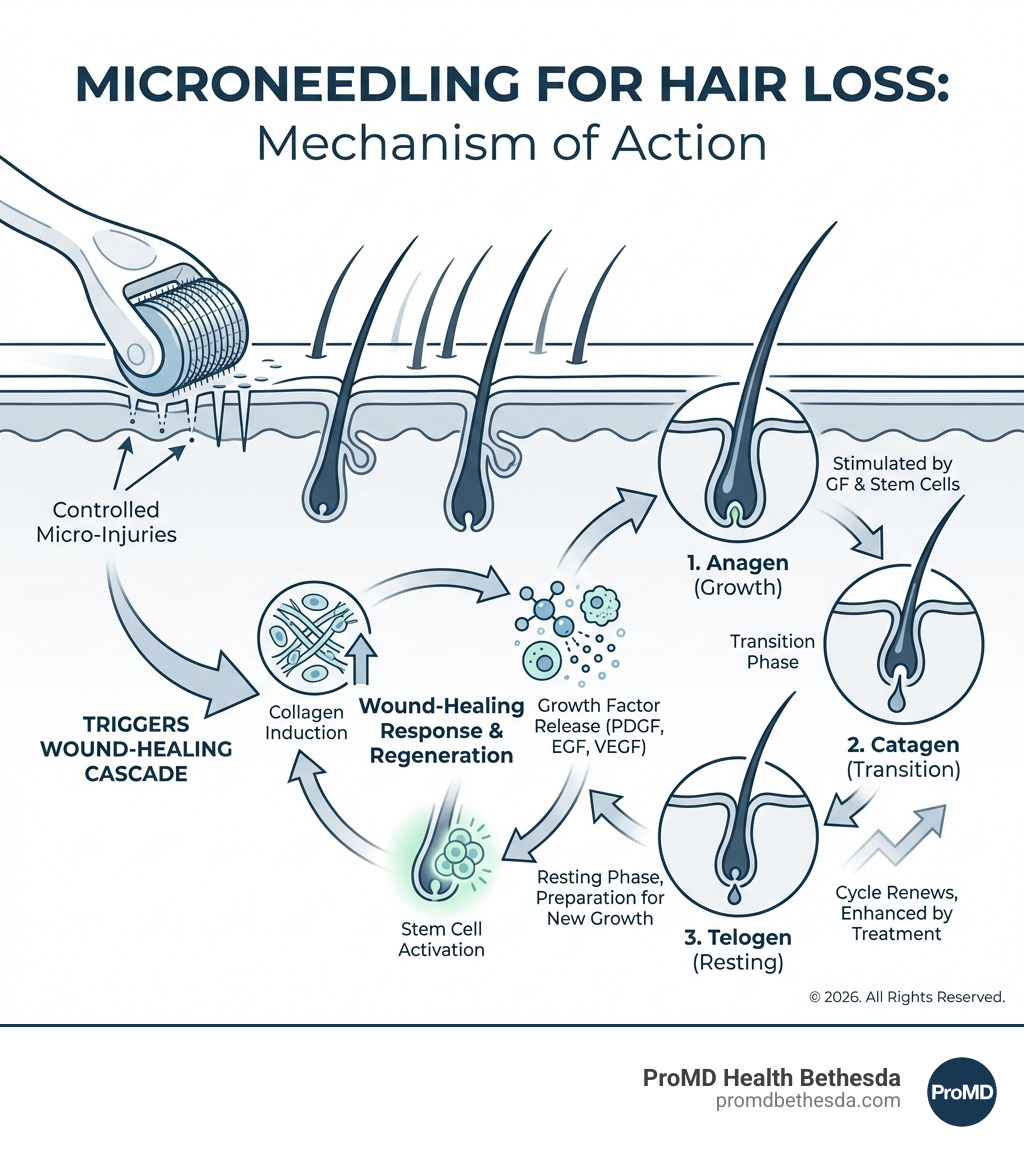
How Microneedling for Hair Loss Works
To understand why poking your scalp with needles works, we have to look at the biology of the hair follicle. Deep within the skin lies the dermal papilla, the “command center” of the hair follicle. This area is rich in stem cells and signaling molecules that dictate whether hair grows, rests, or falls out.
When we perform microneedling, we aren’t just causing damage for the sake of it. We are inducing a controlled wound-healing response. This process activates the Wnt/β-catenin signaling pathway, which is essentially the “on switch” for hair follicle regeneration. As the skin repairs these tiny punctures, it undergoes neovascularization—the creation of new blood vessels. More blood flow means more nutrients and oxygen reaching your follicles, which is exactly what thinning hair needs to thrive.
Furthermore, the production of collagen and elastin helps reinforce the scalp’s structural integrity. While collagen is often associated with youthful skin, it also plays a role in the environment surrounding the hair bulb. By jump-starting the skin’s natural healing process, we help rebuild the scalp’s foundation to support healthier, thicker hair.
The Science Behind microneedling for hair loss
The “magic” happens through the creation of thousands of microscopic channels. These channels serve two primary purposes:
- Growth Factor Release: The micro-injuries trigger the release of Platelet-Derived Growth Factor (PDGF) and Epidermal Growth Factor (EGF). These are biological “messengers” that tell your cells to start repairing and proliferating.
- Stem Cell Activation: The trauma to the skin surface reaches down to the bulge area of the hair follicle, where stem cells reside. This stimulation can coax dormant follicles back into the Anagen (growth) phase.
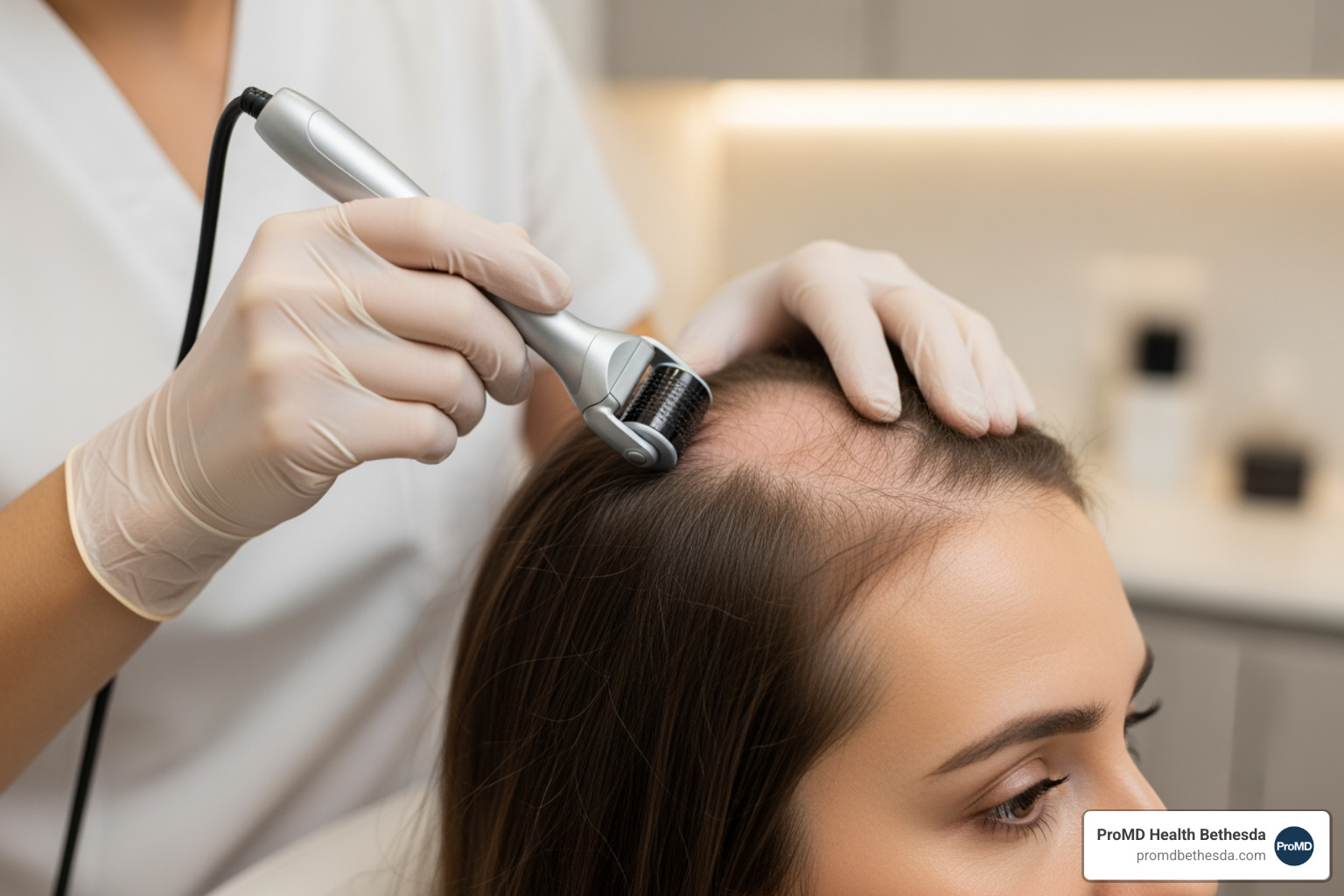
By targeting the specific depth where the follicle bulge sits, we ensure the treatment is effective without being unnecessarily aggressive. This precision is why professional oversight is so critical for those in Bethesda and the surrounding areas looking for real results.
Clinical Efficacy and Scientific Evidence
We don’t just rely on anecdotes; the data backing microneedling for hair loss is robust. A systematic review of 22 clinical studies involving 1,127 subjects confirmed that microneedling is a safe and effective tool for various hair loss disorders.
One of the most famous studies, conducted by Dhurat et al. in 2013, looked at 100 men with androgenetic alopecia. They found that the group using a combination of weekly microneedling and 5% minoxidil saw significantly higher hair counts than the group using minoxidil alone.
According to a scientific review of microneedling efficacy, the statistical evidence is hard to ignore:
As the table shows, while microneedling alone is effective, it truly shines when used as a “force multiplier” for other treatments.
Effectiveness for androgenetic alopecia and alopecia areata
Microneedling isn’t a one-size-fits-all solution, but it is remarkably versatile. It is most commonly used for androgenetic alopecia (male and female pattern baldness). In these cases, it helps reverse the “miniaturization” of follicles, where hair becomes thinner and shorter over time until it stops growing entirely.
It has also shown promise for alopecia areata, an autoimmune condition where the body attacks its own hair follicles. Research involving 201 subjects with alopecia areata found that microneedling improved hair parameters both as a standalone therapy and as an adjunct to other treatments like corticosteroids.
Clinicians often use “Sinclair scores” (for women) and “SALT scores” (for patchy loss) to measure success. Patients typically see an increase in hair density and thickness that becomes visible between 3 to 6 months of consistent treatment.
Professional vs. At-Home microneedling for hair loss
With the rise of social media, many people are tempted to try “DIY” dermarolling. However, there is a massive gap between a home roller and a professional hair restoration treatment.
The biggest difference is needle depth. Most at-home dermarollers use needles that are 0.25mm to 0.5mm long. While these can help with the absorption of serums, they rarely reach the 1.0mm to 1.5mm depth required to stimulate the hair follicle bulge. Professional devices, such as automated microneedling pens, can be adjusted to the exact depth needed for your specific scalp thickness.
Needle Depth and Device Safety
Safety is the other major concern. At ProMD Health, we prioritize a sterile environment to prevent infection. Home rollers are notoriously difficult to clean and can easily harbor bacteria. Furthermore, manual rollers enter the skin at an angle, which can cause “track-mark” scarring or unnecessary tissue trauma.
In contrast, professional microneedling pens use vertical needle insertion. This creates clean, precise micro-channels without tearing the skin. We aim for “pinpoint bleeding” and mild erythema (redness) as the clinical endpoint, ensuring we’ve stimulated the tissue enough to trigger healing without causing permanent damage like peri-follicular fibrosis.
Combining Microneedling with Topicals and PRP
If microneedling is the “wake-up call,” then topicals and PRP are the “breakfast” that fuels the growth. One of the most significant benefits of microneedling for hair loss is that it temporarily breaks the skin barrier, allowing treatments to penetrate much deeper than they would on their own.
Synergistic Effects with Minoxidil and PRP
When you apply minoxidil to a “closed” scalp, only a small fraction reaches the follicle. Microneedling creates a highway for the medication. Interestingly, studies suggest that microneedling also upregulates follicular sulfotransferase enzymes—the very enzymes that turn minoxidil into its active form.
Platelet-rich plasma (PRP) therapy is another popular combination. In this procedure, we take a small sample of your blood, concentrate the platelets, and then apply them to the scalp during or after microneedling. This delivers a massive “dose” of growth factors directly into the micro-channels.
However, caution is required. Research shows that applying minoxidil immediately after a session can potentially increase the absorption of the medication to a systemic level, which might cause heart palpitations, dizziness, or severe scalp irritation. We generally recommend a 24-hour waiting period before resuming topical minoxidil to ensure the micro-channels have begun to close.
For those looking to support their growth from the inside out, we often discuss skincare supplements and a hair loss treatment plan tailored to your specific biology.
Safety, Side Effects, and Contraindications
While microneedling is generally very safe—with no serious adverse events reported in major clinical trials—it is still a medical procedure. The most common side effects are short-term:
- Erythema (Redness): Your scalp will likely look like it has a mild sunburn for 1-3 days.
- Pruritus (Itching): As the skin heals, it may feel itchy.
- Minor Swelling: This usually subsides within 48 hours.
According to the American Academy of Dermatology (AAD) safety guidelines, most side effects diminish within 5 days. The risk of long-term scarring is extremely low when performed by a professional, but over-aggressive at-home use can lead to inflammation or even “peri-follicular fibrosis,” which can permanently damage follicles.
Who Should Avoid microneedling for hair loss?
Microneedling isn’t for everyone. We carefully screen our patients in Bethesda to ensure they are good candidates. You should avoid or postpone microneedling if you have:
- Active Scalp Infections: Such as fungal infections or folliculitis.
- Uncontrolled Diabetes: Which can slow the healing process and increase infection risk.
- Blood Thinners: Which can lead to excessive bruising or bleeding.
- Skin Conditions: Like active eczema or psoriasis on the scalp.
- Pregnancy: As a general precaution, most elective cosmetic procedures are avoided during pregnancy.
If you’re interested in a holistic approach, we can also discuss skincare supplements in bethesda a simple science-backed plan for better skin and healthier hair to ensure your body has the raw materials it needs for repair.
Frequently Asked Questions about Microneedling
How often should I microneedle my scalp for hair growth?
In clinical studies, the frequency varied from once a week to once a month. The average in successful trials was once every 2.6 weeks. We typically recommend starting with a session every 3-4 weeks to allow the scalp enough time to complete the wound-healing cycle and produce new collagen.
Can microneedling reverse total baldness or just thinning?
Realistic expectations are key. Microneedling is most effective for “thinning” areas where the follicles are still alive but miniaturized. If an area has been completely bald and shiny for many years, the follicles may be permanently scarred over. However, microneedling can still improve scalp health in those areas and is often used to prepare the scalp for other treatments.
Is it safe to use minoxidil immediately after microneedling?
We advise waiting at least 24 hours. Applying it too soon can cause the medication to enter your bloodstream too quickly, leading to potential side effects like headaches or changes in blood pressure, not to mention intense stinging and irritation on the freshly “needled” skin.
Conclusion
At ProMD Health Bethesda, we know that hair loss is more than just a cosmetic issue—it’s about how you feel when you look in the mirror. That’s why we don’t believe in “one-size-fits-all” solutions. Our unique approach includes using an AI Simulator, which allows you to preview natural-looking results and helps us create a personalized treatment plan that fits your goals.
Whether you are in Chevy Chase, Rockville, or right here in Bethesda, our team is dedicated to combining advanced technology with expert care. If you’ve plateaued with standard treatments or are just starting your hair restoration journey, microneedling for hair loss might be the missing piece of the puzzle.
Ready to see what’s possible? More info about microneedling services is just a click away. Let us help you needle your way to new growth and regain the confidence you deserve.

