

Laser Hair Restoration Explained Without the Technobabble
Why Understanding Laser Hair Restoration Matters
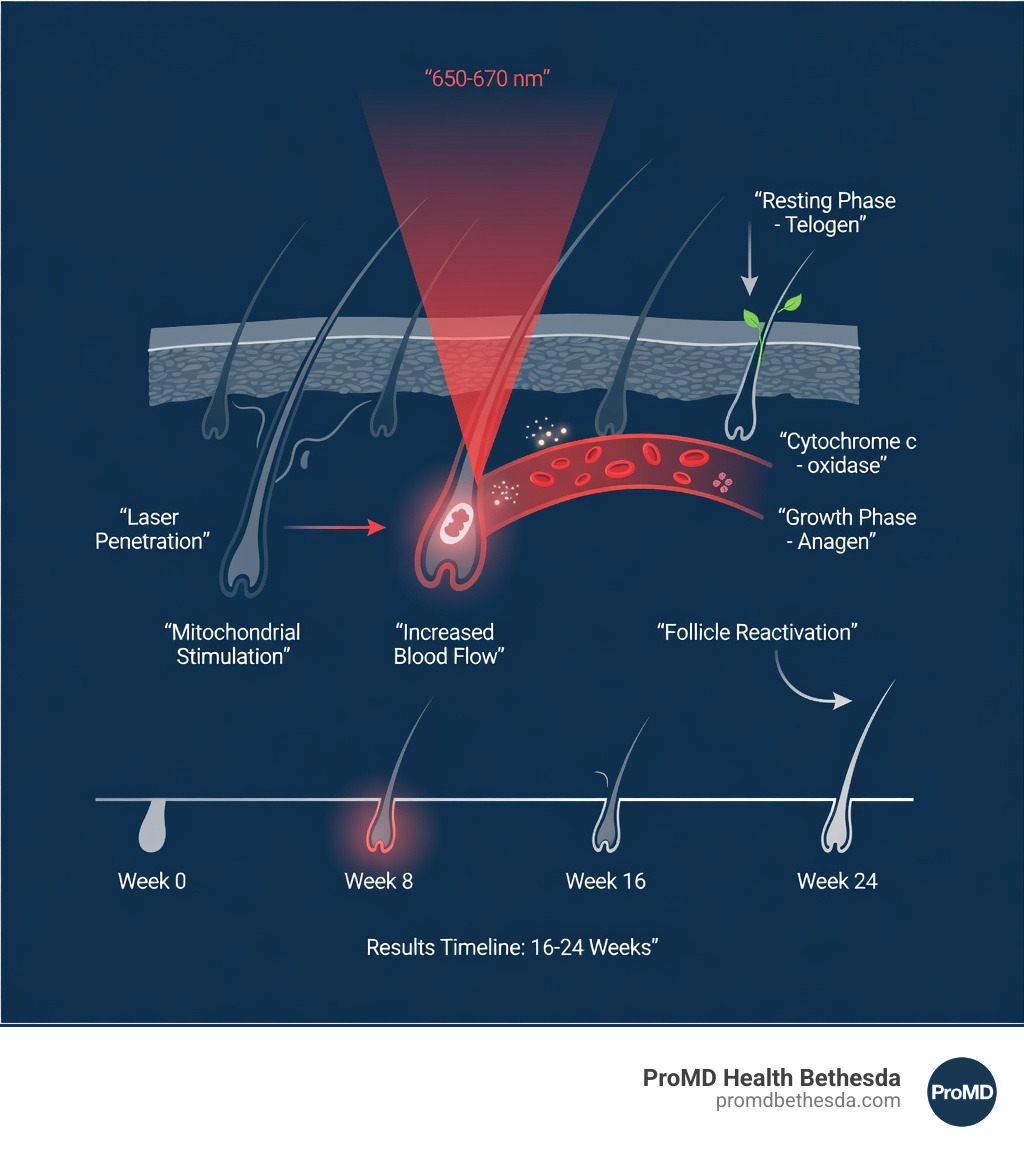
How does laser hair restoration work? It uses low-level laser light (red light wavelengths between 650-670nm) to stimulate hair follicles at a cellular level. The light energy is absorbed by cells in the hair follicle, boosting their metabolism and pushing dormant follicles into active growth phase while improving blood flow to deliver nutrients.
Here’s the simple breakdown:
- Light penetrates the scalp – Red laser light reaches hair follicles without generating heat
- Cells absorb energy – Mitochondria in follicle cells convert light into chemical energy (ATP)
- Blood flow increases – Laser triggers vasodilation, bringing more oxygen and nutrients to follicles
- Follicles reactivate – Dormant or weakening follicles shift into the active growth (anagen) phase
- Hair grows thicker – Over 16-24 weeks, you see increased hair count and improved density
Hair loss affects about 50 million men and 30 million women in the United States. If you’re experiencing thinning hair, you’ve probably encountered conflicting information about what actually works.
The good news? Laser hair restoration isn’t science fiction. It’s a proven, FDA-cleared treatment backed by clinical research showing that over 90% of users see increased regrowth or reduced hair loss.
Unlike medications with potential side effects or invasive surgical procedures, low-level laser therapy (LLLT) offers a non-invasive, painless option that works at the cellular level. Studies show impressive results—like a 51% increase in hair count over 17 weeks and a 35% improvement in growth among male pattern baldness patients.
But here’s what matters most for busy professionals in Bethesda: you can understand exactly how this technology works without needing a PhD in biology. No mysterious claims, no technobabble—just straightforward science.
How Does Laser Hair Restoration Work?
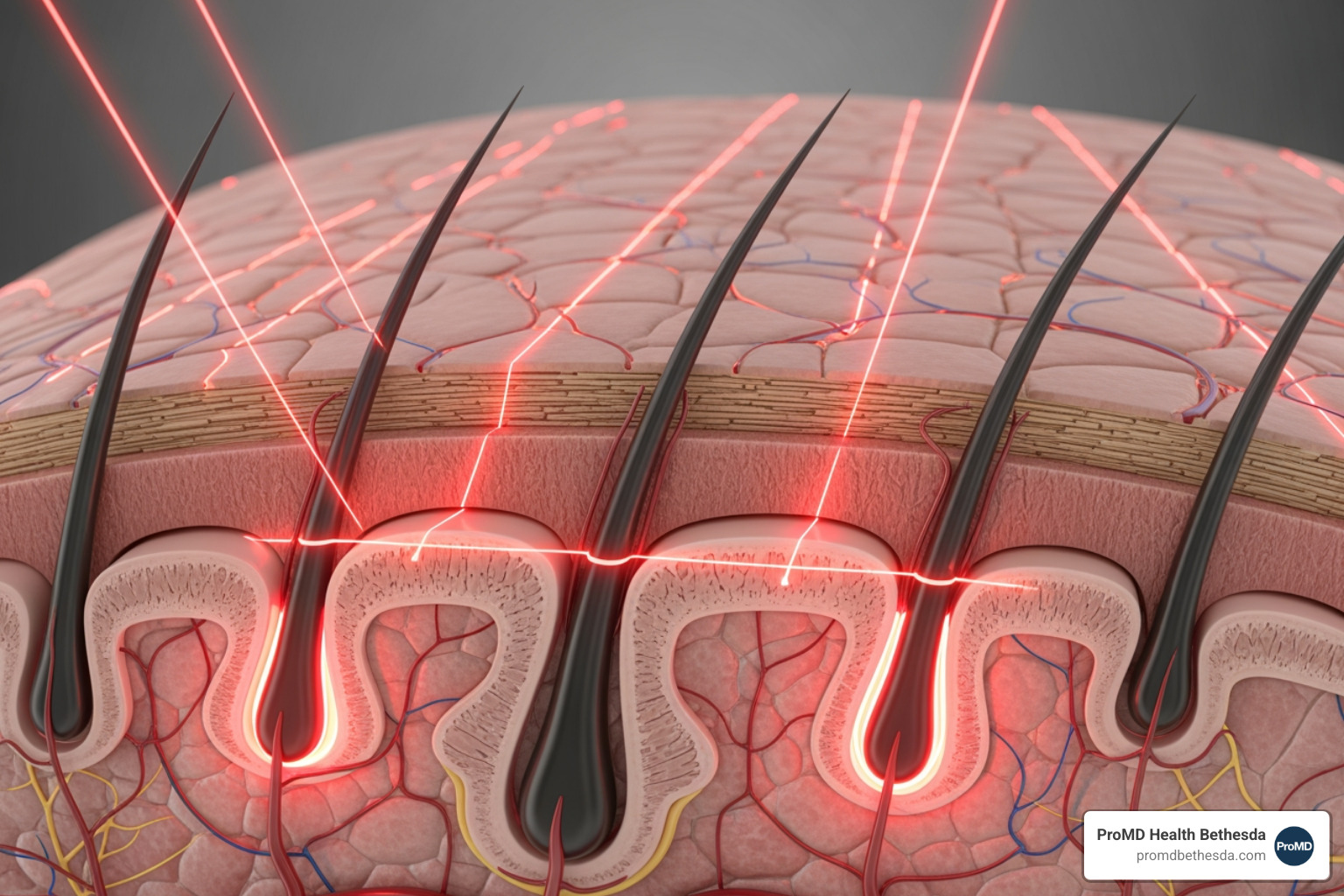
At its core, laser hair restoration relies on a process called photobiostimulation. Think of it like photosynthesis for your scalp. Just as plants absorb sunlight to grow, your hair follicles can absorb specific wavelengths of light to jumpstart their internal machinery.
When we use low-level laser therapy (LLLT), we aren’t burning the skin or removing hair—this isn’t the same “hot” laser used for laser hair removal. Instead, we use “cold” lasers. These lasers target the mitochondria, which are the powerhouses of your cells. Inside the mitochondria is a specific enzyme called cytochrome c oxidase. This enzyme is the primary “receiver” for the red laser light.
Once the light is absorbed, a fascinating chain reaction begins:
- ATP Production: The cell starts producing more Adenosine Triphosphate (ATP). This is the universal energy currency of cells. More ATP means the follicle has the “fuel” it needs to grow hair.
- Nitric Oxide Release: The laser light helps release nitric oxide. This is a crucial molecule because it triggers vasodilation, which is the widening of blood vessels.
- Enhanced Blood Flow: With wider blood vessels, the scalp receives a surge of oxygen and nutrient-rich blood. This creates a “fertile soil” environment for the hair.
- Anagen Phase Induction: The combination of energy and nutrients encourages follicles to exit the resting phase (telogen) and re-enter the active growth phase (anagen).
How does laser hair restoration work at a cellular level?
Going a bit deeper into the biology, the light doesn’t just provide energy; it changes how the cell behaves. The absorption of light helps modulate reactive oxygen species (ROS), which are signaling molecules that can influence hair growth.
It also helps induce important transcription factors, such as NF-κB. These are like the “managers” of the cell that tell the DNA to start producing the proteins necessary for hair structure and growth. Perhaps most importantly, research suggests that LLLT stimulates the epidermal stem cells located in the “bulge” region of the hair follicle. By activating these stem cells, the laser helps regenerate the follicle, making it stronger and more capable of producing thick, healthy hair strands.
How does laser hair restoration work for different types of thinning?
We often see patients in our Bethesda and Rockville offices who wonder if lasers will work for their specific type of hair loss. Because LLLT works on a fundamental cellular level, it is effective for several conditions:
- Androgenetic Alopecia: This is the most common form of hair loss (male or female pattern baldness). The laser helps reverse “miniaturization”—the process where follicles shrink over time—by providing the energy needed to produce thicker, terminal hair.
- Alopecia Areata: This is an autoimmune condition where the body attacks hair follicles. Lasers can help reduce local inflammation and encourage follicles to wake up from their immune-induced slumber.
- Chemotherapy-Induced Hair Loss: LLLT has shown promise in helping hair grow back faster (and sometimes thicker) once treatment has concluded.
- Non-Scarring Alopecia: As long as the hair follicle is still alive and hasn’t been replaced by scar tissue, laser therapy can typically help improve hair density.
The Science and Serendipity of Light Therapy
The story of how laser hair restoration was discovered is actually a bit of a happy accident. In the 1960s, a researcher named Endre Mester was using a low-power red laser on mice to see if it would cause cancer. To his surprise, not only did the mice not get cancer, but the ones he had shaved for the experiment grew their hair back significantly faster than the control group.
This serendipitous discovery birthed the field of LLLT. Scientists eventually realized that the “sweet spot” for hair growth lies in the visible red light spectrum, specifically between 650nm and 670nm.
What makes this technology unique is the biphasic dose response. This is a fancy way of saying that “more” isn’t always “better.” A low dose of laser light stimulates growth, while an excessively high dose could actually inhibit it. This is why using medical-grade, calibrated devices is so important for seeing real results.
Choosing the Right Device and Protocol
If you’ve looked online, you’ve seen everything from $20 laser combs to $3,000 laser helmets. It can be overwhelming. Here is what we look for when recommending a protocol:
- Laser Caps and Helmets: These are generally the most effective “at-home” options because they offer total scalp coverage and “set-it-and-forget-it” convenience. Clinical studies on specific laser caps have shown hair count increases of up to 51% over 17 weeks.
- Handheld Combs: These are more affordable but require you to manually move the device across your scalp for 10-20 minutes, which many people find tedious.
- Clinic-Based Hoods: In our clinics, we often use high-powered “hood” devices that contain hundreds of laser diodes for maximum energy delivery.
The Protocol Matters
Consistency is the secret ingredient. Most protocols require sessions lasting 20 to 30 minutes, performed 2 to 3 times per week. You won’t see results overnight because the hair growth cycle is slow, but by the 16-to-24-week mark, the changes usually become visible.
It is also important to distinguish between FDA Clearance and FDA Approval. Most laser devices are “cleared,” meaning the FDA has determined they are safe and substantially equivalent to other devices already on the market. This is a high standard of safety that ensures you aren’t damaging your scalp while trying to save your hair.
Comparing Results: Lasers vs. Traditional Treatments
How does LLLT stack up against the “Big Two” of hair loss—Minoxidil (Rogaine) and Finasteride (Propecia)?
Evidence-based reviews have shown that LLLT produces a statistically significant difference in hair density. In fact, some studies show a 120% increase in hair count in the vertex area for men using laser combs compared to those using a “sham” device.
One of the biggest advantages of lasers is the safety profile. While Finasteride can occasionally cause hormonal side effects and Minoxidil can cause scalp itching or “dread sheds,” lasers have almost no reported side effects.
Furthermore, lasers are excellent for synergy. We often find that combining LLLT with topical treatments or PRP (Platelet-Rich Plasma) therapy yields better results than any single treatment alone. For those who have undergone a hair transplant, LLLT is a game-changer for graft viability, helping the newly moved follicles heal faster and start growing sooner.
How does laser hair restoration work alongside medications?
Lasers and medications often attack hair loss from different angles. While Finasteride works by blocking the hormone DHT (which shrinks follicles), lasers work by boosting cellular energy.
There is also a “mechanistic overlap” between lasers and Minoxidil. Both treatments involve the release of nitric oxide and the opening of K-ATP channels. This means that if you are already using Minoxidil, adding laser therapy can “supercharge” the effect by ensuring your follicles have the maximum amount of energy and blood flow possible.
Who is the Ideal Candidate for Laser Therapy?
Laser therapy is a powerful tool, but it isn’t a “magic wand” for everyone. The best candidates usually fall into these categories:
- Early to Moderate Thinning: Lasers work best on follicles that are thinning but still alive. If an area has been completely bald for many years, the follicles may have specialized (closed up), making them less responsive to light.
- Norwood and Ludwig Scales: Men in the early stages of the Norwood scale and women with diffuse thinning (Ludwig scale) typically see the most dramatic “before and after” results.
- Fitzpatrick Skin Types I-IV: Because lasers target pigment (melanin) to some extent, they have historically been most effective on lighter skin tones. However, newer technology is making laser therapy safer and more effective for darker skin tones as well.
When to be cautious:
If you have a history of skin cancer on the scalp or take medications that cause photosensitivity (making your skin extra sensitive to light), you must consult with a medical professional before starting LLLT.
At ProMD Health, we believe the best approach starts with a professional consultation. We use advanced diagnostics to ensure you are a good candidate and that there aren’t underlying medical issues (like thyroid problems or iron deficiencies) that need to be addressed first.
Frequently Asked Questions about Laser Hair Restoration
Is laser hair restoration painful?
Not at all. Laser hair restoration is a completely painless experience. Most patients describe the feeling as a very mild, pleasant warming sensation on the scalp. Because it is non-invasive and uses non-thermal energy, there is zero downtime. You can have a session in our Bethesda office and go straight back to work or out to dinner.
How long does it take to see results?
Patience is key. You are working with your body’s natural hair growth cycle.
- Months 1-2: You might actually notice a slight increase in shedding. Don’t panic! This is actually a good sign—it means the laser is pushing out old, weak hairs to make room for new, stronger ones.
- Months 3-4: Shedding usually stabilizes, and you may notice the “fuzz” of new growth.
- Months 6+: This is where the real “wow” factor happens. Most patients see progressive thickening and improved density between 16 and 24 weeks.
What are the potential side effects?
The safety profile of LLLT is one of its best features. Side effects are incredibly rare. Some patients might experience a temporary “dread shed” (telogen effluvium) as the hair cycle resets, or very occasional scalp itching or a mild headache after the first few sessions. Compared to the systemic side effects of many medications, lasers are remarkably gentle.
Conclusion
We know that hair loss can feel like an uphill battle, but you don’t have to face it alone. Understanding how does laser hair restoration work is the first step toward reclaiming your confidence and your hair.
At ProMD Health Bethesda, we combine this cutting-edge laser technology with our unique AI Simulator. This allows you to preview natural-looking results and helps us create a personalized treatment plan tailored specifically to your scalp’s needs. Whether you are in Chevy Chase, Kensington, or Rockville, our team of experts is here to provide the medical-grade care you deserve.
Ready to stop the thinning and start the growing? Start your journey with professional hair restoration at ProMD Health today.

