

You catch them in the mirror first. Not when you're trying to inspect your skin, but when you're brushing your teeth, leaning toward the light, and your forehead stays lined even after your expression relaxes.
That moment usually sends people in one of two directions. Some assume Botox is the only treatment that works. Others decide they'd rather try everything else first. Both reactions are understandable. Forehead wrinkles can come from repeated movement, sun exposure, changes in skin quality, and loss of structural support, so a single answer rarely fits everyone.
If you're looking up how to get rid of forehead wrinkles without botox, the useful question isn't whether one product or one procedure can erase them. The better question is which approach matches the kind of lines you have now, how much downtime you can tolerate, and how gradual or aggressive you want treatment to be.
Table of Contents
- Your Guide to Smoother Skin Without Botox
- Build Your Foundation with Protective Skincare and Habits
- Use Advanced At-Home Actives for Wrinkle Reduction
- Professional Treatments to Stimulate Collagen and Resurface Skin
- Restore Volume and Structure with Dermal Fillers
- Creating Your Personalized Treatment Plan at ProMD Health
- Frequently Asked Questions About Non-Botox Treatments
Your Guide to Smoother Skin Without Botox
Most patients who ask about forehead lines without Botox aren't looking for a gimmick. They're looking for a plan that makes sense. They want to know what they can do at home, what actually changes the skin, and when it makes more sense to move into office treatment.
That distinction matters because forehead wrinkles aren't all the same. A faint line that shows up only when you raise your brows behaves differently from a crease that's visible at rest. Fine surface crinkling also responds differently than a deeper line that has become etched into the skin over time.
Smoother skin without Botox usually comes from layering treatments correctly, not chasing a single miracle fix.
A realistic roadmap starts with protection. If the skin keeps taking daily UV damage and drying out, correction becomes harder. After that, active skincare can help improve texture and support collagen. When home care stops moving the needle, in-office options such as microneedling, peels, PRF EZ Gel, and fillers become more relevant.
Know what daily care can and cannot do
Daily skincare can prevent worsening and improve mild wrinkling. It can also make professional treatment work better and last better. What it usually won't do is erase a deep static line quickly.
That doesn't make home care a weak option. It makes it the baseline. Patients get the most predictable improvement when the basics are in place before they invest in procedures.
The habits that matter most
Think of non-Botox treatment in layers:
- Layer one is prevention. Protect collagen and reduce the habits that keep stressing the skin.
- Layer two is correction. Use topical ingredients that can improve texture and fine lines over time.
- Layer three is clinical treatment. Choose procedures based on whether the main issue is skin quality, collagen loss, or deeper structural change.
If you skip the first two and jump straight to procedures, results can still happen, but the skin often doesn't hold onto them as well.
Build Your Foundation with Protective Skincare and Habits
Forehead lines get more stubborn when daily habits work against the skin. Most good treatment plans start here, even for patients who know they'll eventually want an in-office procedure.

Know what daily care can and cannot do
Protective skincare won't freeze muscle movement and it won't fill a crease from underneath. What it can do is reduce the two common problems that make forehead wrinkles look worse: ongoing sun damage and a weakened skin barrier.
When patients say their lines look deeper on some days than others, they're often noticing dehydration, irritation, or both. Skin that is dry and inflamed tends to show every line more clearly.
Practical rule: If your forehead is irritated, flaky, or sun-exposed most days, you're not giving any anti-aging treatment a fair chance to work.
The habits that matter most
A useful routine doesn't need ten steps. It needs consistency.
- Daily sunscreen: Broad-spectrum sunscreen belongs at the top of the list. UV exposure breaks down the support structure that keeps skin smoother and more resilient.
- Barrier support: A gentle cleanser and a moisturizer help reduce the dry, tight look that exaggerates fine lines.
- Better hydration habits: Well-hydrated skin usually looks less creased than dehydrated skin, even when the underlying wrinkle hasn't changed.
- Sleep and recovery: Poor sleep often shows up first in the skin. Dullness, dryness, and a more fatigued forehead are common patterns.
- Expression awareness: Some people unconsciously lift their brows all day while working, reading, or using screens. Noticing that pattern matters, especially if forehead lines are just starting to set in.
A few simple physical habits help too. Sunglasses reduce squinting. Hats reduce direct sun. Taking breaks from intense screen focus can reduce forehead tension in people who constantly raise their eyebrows without realizing it.
For patients who want to support skin from the inside as well as the outside, this guide to skincare supplements in Bethesda gives a useful overview of where supplements may fit.
What usually doesn't help much
Expectations need a reset. Facial massage can feel good and may temporarily soften tension. That's fine. But repetitive "forehead workouts" or aggressive rubbing usually won't remodel deeper wrinkles in a meaningful way.
A good habit should lower friction and irritation, not add more of it.
| Daily habit | What it helps with | Main limitation |
|---|---|---|
| Sunscreen use | Protects skin from ongoing UV stress | Doesn't correct etched-in lines by itself |
| Moisturizer | Reduces dryness that highlights fine lines | Doesn't stimulate structural change alone |
| Hydration and sleep | Supports a healthier skin appearance | Results are supportive, not corrective |
| Expression awareness | May reduce repeated forehead creasing | Won't reverse lines already set at rest |
Use Advanced At-Home Actives for Wrinkle Reduction
Foundational skincare protects the skin. Active skincare tries to change it. That's the difference.

For forehead wrinkles, the at-home category isn't equal across the board. Many products moisturize. Far fewer have a credible track record for actual wrinkle reduction. If someone wants to know how to get rid of forehead wrinkles without botox using skincare, retinoids are still the first serious conversation.
Why retinoids still lead this category
Retinoids, especially topical tretinoin, have been a cornerstone non-surgical wrinkle treatment since the 1980s. A major clinical trial found that after 10 to 12 months of consistent use, tretinoin increased collagen synthesis by 80% and reduced fine wrinkles by up to 50% in photoaged forehead skin, as described in this review of tretinoin for forehead wrinkles.
Those numbers matter for two reasons. First, they show that topical treatment can do more than moisturize. Second, they show how much patience this category requires. Retinoids are not event-prep skincare. They're long-horizon treatment.
Starting slowly typically yields better results. A low-frequency schedule and careful moisturizing can make the early adjustment period easier to tolerate. If someone uses too much too soon, irritation often becomes the reason they quit before results appear.
- Use a small amount: More product doesn't create faster collagen remodeling.
- Start gradually: Slow introduction reduces the odds of early irritation.
- Support the barrier: Ceramides and a plain moisturizer help many patients stay consistent.
- Protect with sunscreen: If you ignore UV exposure, you undercut the value of the retinoid.
What to pair with retinoids
Retinoids do the heavy lifting, but they rarely work best alone. The rest of the routine should make them easier to tolerate and more practical to keep using.
Peptides are worth considering as support products, not as miracle replacements for injectables. They fit best in patients with mild lines, realistic expectations, and a willingness to use them consistently. Hydrating serums with hyaluronic acid can also improve how the forehead looks day to day by reducing surface dehydration. Ceramide-rich moisturizers are useful when the skin barrier gets reactive.
This short video gives a helpful visual overview of how topical wrinkle strategies fit into a broader plan.
If a serum is being sold with injectable-level promises, expect disappointment.
At-home actives work best for patients with mild to moderate wrinkling, early static lines, and enough patience to treat skin like a long-term project. Once a wrinkle is deep enough to stay visible in normal light at rest, professional treatment usually becomes the more efficient next step.
Professional Treatments to Stimulate Collagen and Resurface Skin
When skincare has done what it can, the next decision is whether the forehead needs collagen stimulation, surface resurfacing, or both.
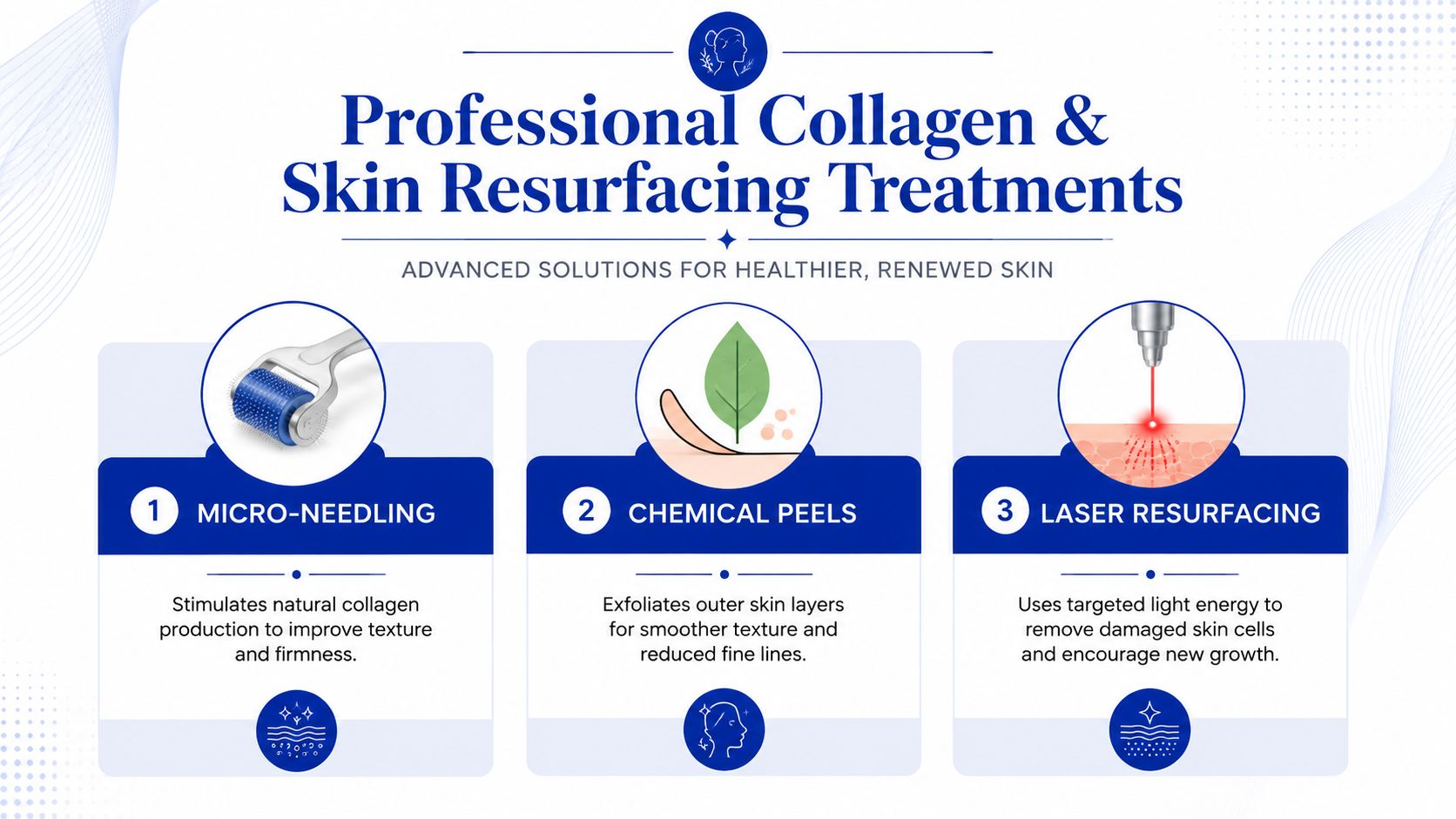
Microneedling for collagen remodeling
Microneedling is one of the most practical non-Botox options for patients with fine to moderate static forehead lines, especially when texture is part of the problem. It works by creating controlled micro-injuries that trigger the skin's repair response and collagen remodeling.
Verified treatment data shows that microneedling can lead to 40 to 60% improvement in wrinkle severity after a series of 3 to 6 treatments, and combining it with PRP or PRF can increase collagen yield by an additional 25%, with durability lasting up to 12 to 18 months, according to this overview of non-Botox forehead treatments.
That doesn't mean every forehead line responds equally well. Microneedling tends to perform better for shallow etched lines and crepey texture than for very deep creases caused by long-term movement and structural change.
For readers considering treatment details, this microneedling page explains how the service is used in a clinical setting.
Peels and PRF EZ Gel in the right role
Chemical peels belong in a different lane. They focus more on the skin surface. If the forehead looks rough, dull, uneven, or sun-damaged, a peel may improve the overall quality of the skin and make fine wrinkling look softer. Peels are often a strong choice for patients who want brighter, smoother skin and can tolerate a short recovery window with peeling or flaking.
PRF EZ Gel adds another layer to treatment planning. Instead of resurfacing the skin directly, it can be used to support regenerative treatment plans in patients who want a more natural route to improvement. In practice, it often makes the most sense as part of combination care rather than as a standalone answer for every forehead wrinkle.
The right combination often beats the most aggressive single treatment.
How to choose between them
Patients usually do better when they choose based on the main problem in the mirror, not the trendiest treatment name.
| Treatment | Best fit | Trade-off |
|---|---|---|
| Microneedling | Fine to moderate static lines, crepey texture, gradual collagen support | Usually works as a series, not one session |
| Chemical peels | Surface roughness, dullness, uneven tone, mild wrinkling | Visible peeling or temporary sensitivity may occur |
| Microneedling with PRF EZ Gel | Patients who want collagen-focused treatment with regenerative support | Still requires a plan and maintenance |
| PRF EZ Gel alone | Select patients needing supportive regeneration rather than primary resurfacing | Not the first choice for every etched line |
A common mistake is choosing a resurfacing treatment for a wrinkle that is mostly structural. Another is expecting one peel to correct a line that has been forming for years. Office treatments can make a visible difference, but the best results come from matching the treatment category to the wrinkle type.
Restore Volume and Structure with Dermal Fillers
Not every forehead wrinkle is a surface problem. Some are partly a support problem.
When the problem is support, not surface texture
If a line stays visible at rest and appears more like a crease than a fine surface wrinkle, collagen stimulation alone may not be enough. The skin can be smoother after microneedling or peels and still show a persistent indentation because the issue isn't just texture. It's structure.
That's where dermal fillers can enter the plan. Their role is different from microneedling and peels. Instead of stimulating gradual change in the skin, fillers can provide strategic support under selected static lines.
What fillers do better than resurfacing treatments
Fillers can be useful when the goal is to soften an established crease that needs lift or support from beneath. In the right patient, that creates a smoother look without trying to force repeated resurfacing to do a job it wasn't designed to do.
This is also where skill and restraint matter. The forehead is not an area for casual, one-size-fits-all filler use. The goal isn't to erase every line at any cost. It's to improve the line while preserving a natural look and normal expression.
Patients who want to understand this option in more detail can review this guide to forehead line fillers.
A practical way to think about it is simple:
- Choose microneedling or peels when the skin itself needs renewal.
- Choose filler evaluation when the crease looks etched and supported by loss of structure.
- Choose combination treatment when both are true.
Fillers aren't the answer for every forehead. But when static lines are deeper and the skin needs support, they can solve a problem that skincare and resurfacing only partly improve.
Creating Your Personalized Treatment Plan at ProMD Health
The most effective Botox-free plan is rarely the most complicated one. It's the one that matches the wrinkle pattern in front of you.
Some patients only need better protection, a retinoid, and time. Others need collagen stimulation because the lines are already visible at rest. Some need a combination of resurfacing and structural support because the skin and the underlying support have changed together.

A practical way to decide your next step
A useful self-check looks like this:
- If lines show mostly with expression, start with prevention and topical correction.
- If lines remain at rest, move toward a consultation for skin-quality treatment such as microneedling, peels, PRF EZ Gel, or filler assessment.
- If texture, creasing, and support loss all show up together, expect a layered plan rather than one treatment.
At ProMD Health Bethesda, that planning process is individualized. Mandy Fawcett, PA-C, MSHS, Leigh Mazzei, PA-C, MSHS, and Marissa Phillips evaluate skin quality, wrinkle depth, facial movement patterns, and downtime tolerance before recommending treatment. That matters because natural-looking results usually come from treating the right problem first, not from doing the most treatment.
Frequently Asked Questions About Non-Botox Treatments
Can non-Botox treatments be combined for better results
Yes, and they often should be. Combination treatment makes sense because forehead wrinkles can involve more than one issue at the same time. A patient may have surface texture change, collagen loss, and an etched crease all in the same area.
A common example is pairing a collagen-focused treatment with a structural one. Another is using a strong home routine to support office treatments between visits. The key is sequencing. If everything is done at once without a clear reason, irritation and disappointment become more likely.
How do I know which professional treatment is right for my wrinkles
Start by looking at your forehead at rest, then with expression.
If the lines are mostly fine, shallow, and tied to skin texture, microneedling or peels are usually more relevant. If the line looks deeper and pressed into the skin even when you're completely relaxed, filler assessment may be more useful. If your forehead looks rough and sun-damaged overall, resurfacing often deserves priority.
A good consultation should identify whether the main problem is movement history, skin quality, structural support, or a mix of all three.
Are results from microneedling, peels, PRF EZ Gel, or fillers permanent
No. Improvement can be meaningful, but maintenance is part of non-Botox care.
Skin continues to age. Facial movement continues. Sun exposure continues unless you actively prevent it. That means even strong results need support over time, whether that support is skincare, repeat procedures, or both.
Is there a point where Botox-free treatment stops making sense
That depends on your goals, not a rule. If you want softer lines, better texture, and a more refreshed forehead without changing movement, Botox-free treatment can make a lot of sense. If you want the most direct treatment for dynamic forehead wrinkling from muscle activity, then non-Botox options have limits.
The important part is understanding the trade-off before you start. Many patients are happy with gradual, natural-looking improvement. They just need a plan that's realistic.
If you're ready for a personalized evaluation, ProMD Health Bethesda can help you decide whether your forehead lines are best addressed with skincare guidance, microneedling, peels, PRF EZ Gel, fillers, or a layered plan that fits your goals.

