

How much do dermal fillers cost in 2025
What Do Dermal Fillers Cost in 2026? Here’s What to Expect
How much do dermal fillers cost is one of the most common questions we hear from patients considering their first treatment — and the answer depends on several key factors.
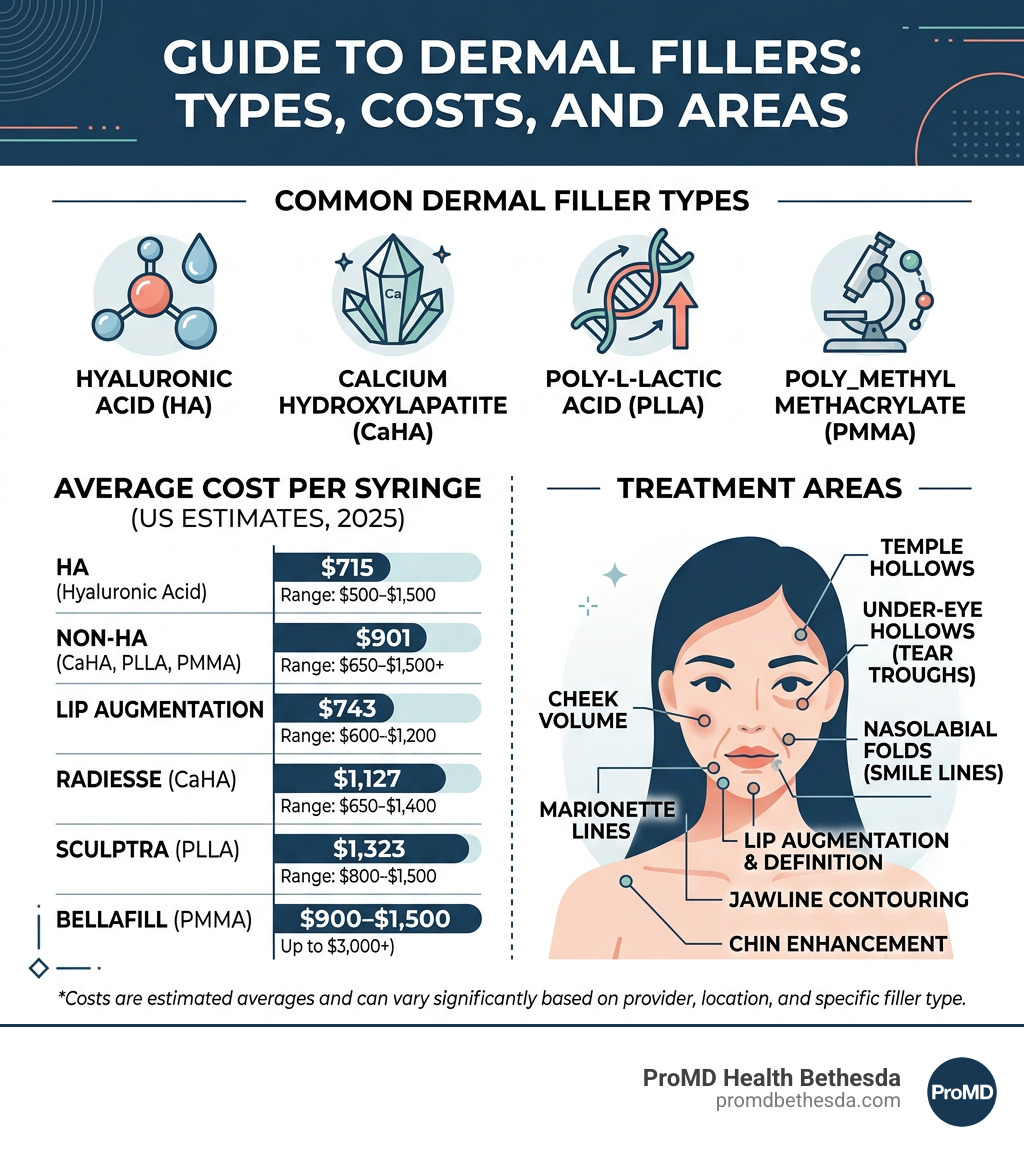
Here’s a quick overview of current pricing in the US:
| Filler Type | Average Cost Per Syringe | Typical Range |
|---|---|---|
| Hyaluronic Acid (HA) | $715 | $500 – $1,500 |
| Non-Hyaluronic Acid | $901 | $650 – $1,500+ |
| Lip Augmentation | $743 | $600 – $1,200 |
| Radiesse (CaHA) | $1,127 | $650 – $1,400 |
| Sculptra (PLLA) | $1,323 | $800 – $1,500 |
| Bellafill (PMMA) | $900 – $1,500 | Up to $3,000+ |
Source: American Society of Plastic Surgeons
Most patients in the US pay $700 to $750 per syringe on average, with full treatment sessions typically ranging from $1,800 to $2,500 depending on the area treated and the number of syringes used.
Prices vary based on:
- The type and brand of filler
- The treatment area and syringes needed
- Your provider’s expertise and credentials
- Your geographic location (metro areas like Bethesda tend to run higher)
These numbers give you a solid starting point — but your actual cost will depend on your specific anatomy and goals.
I’m Mandy Fawcett, PA-C, a board-certified Physician Assistant with over 8 years of clinical experience and specialized aesthetic training, and I hear questions about how much do dermal fillers cost from nearly every new patient I consult with. In this guide, I’ll walk you through everything you need to budget confidently — from brand-by-brand pricing to what drives costs up or down in the Bethesda area.
Understanding Dermal Fillers and Their Cosmetic Uses
Before we dive deep into the dollars and cents, it is helpful to understand what you are actually paying for. Dermal fillers are gel-like substances injected beneath the skin to restore lost volume, smooth lines, soften creases, or enhance facial contours. Think of them as a way to “refill” the structural support that naturally diminishes as we age.
Most modern fillers utilize Hyaluronic acid (HA), a sugar molecule naturally found in your skin that can hold up to 1,000 times its weight in water. This makes it incredible for hydration and soft, natural-looking volume. Other fillers act as biostimulators, meaning they trigger your body’s own collagen production over time.
According to FDA information on dermal fillers, these products are approved for various uses, including:
- Smoothing “smile lines” (nasolabial folds)
- Plumping thin lips
- Restoring volume to sunken cheeks or temples
- Improving the appearance of recessed scars
- Contouring the jawline and chin
At ProMD Health Bethesda, we specialize in using these tools for facial contouring that looks refreshed, not “done.” Whether you are looking for subtle wrinkle smoothing or a more defined profile, understanding the substance being used is the first step in understanding the price tag.
How much do dermal fillers cost?
When researching how much do dermal fillers cost, you will likely see prices quoted “per syringe.” Most syringes contain 1.0 mL of product—about one-fifth of a teaspoon. While that sounds small, in the hands of an expert, it can make a significant difference.
Based on American Society of Plastic Surgeons cost data, the national average for HA fillers is approximately $715, while non-HA fillers (like Radiesse or Sculptra) average around $901. However, in high-demand areas like Bethesda and Chevy Chase, you should expect prices to align more closely with metropolitan averages, often ranging from $800 to $1,200 per syringe.
| Category | National Average (Per Syringe/Vial) | Longevity |
|---|---|---|
| Hyaluronic Acid (HA) | $715 – $868 | 6–18 Months |
| Calcium Hydroxylapatite (CaHA) | $1,127 | 12–15 Months |
| Poly-L-lactic Acid (PLLA) | $1,323 | Up to 2 Years |
| PMMA (Semi-Permanent) | $900 – $1,500 | Up to 5 Years |
It is important to note the difference between syringe and vial pricing. Some products, like Sculptra, are sold by the vial and may require multiple vials over several sessions to achieve the desired collagen-stimulating effect.
Average cost of dermal fillers by brand
Not all fillers are created equal. Different brands use different technologies to achieve specific textures—some are soft and flexible for the lips, while others are robust and “bony” for the jawline.
- Juvederm®: This family of fillers (including Ultra, Voluma, and Volbella) typically costs between $600 and $900 per syringe. According to Juvederm® cost details, Voluma—used for cheek lifting—tends to be at the higher end of that range due to its thickness and longevity.
- Restylane®: Similar to Juvederm, Restylane® pricing information shows an average of $700 to $800 per syringe. Specialized versions like Restylane Kysse (for lips) or Lyft (for cheeks) may vary slightly.
- Radiesse®: A CaHA filler often used for jawlines and hands, it typically costs $800 to $1,200. It provides immediate volume and stimulates collagen.
- Sculptra®: This is a long-term investment. At roughly $850 to $1,500 per vial, most patients need 2–4 vials spread across several months.
- Bellafill®: As a semi-permanent filler containing PMMA microspheres, it can cost between $1,000 and $1,500 per syringe, but because it lasts up to five years, the long-term cost-per-year is often lower.
Regional price variations: US vs. Toronto
While our focus is on the Maryland area, it is interesting to see how geography shifts the “market rate.” In large Canadian hubs like Toronto, fillers often range from $450 to $650 CAD per syringe. In the United States, however, the national average is higher.
Specifically in the Mid-Atlantic region (Bethesda, Rockville, and DC), costs are influenced by a higher cost of living and a high concentration of board-certified specialists. You might find “bargain” prices in rural areas or from less-experienced injectors, but in metropolitan hubs, you are paying for the accessibility of top-tier medical expertise and the latest FDA-approved technologies.
Factors Influencing the Price of Your Treatment

If you call three different clinics in Bethesda, you will likely get three different quotes for the same brand of filler. Why? Because you aren’t just paying for the gel inside the syringe; you are paying for the “who,” “where,” and “how.”
- Provider Expertise: This is the most significant factor. A board-certified physician or a highly trained Physician Assistant with years of experience in facial anatomy will charge more than a technician at a “strip-mall” medspa. According to FDA safety warnings on inexperienced injectors, choosing a provider based solely on price can lead to complications like asymmetry, lumps, or even dangerous vascular occlusions.
- Facility and Safety Standards: Reputable clinics invest in high-quality numbing agents, emergency supplies (like hyaluronidase to dissolve filler if needed), and a sterile environment.
- Customized Treatment Plans: At ProMD Health Bethesda, we don’t believe in a “one size fits all” approach. We use an AI Simulator to help you preview your results before we even open a syringe. This technology ensures we use the exact amount of product needed—no more, no less—to achieve a natural look.
- Number of Syringes: A “full-face refresh” will obviously cost more than a simple lip plump. Most patients require at least two syringes for facial balancing to ensure symmetry.
Estimating Syringes and Maintenance for Common Areas
One of the hardest things for patients to visualize is how much product they actually need. To help you budget for how much do dermal fillers cost, here are the typical estimates for common treatment areas:
- Lips: Usually 1 to 2 syringes. One syringe provides a subtle refresh, while two can create more significant volume and shape.
- Cheeks: 2 to 4 syringes. Because the cheek area is larger and requires more “lift,” it often requires more product than the lips.
- Jawline and Chin: 2 to 6 syringes. Creating a sharp, defined jawline requires a denser product and more volume. You can learn more about this in our Bethesda jawline guide.
- Under-Eyes (Tear Troughs): 1 to 2 syringes. This is a delicate area that requires a soft filler and high precision.
- Forehead and Smile Lines: 1 to 2 syringes. These areas are often treated in conjunction with neuromodulators like Botox. Check out our guide to forehead fillers for more details.
How much do dermal fillers cost for lips and cheeks?
Lip augmentation is one of the most popular requests. On average, lip filler treatments cost between $650 and $1,600. Scientific research on hyaluronic acid benefits shows that HA not only adds volume but also improves lip hydration, which can make the results look even better over time.
Cheek augmentation is typically a larger investment, often ranging from $1,300 to $3,200. While the upfront cost is higher, the results in the cheeks often last longer (up to 18–24 months with products like Juvederm Voluma) compared to the lips (6–12 months) because the cheeks move less when you talk or eat. Longevity and maintenance needs play a huge role in your total “cost of ownership” for these treatments.
Comparing Fillers to Other Aesthetic Treatments
When considering how much do dermal fillers cost, it is helpful to compare them to other options.
- Fillers vs. Botox: Botox and other neuromodulators are generally cheaper per session (averaging $350–$700), but they only last 3–4 months. Fillers cost more upfront but can last up to two years. Botox relaxes muscles to stop wrinkles from forming; fillers “fill” the wrinkles that are already there.
- The Liquid Facelift Approach: For patients seeking comprehensive rejuvenation without the intensity of invasive procedures, a combination of fillers can provide what is often called a “liquid facelift.” This approach offers immediate results with zero downtime, allowing patients to achieve a refreshed look through strategic volume restoration.
- Gender Trends: Recent research on male aesthetic trends shows that men are increasingly seeking jawline and chin fillers to create a more masculine profile. Because men often have larger facial structures and stronger muscles, they may require more syringes than women, which increases the total cost.
Whether you are treating marionette lines or hollow temples, the goal is always a harmonious, balanced result.
Safety, Risks, and Financing Options
We understand that cosmetic treatments are an investment. Because dermal fillers are elective, they are not covered by health insurance. However, there are ways to make the cost more manageable.
Financing Options: Many clinics, including ours, accept CareCredit, which allows you to pay for your treatment in monthly installments. Some patients also use loyalty programs like Alle (Juvederm) or ASPIRE (Restylane) to earn points and discounts on future treatments.
The Cost of Risk: According to RealSelf dermal filler risk and cost data, the average cost of a filler treatment is around $1,462. However, the cost of fixing a bad filler job can be much higher. If a filler is injected incorrectly, you may need multiple sessions of hyaluronidase to dissolve it (costing $100–$300 per session) before starting over.
While Bellafill® safety and cost profiles are excellent for long-term use, semi-permanent fillers require even greater injector skill because they cannot be easily dissolved. Always prioritize safety and expertise over a “groupon” deal.
Frequently Asked Questions about Dermal Filler Costs
Are dermal fillers covered by health insurance?
No. Dermal fillers are considered cosmetic, elective procedures. In very rare cases involving reconstructive surgery after a traumatic injury or for specific medical conditions like HIV-related facial lipoatrophy, there may be exceptions, but for 99% of patients, it is an out-of-pocket expense.
How many syringes of filler will I need for a full face refresh?
A full-face rejuvenation typically requires between 4 and 8 syringes. This sounds like a lot, but when spread across the temples, cheeks, jawline, and nasolabial folds, it provides a subtle, balanced lift rather than over-filling one specific area.
Is it safe to choose a provider based on the lowest price?
In short: No. A low price often indicates that the provider is either inexperienced, using non-FDA-approved products, or diluting the product. Your face is not the place to look for a bargain. The cost of correcting a complication or a poor aesthetic result far outweighs the initial savings of a “cheap” injector.
Conclusion
Determining how much do dermal fillers cost in 2026 involves looking at the brand, the area of treatment, and—most importantly—the hands of the person holding the syringe. At ProMD Health Bethesda, we combine our years of medical expertise with cutting-edge AI Simulator technology. This allows our patients in Bethesda, Chevy Chase, and the surrounding Maryland areas to see their potential results before they commit to a treatment plan.
By focusing on natural-looking results and transparent pricing, we ensure that your investment in dermal fillers translates into the confidence and refreshed appearance you deserve. Ready to see what is possible? We invite you to schedule a personalized consultation at our Bethesda clinic to receive an exact quote tailored to your unique facial anatomy.

