

How Bosley Hair Restoration Works to Restore Your Confidence
How Hair Restoration Actually Works — And Why It’s Worth Understanding First
How does Bosley hair restoration work is one of the most common questions people ask before committing to a procedure — and it deserves a straight answer.
Here’s the short version:
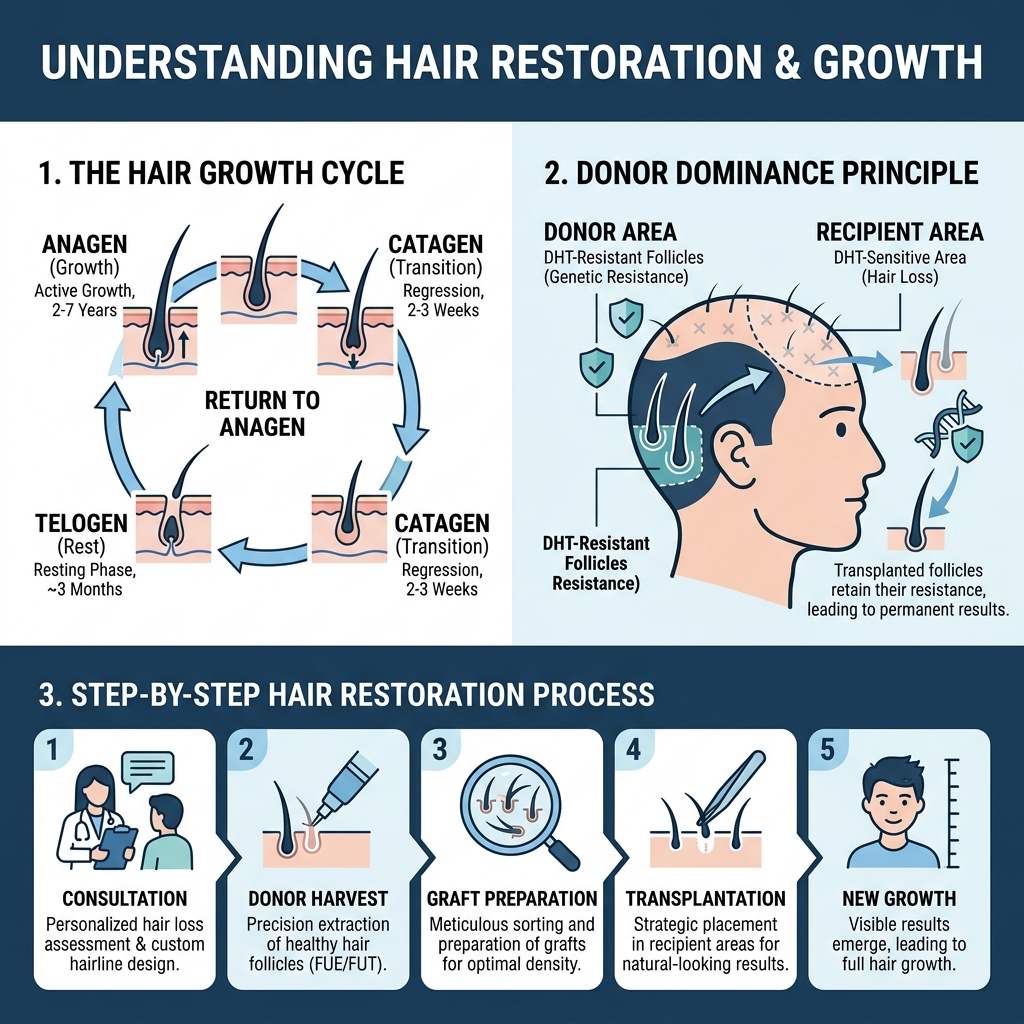
- Consultation — A specialist evaluates your hair loss pattern and designs a custom hairline.
- Donor harvest — Healthy, DHT-resistant follicles are extracted from the back or sides of your scalp.
- Graft preparation — Follicles are sorted by size and hair count for optimal placement.
- Transplantation — Grafts are precisely placed into thinning or bald areas using tiny incisions.
- Growth — New hair begins to appear around 3 months, with full results visible by 12 months.
The results are permanent because of a principle called Donor Dominance — transplanted follicles keep their original genetic traits and resist the hormone (DHT) that caused your hair loss in the first place.
Hair loss is more common than most people realize. Around 50% of men experience noticeable thinning by age 50, and millions of women face the same challenge. For many, it quietly chips away at confidence long before they seek help.
The good news? Modern hair restoration has come a long way from the old “hair plug” look. Today’s procedures use individual follicular units — grafts of just 1 to 4 hairs — placed with surgical precision for results that are virtually undetectable.
I’m Mandy Fawcett, PA-C, MSHS, a Board-Certified Physician Assistant with over 8 years of clinical experience, including specialized aesthetic training directly relevant to understanding how does Bosley hair restoration work and what patients need to know before choosing a provider. In this guide, I’ll walk you through the science, the procedure, and what to realistically expect — so you can make a confident, informed decision.
Must-know how does bosley hair restoration work terms:
Understanding the Science: How Does ProMD Health Bethesda Hair Restoration Work?
To understand how does bosley hair restoration work, we first have to look at the biological foundation of hair loss. Most people experiencing thinning are dealing with Androgenetic Alopecia, commonly known as male or female pattern baldness.
The primary culprit here is Dihydrotestosterone (DHT), a hormone that causes susceptible hair follicles to shrink over time until they stop producing hair entirely. However, not all hair on your head is created equal. The hair on the back and sides of your scalp is genetically programmed to be resistant to DHT. This is the cornerstone of hair restoration science.
The process relies on a biological rule known as Donor Dominance. This principle, discovered decades ago, proves that a hair follicle retains its original genetic characteristics even after it is moved to a new location. If we take a follicle from a “permanent” zone (the back of the head) and move it to a “balding” zone (the hairline), that follicle will continue to grow hair for a lifetime because it remains resistant to DHT.
Scientific research consistently supports the efficacy of this approach. According to Policy Cleveland Clinic is a non-profit academic medical center. Advertising on our site helps support our mission. We do not endorse non-Cleveland Clinic products or services.Policy, modern hair transplantation is a highly effective way to move hair from one place to another to address thinning.
The Role of DHT and Follicle Survival
The success of a transplant isn’t just about moving hair; it’s about the survival of the “grafts.” A graft is a tiny piece of scalp tissue containing one to four hair follicles. When these are harvested and implanted correctly, the survival rate is remarkably high.
In fact, an NIH study on 90% to 100% graft survival rates confirms that when performed by a qualified physician and team, the vast majority of transplanted follicles successfully take root in their new home. At ProMD Health Bethesda, we emphasize this biological precision. By ensuring the scalp tissue is handled with care and the follicles are kept hydrated and healthy during the transition, we facilitate permanent growth that looks and feels completely natural.
FUE vs. FUT: Comparing the Main Types of Procedures
When exploring how does bosley hair restoration work, you will inevitably encounter two main acronyms: FUE and FUT. While both rely on the same principle of donor dominance, the way the hair is harvested differs significantly.
Follicular Unit Extraction (FUE): This is currently the most popular hair transplant option worldwide. In an FUE procedure, individual follicular units are extracted one by one from the donor area using a specialized micro-punch tool.
- Pros: No linear scar, faster recovery (usually 1-2 days), and the ability to wear your hair very short.
- Cons: Often more time-consuming and can be more expensive due to the labor-intensive nature of individual extraction.
Follicular Unit Transplantation (FUT): Also known as “strip surgery,” this method involves removing a thin strip of healthy scalp from the donor area. The strip is then divided into individual grafts under a microscope.
- Pros: Allows for the transplantation of a large number of grafts in a single session and often results in a higher follicle survival rate because the tissue remains intact longer.
- Cons: Leaves a fine linear scar at the back of the head, which is easily hidden by surrounding hair but may be visible if the hair is buzzed very short.
| Feature | FUE (Follicular Unit Extraction) | FUT (Follicular Unit Transplantation) |
|---|---|---|
| Harvesting Method | Individual follicle units | Thin strip of tissue |
| Scarring | Tiny, dot-like scars (nearly invisible) | Fine linear scar |
| Recovery Time | 1-2 days for initial healing | 5-7 days for initial healing |
| Best For | Patients who want short hair | Patients needing maximum density |
| Shaving Required | Usually requires donor area shave | No shaving required (strip is hidden) |
As noted in Research on follicular grafts, these healthy growing follicles are the key to restoring areas that have experienced significant loss.
Advanced Technology and How ProMD Health Bethesda Hair Restoration Works for High Density
At ProMD Health Bethesda, we don’t just stop at the basics. We believe that the marriage of medical artistry and advanced technology is what creates a truly “undetectable” result.
One of the ways we ensure high density is through meticulous site creation. We use precision instruments—sometimes referred to as Sapphire or Infinity blades in the industry—to create tiny recipient sites that mimic the natural angle and direction of your original hair. This ensures that as the new hair grows in, it blends seamlessly with your existing strands.
Furthermore, we utilize a unique AI Simulator. This allows our patients in Bethesda and Chevy Chase to preview their potential results before the first incision is even made. By combining this tech with the expert eyes of providers like Leigh Mazzei, PA-C, and Marissa Phillips, we create a custom hairline design that respects your facial proportions and age, avoiding the “too-perfect” look that often screams “transplant.” For more details, you can explore our hair restoration services.
The Step-by-Step Process of a ProMD Health Bethesda Hair Transplant
If you’re wondering what the actual day feels like, it’s helpful to view it as a focused, “done-in-a-day” outpatient procedure. You aren’t “going under” general anesthesia; instead, we use local numbing agents so you are awake and comfortable throughout.

Step 1: Preparation and Design We begin by marking the donor and recipient areas. This is where the artistry happens—designing a hairline that looks natural for your face shape. The donor area (usually the back of the head) is trimmed to prepare for extraction.
Step 2: Local Anesthesia We apply a local anesthetic to both the donor and recipient sites. Most patients describe this as the only “uncomfortable” part—a few quick pinpricks, and then you won’t feel a thing. Many of our patients spend the rest of the day watching movies, listening to podcasts, or even napping.
Step 3: Harvesting the Grafts Using either FUE or FUT techniques, the healthy follicles are harvested. Our team works with extreme precision to ensure the integrity of each bulb.
Step 4: Graft Preparation While the physician prepares the recipient sites, our specialized technicians sort the grafts. We categorize them by the number of hairs (1-hair grafts for the very front of the hairline, 3-4 hair grafts for density in the back).
Step 5: Site Creation and Placement The physician creates tiny incisions (sites) in the thinning areas. Then, the grafts are placed one by one. This part of the process requires incredible patience and a steady hand to ensure the depth and angle are perfect for future growth.
The entire process typically takes between 4 to 8 hours, depending on the number of grafts needed. Because it is an outpatient procedure, you can head home (or back to your hotel in Rockville or Kensington) immediately afterward.
Who is a Candidate and How Does ProMD Health Bethesda Hair Restoration Works Long-Term?
Not everyone is a perfect candidate for a transplant. To determine eligibility, we use tools like the Norwood Scale (for men) and the Ludwig Scale (for women). These scales help us classify the extent of hair loss and determine if there is enough donor hair available to cover the thinning areas.
Ideal candidates typically have:
- Sufficient donor hair density on the back and sides of the head.
- Realistic expectations about what can be achieved.
- Good scalp elasticity (especially for FUT).
- Stabilized hair loss (often through the help of medications).
The “long-term” answer to how does bosley hair restoration work is simple: it works for life. Because those transplanted follicles are DHT-resistant, they will continue to produce hair even as the rest of your non-transplanted hair might continue to thin. This is why we often recommend a “360-degree approach” that includes non-surgical maintenance to protect your existing hair.
Recovery, Results, and the ProMD Health Bethesda Approach
Recovery is surprisingly quick. Most of our patients return to light activity within 24 hours and are back at work within 2 to 3 days.
The Recovery Timeline:
- Days 1-3: Minor swelling and redness. You’ll be given a post-op kit with saline spray to keep the grafts hydrated.
- Weeks 2-3: The “Shedding Phase.” Don’t panic! The hair shafts will fall out, but the living follicle remains safely tucked under the skin. This is a normal part of the cycle.
- Months 3-4: New, fine hairs begin to sprout.
- Months 6-9: Significant growth and thickening occur. You’ll see about 60% of your final result.
- Month 12: Full results. The hair is now long enough to be styled, cut, and treated just like your original hair.
When considering the cost, it’s important to look at the value of a permanent solution. While the average cost of a hair transplant in the U.S. is around $13,610, most procedures at specialized clinics range from $6,000 to $12,000. We offer various financing options through third-party lenders to make this investment in your confidence more accessible for our neighbors in Chevy Chase and Bethesda.
Choosing a local, U.S.-based clinic like ProMD Health Bethesda over “hair tourism” options overseas ensures you have access to continuous follow-up care and the protection of U.S. medical standards. We are here for you at the 1-day, 1-month, and 1-year mark to ensure your results are exactly what you hoped for.
Frequently Asked Questions about ProMD Health Bethesda Hair Restoration
How long does a ProMD Health Bethesda hair transplant procedure take?
Most procedures are completed in a single day, typically lasting between 4 and 8 hours. The exact time depends on the technique (FUE takes longer than FUT) and the number of grafts being moved. Because it is a “done-in-a-day” procedure, you can return home shortly after we finish.
What is the typical cost and financing for hair restoration?
The cost is primarily determined by the number of grafts needed to reach your desired density. Most patients can expect an investment between $6,000 and $12,000. We provide transparent pricing during your initial consultation and offer flexible financing plans, including some with 0% interest for up to 18 months, to help fit the procedure into your budget.
What additional non-surgical options are available?
Transplants are the only permanent way to restore hair to a bald area, but they work best when combined with maintenance therapies. We offer:
- Finasteride & Minoxidil: FDA-approved medications to slow thinning.
- Low-Level Laser Therapy (LLLT): To stimulate follicle health.
- PRP/PRF Therapy: Using your own growth factors to “fertilize” the scalp.
- Scalp Micropigmentation: A medical-grade “tattooing” technique that creates the illusion of a fuller head of hair.
Conclusion
Understanding how does bosley hair restoration work is the first step toward reclaiming a part of yourself that hair loss might have taken away. By leveraging the science of donor dominance and the precision of modern FUE and FUT techniques, we can provide a permanent, natural-looking solution that grows for a lifetime.
At ProMD Health Bethesda, we combine the expertise of Mandy Fawcett, PA-C, Leigh Mazzei, PA-C, and Marissa Phillips with cutting-edge tools like our AI Simulator to ensure you feel confident every step of the way. Whether you are in Bethesda, Kensington, or Rockville, you don’t have to settle for thinning hair.
Ready to see what’s possible? Schedule your consultation for hair restoration today and let us help you restore your hair—and your confidence.

