

Everything You Need to Know About IV Vitamin Therapy
Understanding IV Vitamin Therapy: A Modern Wellness Approach
What is iv vitamin therapy? It’s a medical procedure that delivers vitamins, minerals, and nutrients directly into your bloodstream through an intravenous drip, bypassing your digestive system entirely.
Quick Answer:
- Definition: Intravenous infusion of vitamins and minerals directly into the bloodstream
- How it works: A small catheter inserted into a vein delivers nutrients at 100% bioavailability
- Common uses: Treating malabsorption issues, boosting hydration, supporting recovery
- Cost range: $100-$800 per session, typically not covered by insurance
- Safety: Generally safe when administered by licensed medical professionals in sterile settings
Over the past few years, IV vitamin therapy has transformed from a hospital-only treatment into a popular wellness trend. Celebrities and health enthusiasts have helped propel it into the mainstream, with clinics now offering everything from hangover relief to immune system support.
But the science behind IV therapy goes back much further. In the 1830s, Dr. Thomas Latta pioneered intravenous fluid delivery during cholera epidemics, revolutionizing how we think about nutrient and fluid resuscitation. By the mid-20th century, IV therapy became standard practice in hospitals worldwide.
Today’s wellness-focused IV treatments trace their roots to Dr. John Myers, who developed the famous “Myers’ Cocktail” in the 1970s—a customizable blend of vitamins and minerals designed to address specific health conditions. His successor, Dr. Alan Gaby, performed around 15,000 IV vitamin therapy treatments with no severe adverse reactions reported.
The key advantage? IV therapy achieves plasma levels up to 100 times higher than oral supplements, particularly with vitamin C. This bypasses the digestive system’s natural absorption barriers, liver metabolism, and the limitations of gut health.
However, this doesn’t mean IV therapy is right for everyone. While it offers clear benefits for people with malabsorption issues—like those with IBD, celiac disease, or post-bariatric surgery patients—the evidence for routine wellness use in healthy individuals remains limited.
What is IV Vitamin Therapy?
At its core, what is iv vitamin therapy? It is the process of administering high concentrations of minerals and vitamins directly into the vein. While we usually think of vitamins as pills or gummies we take with breakfast, the IV method changes the delivery game entirely.
When you swallow a supplement, it must travel through your stomach and intestines. This is a long, arduous journey where much of the nutrient value can be lost due to stomach acid, enzymes, and the “first-pass” metabolism of the liver. By the time that vitamin C tablet reaches your cells, only a fraction of it might actually be usable.
IV therapy provides 100% bioavailability. This means the nutrients are immediately available for cellular absorption because they enter the bloodstream directly. This method is considered an invasive procedure, which is why it is traditionally used in healthcare settings to treat dehydration, nutrient deficiencies, and acute illnesses. To understand the technical side, you can explore the medical procedures involved in IV therapy.

| Feature | Oral Supplements | IV Vitamin Therapy |
|---|---|---|
| Absorption Rate | 20% – 50% (Variable) | 100% (Immediate) |
| Bioavailability | Low to Moderate | Maximum |
| Digestive System | Required | Bypassed |
| Hydration | Minimal | High (Saline-based) |
| Speed of Action | Slow (Hours) | Rapid (Minutes) |
How the procedure works
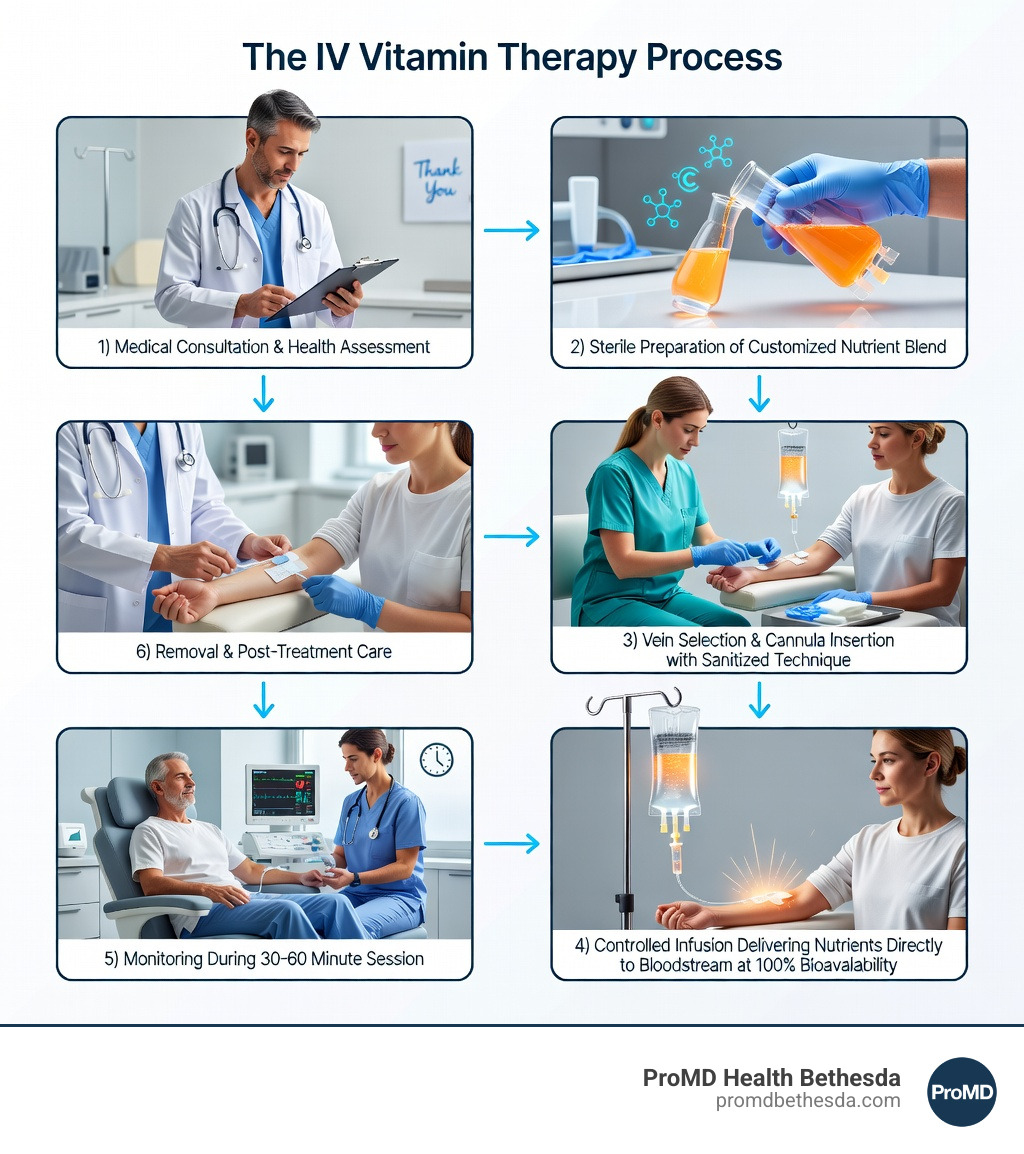
If you’ve ever been to a hospital in Bethesda or Rockville for a procedure, the setup will look familiar. A healthcare professional first selects a suitable vein, usually in the forearm, the back of the hand, or the wrist.
The area is sanitized, and a small needle is used to insert a thin plastic tube called a cannula. Once the cannula is in place, the needle is removed, and the tube is connected to an IV bag. This bag contains a mixture of sterile water or saline solution infused with a specific “cocktail” of nutrients. The fluid then drips into your body, either via gravity or an infusion pump, typically taking between 30 to 60 minutes.
Who should consider IV vitamin therapy?
While many healthy people use it for a “wellness boost,” IV therapy is most beneficial for those with specific medical needs. For instance, individuals with malabsorption issues—where the gut simply cannot pull nutrients from food—find this life-changing.
This includes people with:
- Inflammatory Bowel Disease (IBD) or Crohn’s disease
- Celiac disease
- Post-bariatric surgery patients (who have shortened digestive tracts)
- Chronic fatigue syndrome or fibromyalgia
- Acute dehydration from illness or intense athletic exertion
If you are dealing with these conditions, you can learn more about how we approach tailored IV therapy services to support your recovery.
The History and Science of Nutrient Infusions
The story of IV therapy didn’t start in a trendy wellness lounge. It began in the 17th century with early animal blood transfusions, though those were—to put it lightly—a bit of a disaster due to a lack of knowledge about blood types and sterility.
The real breakthrough came in the 1830s when Dr. Thomas Latta used saline infusions to save patients during the cholera epidemics. Fast forward to the 1970s, and Dr. John Myers of Baltimore began using “nutrient cocktails” to treat everything from asthma to migraines. After his death, Dr. Alan Gaby refined these protocols, documenting thousands of successful treatments. For a deeper dive into the archives, check out the scientific research on the history of IV nutrient therapy.
Bioavailability and the 100x Vitamin C effect
One of the most staggering statistics in nutrient science is the “100x effect” of Vitamin C. When you take Vitamin C orally, your body has a “renal threshold”—once you hit about 1 gram, your kidneys and gut start dumping the excess.
However, when delivered intravenously, Vitamin C can reach plasma levels up to 100 times higher than what is possible through the mouth. These therapeutic doses are often used in clinical settings to enhance immune function, support wound healing, and act as a powerful antioxidant.
Clinical evidence and study limitations
We believe in being transparent: while anecdotal evidence is massive, large-scale clinical trials are still catching up. A 2009 study involving 34 adults with fibromyalgia who received the Myers’ Cocktail over 8 weeks showed significant improvements in pain and quality of life. However, the placebo group also showed improvement, which suggests that the “feeling” of being cared for and hydrated plays a role.
Many experts, including those at the Mayo Clinic, point out that while IV therapy is a medical necessity for those with deficiencies, it may not offer much more than a “very expensive multivitamin” for someone who is already perfectly healthy and eating a balanced diet. You can read more about the specifics of the Myers’ Cocktail and fibromyalgia research to see the data for yourself.
Claimed Benefits and Popular Formulations
When you walk into a wellness clinic, you’ll likely see a “menu” of drips. Most of these are variations of the original Myers’ Cocktail, but they can be customized for your specific goals.
- The Myers’ Cocktail: The “Gold Standard.” It typically includes B vitamins, Vitamin C, calcium, and magnesium.
- Glutathione Drips: Known as the “Master Antioxidant,” this is often used for skin brightening and detoxification.
- Recovery Drips: High in amino acids and magnesium to help athletes in Chevy Chase or Kensington bounce back after a marathon.
- Immune Boosters: Packed with Zinc and high-dose Vitamin C to help fight off seasonal bugs.
Boosting energy and immune support
Many of our patients report a “surge” of energy following a session. This is often due to the high dose of B12 and B-complex vitamins, which play a crucial role in cellular energy production. For those suffering from “adrenal fatigue” or chronic stress, these infusions can provide a much-needed reset. Additionally, nutrients like selenium and zinc are added to support the body’s natural defense mechanisms.
What is IV vitamin therapy cost and coverage?
Let’s talk numbers. Because IV vitamin therapy is often classified as a wellness or complementary treatment, it is rarely covered by insurance.
- Typical Cost: Individual sessions usually range from $100 to $300.
- Premium Drips: Specialized formulas (like high-dose NAD+ or specialized cancer support) can range from $250 to $800 per treatment.
While it might seem pricey compared to a bottle of vitamins from the grocery store, you are paying for the medical expertise, the sterile equipment, and the 100% absorption rate that pills simply cannot match.
Safety, Risks, and Potential Side Effects
Is it safe? Generally, yes—but it is an invasive procedure. Any time you break the skin with a needle, there are risks.
Common side effects include:
- Bruising or swelling at the insertion site.
- A metallic taste in the mouth (common with certain vitamins).
- Flushing or a warm sensation (especially if magnesium is administered too quickly).
More serious risks, though rare, include phlebitis (vein inflammation) or infection. There is also the risk of “nutrient toxicity” or electrolyte imbalances if the drip is not formulated correctly. For example, high doses of Vitamin C can increase oxalate production, which might lead to kidney stones in susceptible individuals. You can read more about the risks and complications of IV therapy to stay fully informed.
Contraindications and medical oversight
This is why medical oversight is non-negotiable. At ProMD Health, we ensure that every patient is screened. People with congestive heart failure or kidney disease should be extremely cautious, as their bodies may not be able to handle the sudden influx of fluids and minerals.
Furthermore, if you are undergoing chemotherapy, you must consult your oncologist. Some antioxidants can actually protect cancer cells from the treatment, making the chemo less effective. For more on this, check out the safety considerations for IV therapy during chemotherapy.
Frequently Asked Questions about IV Therapy
How long does IV therapy stay in your system?
The hydration effects are often felt immediately. However, since most vitamins used in these drips (like B-complex and C) are water-soluble, your body will use what it needs and then filter the rest through your kidneys. The “boosted” feeling typically lasts anywhere from a few days to two weeks, depending on your metabolic rate and activity levels.
Can you do IV therapy at home?
There are mobile IV services available in the Bethesda and Rockville areas. While convenient, we always recommend receiving treatment in a controlled medical environment. If an allergic reaction or a “vasovagal response” (fainting) occurs, you want to be in a place with emergency protocols and trained staff ready to assist.
Is IV vitamin therapy better than oral vitamins?
“Better” is a relative term. For daily maintenance in a healthy person, a balanced diet and oral vitamins are usually sufficient. However, for rapid recovery, treating a deficiency, or bypassing a compromised gut, IV therapy is undeniably more effective due to its 100% bioavailability.
Conclusion
At ProMD Health Bethesda, we believe that wellness should be as informed as it is effective. Whether you are looking to recover from a grueling workout, manage a chronic condition, or simply optimize your nutrient levels, what is iv vitamin therapy remains a powerful tool in your health arsenal.
We combine advanced technology—like our AI Simulator that allows you to preview natural-looking results for our aesthetic treatments—with expert medical care. Our goal is to ensure you feel confident and cared for every step of the way.
Ready to experience the benefits of nutrient optimization for yourself? Whether you’re in Chevy Chase, Garrett Park, or right here in Bethesda, we are here to help.
Schedule your IV Vitamin Therapy session today and take the first step toward feeling your absolute best!

