

Chemical Peel Costs and Everything You Need to Know Before You Glow
How Much Do Chemical Peels Cost? Here’s What to Expect
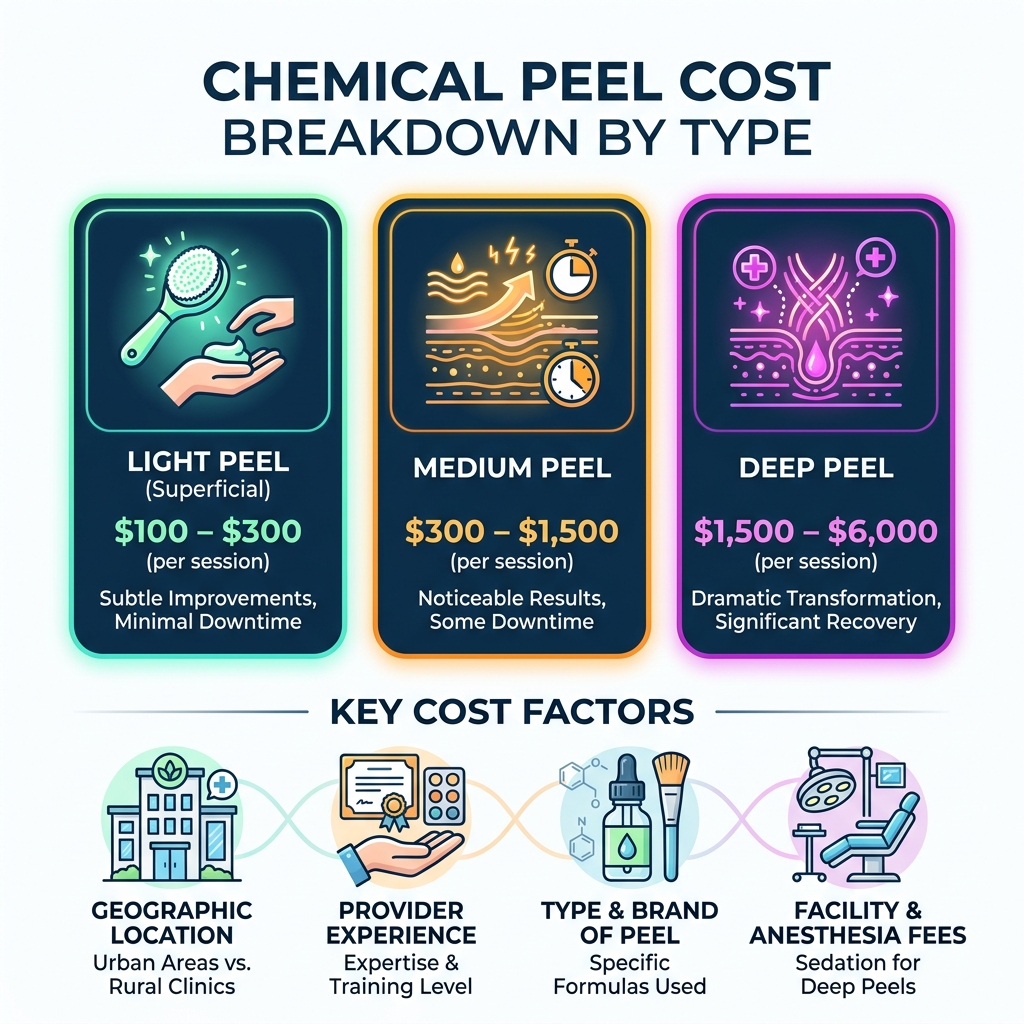
How much do chemical peels cost depends on the type of peel you choose — and the range is wide.
Here’s a quick breakdown:
| Peel Type | Typical Cost Per Session |
|---|---|
| Light (superficial) | $100 – $300 |
| Medium | $300 – $1,500 |
| Deep | $1,500 – $6,000 |
The overall average sits around $500, though the American Society of Plastic Surgeons reports the average for skin resurfacing procedures at $1,829 when factoring in provider fees, facility costs, and other expenses.
So yes — there’s a real spread. A quick lunchtime glycolic peel at a med spa is a very different investment than a deep phenol peel performed under sedation by a physician.
The right peel for you depends on your skin goals, your skin type, and how much downtime you can manage. This guide walks you through all of it.
I’m Mandy Fawcett, PA-C, MSHS, a Board-Certified Physician Assistant with over 8 years of clinical experience and specialized aesthetic training through the National Institute of Medical Aesthetics — and questions about how much do chemical peels cost come up in nearly every skin consultation I do here in Bethesda. Understanding what drives those numbers is the first step to choosing a treatment that actually delivers for your skin.
Basic how much do chemical peels cost terms:
Understanding Peel Types and Average Pricing
When you ask, “how much do chemical peels cost?” the answer starts with the depth of the treatment. Not all peels are created equal. Some just tickle the surface to give you a “glow-up” before a wedding in Chevy Chase, while others go deep into the dermis to hit the “reset” button on years of sun damage.
Light (Superficial) Peels: The “Lunchtime” Refresh
A light chemical peel is the most affordable entry point into professional skin resurfacing. These typically use Alpha-Hydroxy Acids (AHAs) like glycolic or lactic acid, or Beta-Hydroxy Acids (BHAs) like salicylic acid.
- Cost: $100 to $300 per session.
- What it does: It removes the outermost layer of the skin (the epidermis). It’s fantastic for brightening a dull complexion, managing mild acne, and smoothing very fine lines.
- Downtime: Minimal. You might look slightly flushed, like you just finished a brisk walk through Kensington, but you can usually head right back to work.
Medium Peels: Targeting the Deeper Damage
Medium-depth peels often use Trichloroacetic Acid (TCA) or specialized blends like the VI Peel. These penetrate through the epidermis and into the upper part of the middle layer of skin (the dermis).
- Cost: $300 to $1,500 per session.
- What it does: This is where we start seeing significant improvement in hyperpigmentation, age spots, and moderate acne scarring.
- Downtime: Expect about 7 to 14 days of “social downtime.” Your skin will actually peel—think of it as shedding a layer of past mistakes to reveal fresher skin underneath.
Deep Peels: The Ultimate Transformation
Deep peels usually involve phenol or high-concentration TCA. These are intensive medical procedures that reach the lower dermal layers.
- Cost: $1,500 to $6,000+.
- What it does: These are for severe wrinkling, deep scars, or significant sun damage. According to the American Society of Plastic Surgeons, the average for these intensive resurfacing procedures can be quite high because they often require sedation or local anesthesia.
- Downtime: Significant. You’ll need 14 to 21 days for the initial healing, and your skin may remain pink for several months. However, the results can last for a decade!
Key Factors That Influence How Much Do Chemical Peels Cost
If you’ve been browsing prices in Rockville or Garrett Park, you’ve probably noticed that quotes vary wildly. It’s not just about the chemicals in the bottle; it’s about the expertise and the environment.
1. Provider Expertise and Qualifications
Who is holding the applicator? A licensed esthetician can perform many light and some medium peels. However, for deeper treatments or medical-grade formulations, you want a medical professional like a Board-Certified Physician Assistant (PA-C) or a dermatologist.
At ProMD Health Bethesda, our team—including Leigh Mazzei, PA-C, MSHS and Marissa Phillips—brings years of clinical experience to the table. You are paying for the peace of mind that comes with knowing your provider can handle any skin reaction and customize the peel to your specific Fitzpatrick skin type.
2. Geographic Location
Location matters in aesthetics. The cost of living and operating a high-end clinic in Bethesda, MD, or Chevy Chase is higher than in more rural areas. According to industry data, average chemical peel costs in Maryland hover around $3,048 for comprehensive resurfacing packages, though individual sessions are much lower.
3. Facility and Anesthesia Fees
For a light or medium peel, you’re just paying for the treatment. But for a deep phenol peel, the how much do chemical peels cost equation changes. You might need:
- Anesthesia or sedation fees.
- Facility fees for a surgical suite.
- Prescription medications for post-peel recovery.
4. Customization and Combination Treatments
Often, a peel isn’t a standalone event. We might recommend a facial to prep the skin or suggest combining a peel with dermal fillers to address both texture and volume. Some patients find that a microneedling session alternating with light peels provides the best “bang for your buck” for long-term skin health.
Benefits, Risks, and Recovery Expectations
Investing in a chemical peel isn’t just about the dollar amount; it’s about the “ROI” (Return on Investment) for your face.
The Benefits: Why We Love Peels
- Texture and Tone: Peels dissolve the “glue” holding dead skin cells together, revealing a smoother surface.
- Acne Management: Salicylic peels are a game-changer for clogged pores and active breakouts.
- Anti-Aging: By stimulating collagen production, peels help soften fine lines and wrinkles.
- Consistency: Unlike store-bought serums, professional peels deliver deep, consistent results that last.
The Risks: Safety First
While peels are generally very safe, they are still medical treatments. Potential risks include:
- Redness and Swelling: Normal for a few days post-treatment.
- Pigment Changes: If not performed correctly, especially on darker skin tones, there is a risk of hyperpigmentation or hypopigmentation. This is why we emphasize consulting a board-certified plastic surgeon or professional for higher-strength treatments.
- Phenol Risks: Deep phenol peels require careful monitoring. Improper exposure to phenol can affect the heart, kidneys, or liver, which is why we take a conservative, safety-first approach.
Recovery: The “Peel” in Chemical Peel
Recovery depends entirely on the depth:
- Light: 1-7 days. Skin might be slightly dry or flaky.
- Medium: 7-14 days. Significant peeling occurs around day 3-5. You’ll need to follow a strict aftercare routine of gentle cleansing and heavy moisturizing.
- Deep: 2-3 weeks of crusting and peeling, followed by several weeks of redness.
Frequently Asked Questions about Chemical Peel Costs
Does insurance cover how much do chemical peels cost?
In 99% of cases, no. Insurance companies view chemical peels as a cosmetic enhancement. However, there is a small exception: if a peel is used to treat precancerous skin growths (like actinic keratoses), a portion of the procedure might be covered. Always check with your provider and your insurance carrier to see if you have a medically necessary case. For most of our Bethesda patients, this is an out-of-pocket investment in their self-confidence.
How many sessions are needed to justify how much do chemical peels cost?
If you’re doing light peels, think of them like a gym membership for your skin. One session is great, but a series of 3 to 6 sessions spaced 4 weeks apart is where the magic happens. Medium peels might only be needed once or twice a year, while a deep peel is often a “one and done” procedure for a decade.
Who should perform a professional chemical peel?
Safety should always trump a “bargain” price. While you can find cheap peels at local salons, medical-grade peels should be performed by board-certified plastic surgeons or highly trained medical professionals like our team at ProMD Health Bethesda. We have the training to identify contraindications and the medical-grade products (like GlyMed Plus or SkinMedica) that deliver results you simply can’t get at home.
Conclusion: Ready to Glow in Bethesda?
Understanding how much do chemical peels cost is the first step toward the skin you’ve always wanted. Whether you’re looking for a quick refresh before a gala in Bethesda or a deep transformation to erase years of sun damage from summers on the Chesapeake, we are here to help.
At ProMD Health Bethesda, we don’t believe in guesswork. We use an AI Simulator so you can preview your natural-looking results before we even start. It’s all about making an informed, confident decision for your skin.
Ready to see what a customized peel can do for you? Our expert team—Mandy Fawcett, PA-C, MSHS, Leigh Mazzei, PA-C, MSHS, and Marissa Phillips—is ready to guide you.
Schedule your chemical peel in Bethesda today and let’s get you glowing!

