

BHRT by the Numbers: A Guide to Calculating Your Perfect Dose
Why Getting Your BHRT Formula Right Changes Everything
How to calculate formulation for bhrt is one of the most important — and most misunderstood — steps in hormone therapy. Get it right, and you can feel dramatically better. Get it wrong, and you may end up with symptoms that persist or worsen.
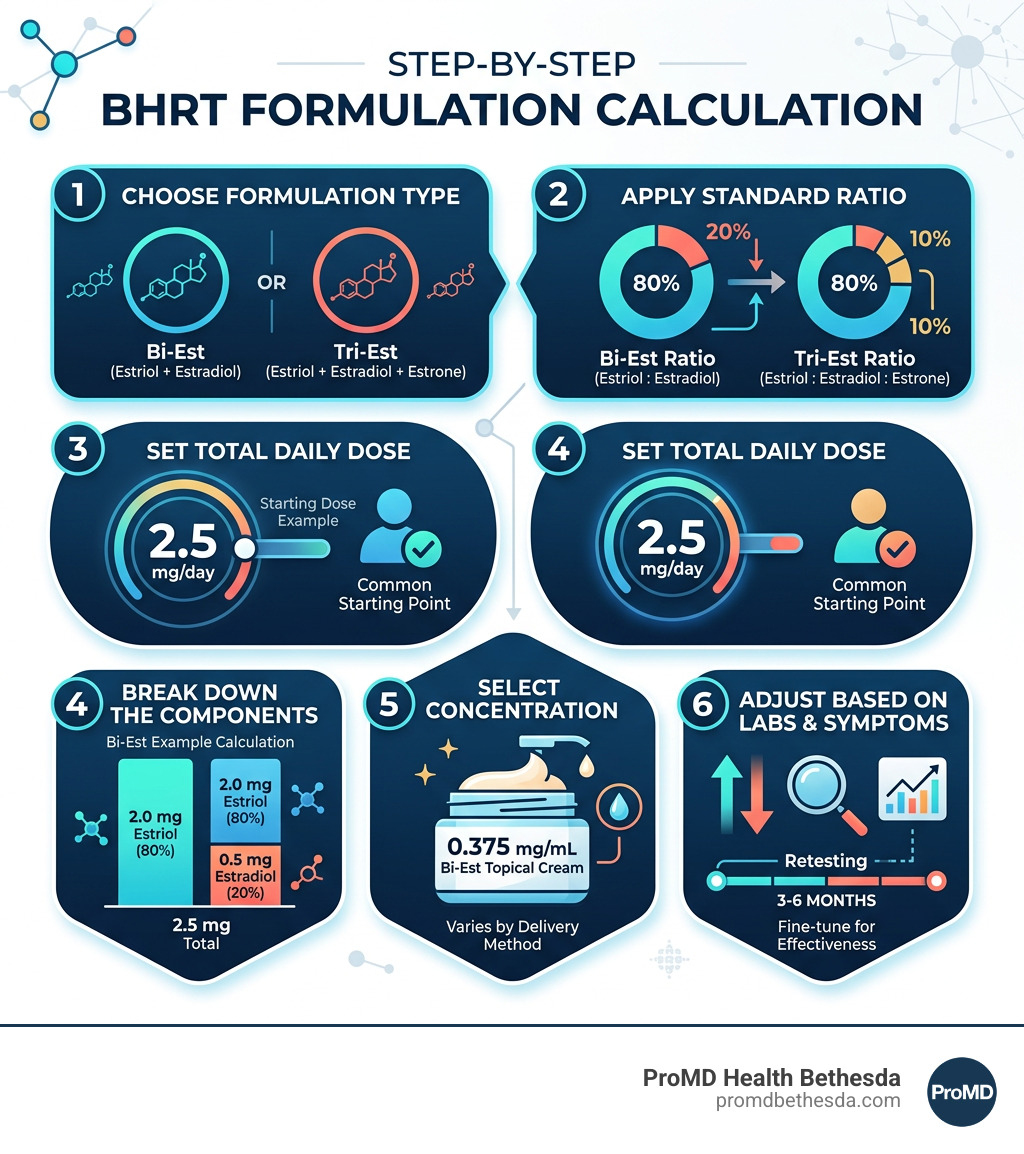
Here is a quick-reference guide to the core calculation steps:
- Choose your formulation type — Bi-Est (estriol + estradiol) or Tri-Est (estriol + estradiol + estrone)
- Apply the standard ratio — Bi-Est uses an 80:20 split; Tri-Est uses an 8:1:1 split
- Set your total dose — A common starting dose is 2.5 mg/day
- Break down the components — For a 2.5 mg Bi-Est dose: 2.0 mg estriol (80%) + 0.5 mg estradiol (20%)
- Select your concentration — Topical creams typically use 0.375 mg/mL for Bi-Est or 20–40 mg/mL for progesterone
- Adjust based on lab results and symptoms — Retest every 3–6 months and fine-tune as needed
Those six steps are the foundation. But the details behind each one matter a lot — especially if you want a formulation that is both safe and effective for your specific body.
Hormones are not one-size-fits-all. Your estrogen levels during perimenopause look nothing like your postmenopausal levels. Your symptom picture — hot flashes, brain fog, mood shifts, poor sleep — tells a story that numbers alone cannot fully capture.
That is why personalized BHRT formulation is part science, part clinical art.
I’m Mandy Fawcett, PA-C, a Board-Certified Physician Assistant with over 8 years of experience in women’s health and osteoporosis, and I have guided many patients through the process of how to calculate formulation for BHRT to find the dose that truly fits their needs. In this guide, I will walk you through every step — from understanding the basic ratios to adjusting your formula based on real lab results.
The Science of Bioidentical Hormones and Plant Sources
To understand how we calculate these doses, we first have to look at what we are actually measuring. Bioidentical hormones are called “bioidentical” because their molecular structure is a 100% match to the hormones your body produces naturally. This is a far cry from synthetic versions, which are often derived from animal sources (like pregnant mare’s urine) and chemically altered to be “hormone-like” but not identical.
The journey of a bioidentical hormone often begins in a field of wild yams or soybeans. These plants contain a compound called diosgenin. While some marketing might suggest you can just eat wild yams to balance your hormones, our bodies actually lack the enzymes to convert plant diosgenin into usable human hormones on our own.
Instead, this conversion happens in a specialized laboratory. Through a series of chemical steps, scientists transform diosgenin into:
- 17β-estradiol: The “heavy lifter” estrogen predominant before menopause.
- Estrone: The primary estrogen your body makes after menopause.
- Estriol: A weaker estrogen often used in BHRT for its protective qualities.
- Progesterone: The vital “balancer” that helps regulate the uterine lining and supports mood and sleep.
Understanding the physiology of progesterone and its role in the body is crucial because it acts as the “nurturer,” counteracting the proliferative effects of estrogen. Once these hormones are synthesized, they are sent to a compounding pharmacy where the real math begins.
How to Calculate Formulation for BHRT: A Step-by-Step Guide
When we sit down to determine how to calculate formulation for bhrt, we aren’t just picking a number out of a hat. We use specific ratios designed to mimic the body’s natural hormonal environment.
The two most common estrogen formulations are Bi-Est and Tri-Est.
1. The Bi-Est Calculation (80:20 Ratio)
Bi-Est is the gold standard for many practitioners. It combines Estriol (E3) and Estradiol (E2). The most common ratio is 80:20.
Why 80:20? Because while estradiol is about 80 times more potent than estriol, estriol is considered “weaker” and potentially safer for long-term breast and uterine health. By mixing them, we get the symptom relief of estradiol with the protective buffer of estriol.
Example Calculation for a 2.5 mg Total Dose:
- Total Dose: 2.5 mg
- Estriol (80%): 2.5 mg x 0.80 = 2.0 mg
- Estradiol (20%): 2.5 mg x 0.20 = 0.5 mg
Even though estradiol is only 20% of the mix, it accounts for the vast majority of the estrogenic activity in your body.
2. The Tri-Est Calculation (8:1:1 Ratio)
Tri-Est adds a third estrogen: Estrone (E1). The standard ratio here is 80% Estriol, 10% Estradiol, and 10% Estrone.
Example Calculation for a 2.5 mg Total Dose:
- Total Dose: 2.5 mg
- Estriol (80%): 2.0 mg
- Estradiol (10%): 0.25 mg
- Estrone (10%): 0.25 mg
According to Bioidentical Hormone Therapy research from Mayo Clinic, while Tri-Est was popular in the past, many modern practitioners have moved toward Bi-Est because estrone is already the dominant estrogen produced by fat cells after menopause, and adding more isn’t always necessary.
How to Calculate Formulation for BHRT Based on Lab Results
Numbers on a prescription pad are only half the story. To truly personalize a dose, we have to look at your internal “milieu.”
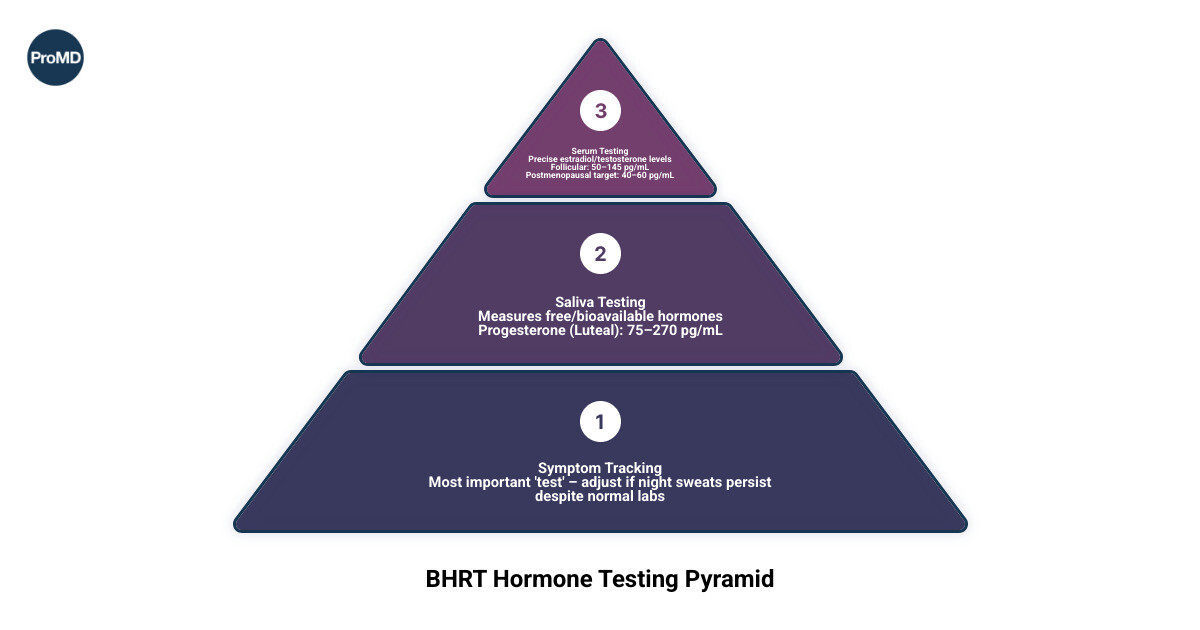
We typically look at three main testing avenues:
- Serum (Blood) Testing: Great for measuring estradiol and total testosterone.
- Saliva Testing: Useful for measuring “free” or bioavailable hormones, though its reproducibility is sometimes debated in clinical literature.
- Symptom Tracking: This is actually the most important “test.” If your labs say you are “normal” but you are still having night sweats, your dose isn’t right yet.
Reference Ranges to Watch:
- Estradiol (Follicular Phase): 50–145 pg/mL
- Estradiol (Postmenopausal): Typically < 30 pg/mL (we often aim for a therapeutic range of 40–60 pg/mL in BHRT)
- Progesterone (Luteal Phase): 75–270 pg/mL (salivary)
If your levels are below these ranges and you have symptoms, we calculate a “step-up” dose. For instance, if a patient is on 1.0 mg of Bi-Est and still experiencing hot flashes, we might calculate a 25% increase to 1.25 mg. You can find more info about hormone therapy on our specialized service page.
How to Calculate Formulation for BHRT for Topical Creams
Most BHRT is delivered via topical creams because they bypass the “first-pass metabolism” of the liver, reducing the risk of blood clots. But how do you turn a milligram dose into a “pump” of cream?
Compounding pharmacies follow standard concentration guidelines:
- Bi-Est: Common concentration is 0.375 mg/mL to 1.25 mg/mL.
- Progesterone: Often 20–40 mg/mL, though it can go as high as 100–200 mg/mL for specific needs.
The “Click” Math: Many patients use devices like the Topi-Click. One full turn or a specific number of “clicks” dispenses a precise volume.
- Topi-Click: Typically dispenses 0.25 mL per two clicks.
- If your prescription is for 2.0 mg of Progesterone and the cream is 40 mg/mL:
- You need 0.05 mL of cream. (This would require a very high concentration or a different dispensing device like a Ticker or oral syringe for accuracy).
Accuracy is key here. A study found that 34% of compounded BHRT samples failed quality testing for potency. This is why we only work with the most reputable compounding pharmacies in the Bethesda and Rockville areas to ensure your “1 mg” is actually 1 mg.
Delivery Methods and Absorption Adjustments
Not all delivery methods are created equal. When we decide how to calculate formulation for bhrt, we must account for “bioavailability”—how much of the hormone actually makes it into your bloodstream.
| Method | Absorption Efficiency | Notes |
|---|---|---|
| Oral Capsules | Low (approx. 10-15%) | Subject to “first-pass” liver metabolism; can increase clotting factors. |
| Topical Creams | Moderate (Steady) | Bypasses liver; stores in fatty tissue for slow release. |
| Vaginal Gels | High (Local & Systemic) | Excellent for vaginal atrophy; high systemic absorption. |
| Sublingual | High | Bypasses liver; enters bloodstream directly through mouth tissues. |
| Pellets | Very High (Constant) | Placed under the skin; lasts 3-4 months. |
For example, if we are converting a patient from an oral synthetic hormone to a bioidentical topical cream, we don’t just use the same milligram dose. Because the cream bypasses the liver, a lower dose is often more effective.
We also learned a great deal from The Women’s Health Initiative (WHI) study findings. While the original study caused a panic regarding synthetic hormones, modern analysis shows that transdermal (topical) bioidentical estradiol does not carry the same risks for blood clots or stroke because it doesn’t stimulate the liver to produce clotting factors.
Safety Considerations and Balancing Progesterone
The most critical calculation in BHRT isn’t just the estrogen—it’s the Pg/E2 ratio (Progesterone to Estradiol).
If you have an intact uterus, you must take progesterone if you are taking estrogen. Estrogen causes the uterine lining (endometrium) to grow; progesterone tells it to stop. Without this balance, the risk of endometrial hyperplasia (and potentially cancer) increases.
Calculating the Ratio: In a healthy, cycling woman, the Pg/E2 ratio in the luteal phase is often between 100:1 and 500:1. In BHRT, we aim to maintain a ratio that provides “endometrial protection.”
- Standard Dosing: If a woman takes 1.0 mg of Estradiol, she may need 100–200 mg of oral micronized progesterone or 20–40 mg of topical progesterone to maintain balance.
Potency and Pitfalls: One common pitfall in calculating BHRT is misleading labeling. A cream labeled “2.5 mg Bi-Est” might mean 2.5 mg per pump or 2.5 mg per gram. Always check the “mg/mL” concentration to ensure you aren’t under-dosing or over-dosing.
We also recommend “hormone holidays” for some patients—taking a few days off each month to allow receptors to reset—though this is calculated strictly based on individual menopausal stages (perimenopause vs. postmenopause).
Frequently Asked Questions about BHRT Calculations
What is the difference between Bi-Est and Tri-Est ratios?
Bi-Est contains two estrogens (Estriol and Estradiol), usually in an 80:20 ratio. Tri-Est adds a third (Estrone), usually in an 8:1:1 ratio. Most modern Bethesda practitioners prefer Bi-Est because it avoids adding extra Estrone, which the body already produces in sufficient amounts post-menopause.
How do I convert a 2.5 mg Bi-Est dose into individual components?
You use the 80:20 rule. Multiply the total dose (2.5 mg) by 0.80 to get the Estriol amount (2.0 mg) and by 0.20 to get the Estradiol amount (0.5 mg).
Why is the Pg/E2 ratio important for BHRT formulations?
The ratio ensures that the “growth” signal from estrogen is balanced by the “stabilizing” signal from progesterone. This is vital for protecting the uterus and breast tissue from over-stimulation.
Conclusion: Your Personalized Path to Balance
Calculating the perfect BHRT dose is a journey, not a destination. At ProMD Health Bethesda, we don’t believe in “cookie-cutter” medicine. We serve patients across Bethesda, Chevy Chase, Rockville, and the surrounding areas with a high-tech, high-touch approach.
Our unique AI Simulator allows patients to visualize their wellness journey, combining advanced technology with Mandy Fawcett’s expert clinical oversight. Whether you are struggling with the first signs of perimenopause or looking to optimize your health in postmenopause, we use these precise calculations to ensure your therapy is as unique as your DNA.
Ready to stop guessing and start feeling like yourself again? Discover how hormone replacement therapy in Bethesda to restore balance and energy can transform your quality of life. Contact us today to schedule your consultation and let’s get your numbers right.

