

A Step-by-Step Guide to How Hair Restoration Actually Works
What Is Hair Restoration and How Does It Work?
How does hair restoration work is a question worth answering upfront, before diving into the details.
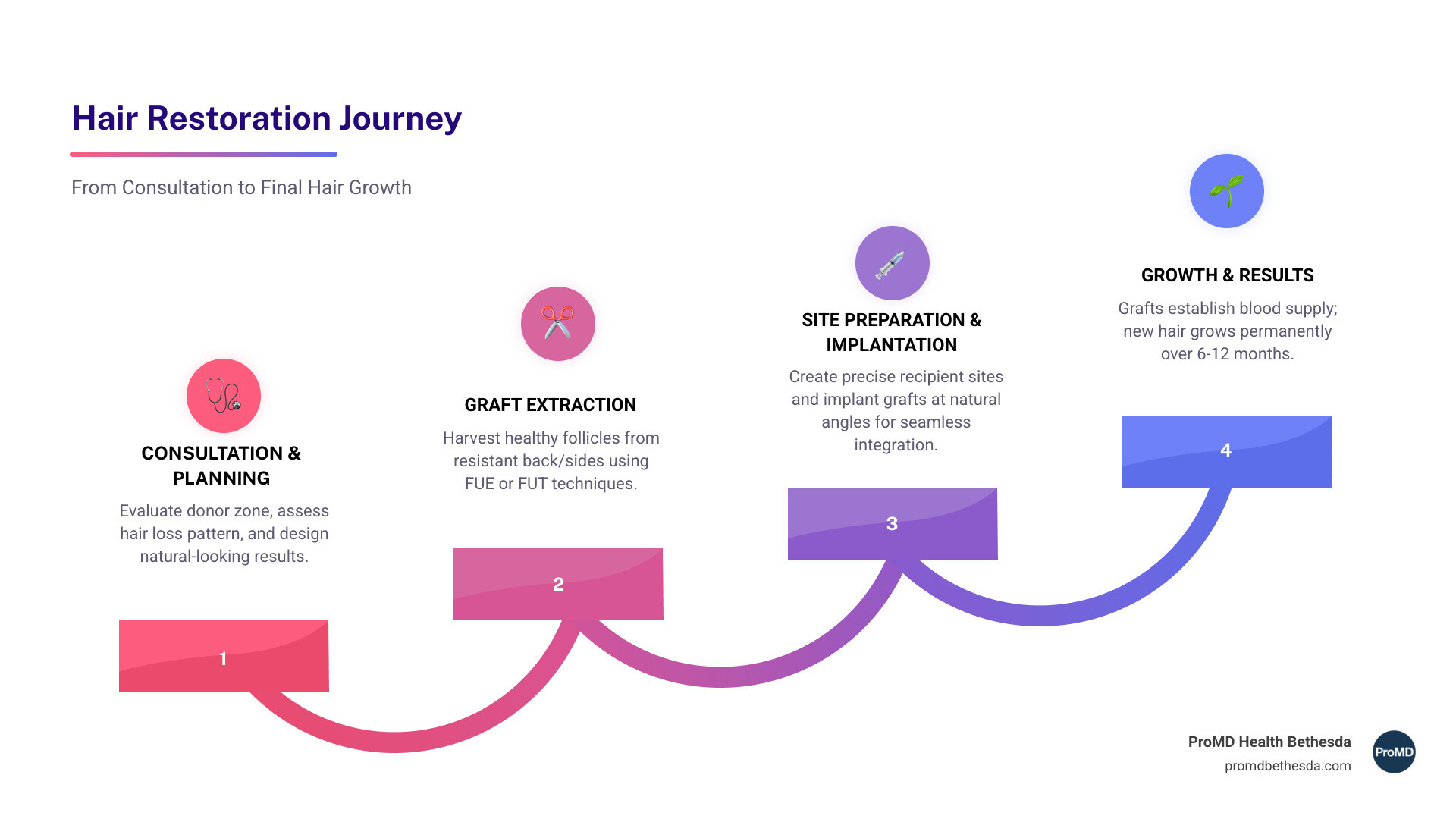
Here is a quick overview:
- Donor hair is identified – A surgeon selects healthy, permanent hair follicles from the back or sides of your scalp (the “donor zone”).
- Follicles are extracted – Using strip surgery (FUT) or individual punch extraction (FUE/DHI), grafts are carefully removed.
- Recipient sites are prepared – Tiny incisions are made in the thinning or bald area at precise angles to mimic natural hair growth.
- Grafts are implanted – Follicles are placed into the recipient sites, where they establish a new blood supply and begin growing.
- Hair grows permanently – Transplanted follicles retain their genetic resistance to balding, so results are long-lasting.
Hair loss is one of those things most people don’t think about until it’s already happening. Then it can quietly chip away at confidence – especially for professionals who want to show up looking and feeling their best. The good news is that modern hair restoration surgery has moved far beyond the unnatural “hair plug” look of decades past. Today’s techniques redistribute your own existing hair with surgical precision, producing results that look completely natural.
As a Board-Certified Physician Assistant with over 8 years of experience and specialized aesthetic training, I’m Mandy Fawcett – and understanding how does hair restoration work is central to helping patients at ProMD Health Bethesda make informed, confident decisions about their care. In the sections below, I’ll walk you through everything step by step, from the biology behind why transplants work to what you can realistically expect from results.
Understanding the Science: How Does Hair Restoration Work?
At its core, hair restoration is a form of tissue transplantation. We aren’t creating “new” hair out of thin air; rather, we are strategically moving healthy hair follicles from one part of your head to another. This process relies on a fascinating biological principle known as “donor dominance.”

Doctors have been performing these transplants in the U.S. since the 1950s, but the science has evolved tremendously. According to the National Center for Biotechnology Information (NCBI), modern hair transplantation is the standard surgical treatment for androgenic alopecia. It replaces older, clunky “plug” methods with the harvesting of individual follicular units to create a natural, fuller appearance.
If you are curious about the specifics of our approach in Bethesda, you can find more info about hair restoration on our dedicated service page.
The Biological Basis of How Hair Restoration Works
To understand the transplant, you have to understand the hair growth cycle. At any given time, approximately 90% to 95% of your scalp hairs are in the anagen phase (the active growth phase). This is followed by the catagen phase (a short transition lasting 2-3 weeks) and the telogen phase (a resting phase). Finally, exogen occurs, which is the daily shedding of 25 to 100 hairs.
In pattern baldness, dihydrotestosterone (DHT) causes follicles to shrink over time until they stop producing visible terminal hair. When we perform a restoration, we move “follicular units”—natural groupings of one to four hairs—that are genetically programmed to stay in the anagen phase for much longer.
Why Donor Dominance Matters in How Hair Restoration Works
Why doesn’t the moved hair just fall out like the hair that was there before? The answer lies in the safe donor zone. This area is typically located in the mid-occipital region (the back of the head).
Follicles in this region are naturally resistant to the hormones that cause balding. When we move them to the front or the crown, they retain that genetic resistance. This is “donor dominance”: the hair behaves like it’s still at the back of your head, even though it’s now sitting at your new hairline. We look for donor densities of over 80 follicular units/cm² for the best results, while anything below 40 units/cm² is usually considered less suitable for surgery.
Surgical Techniques: From FUT to FUE and DHI
Choosing the right technique is like choosing the right tool for a specific job. While they all aim for the same goal—fuller hair—the “how” varies significantly in terms of extraction and recovery.
Follicular Unit Transplantation (FUT/FUSS)
Follicular Unit Strip Surgery (FUSS), often called FUT, is the more traditional method. In this procedure, the surgeon removes a 6- to 10-inch strip of skin from the back of the head. The strip is usually 1 to 1.5 cm wide to allow for a tension-free closure.
Once the strip is removed, our team uses high-powered microscopes to divide it into 500 to 2,000 tiny grafts. Each graft contains just a few hairs. While this method is efficient for large areas of baldness, it does leave a linear scar at the back of the head, which is usually hidden by surrounding hair.
Follicular Unit Extraction (FUE)
FUE has become incredibly popular because it avoids the linear scar. Instead of removing a strip, we use a specialized punch tool (usually 0.6mm to 1.0mm in diameter) to extract individual follicular units one by one.
This results in tiny, circular scars that are nearly invisible to the naked eye, even if you wear your hair short. Modern motorized systems often operate at 1000 to 2000 rpm, allowing for precise harvesting with a very low transection rate (the rate of accidental hair damage), typically kept below 5%.
Direct Hair Implantation (DHI)
DHI is a specialized subtype of FUE. The main difference lies in how the hair is put back in. In standard FUE, we create “channels” or slits in the scalp first and then place the hairs. With DHI, we use a patented tool called a DHI Implanter.
This tool allows us to control the depth, direction, and angle of each hair with extreme precision without needing to pre-cut the skin. Some studies suggest the success rate of follicles transplanted via DHI is over 90%, compared to a range of 50% to 90% with other methods.
The Step-by-Step Process: From Preparation to Recovery
If you’re wondering exactly what happens on the day of the procedure, here is the roadmap. At ProMD Health Bethesda, we combine this clinical process with our AI Simulator, which allows you to preview your natural-looking results before we even begin.
Pre-Operative Preparation and Extraction
The day begins with a thorough cleaning of the scalp. We then inject a local numbing medicine to ensure you are comfortable throughout the 5 to 8-hour session. To make extraction easier, we may inject a saline solution into the donor area to puff up the skin, making the follicles easier to reach.
Our expert team then begins the harvest. Whether it’s the strip method or FUE, we carefully count and categorize every graft. Micro-grafts (1-2 hairs) are usually reserved for the very front of the hairline, while larger mini-grafts (2-4 hairs) provide density further back. You can meet our team to see the experts who handle this delicate work.
Implantation and Post-Operative Care
Once the grafts are ready, we turn our attention to the recipient site. This is where the artistry happens. We create recipient sites at a 15-to-20-degree angle to match the way your natural hair grows.
After the surgery, you may experience “shock loss”—a temporary shedding of the transplanted hair (and sometimes native hair). Don’t panic! This is normal and almost always temporary. Within a few months, the follicles will enter a new growth phase. To see the progression of these results, see our before and after gallery.
Candidacy and Expectations: Is Hair Restoration Right for You?
Not everyone is a perfect candidate for a hair transplant. It’s important to have a realistic understanding of what surgery can achieve.
Who is a Suitable Candidate?
Ideal candidates generally meet the following criteria:
- Age: Ideally over 25. Hair loss patterns are often unpredictable in younger patients.
- Stability: Those with stable hair loss patterns (like Hamilton-Norwood III-V).
- Donor Supply: You must have enough healthy hair at the back of the head to move to the front.
- Noticeable Loss: Most clinicians consider a transplant once a patient has lost about 50% of their native hair in a specific area.
For a deeper dive into success rates and patient selection, the Cleveland Clinic offers excellent resources on hair restoration expectations.
Potential Risks and Long-Term Outlook
Like any surgery, hair restoration carries some risks, though they are generally minor. These can include:
- Infection or Folliculitis: Inflammation of the hair follicles.
- Scarring: While FUE minimizes this, some scarring is inevitable.
- Unnatural Look: If not done by experts, the hair can grow at odd angles.
The final results of a transplant are usually seen around the two-year mark. While the transplanted hair is permanent, your “native” (non-transplanted) hair may continue to thin over time, which is why we often recommend a holistic approach involving maintenance treatments.
Frequently Asked Questions about Hair Restoration
Is a hair transplant procedure permanent?
Yes, the procedure is designed to be permanent. Because the donor hair comes from a region of the scalp that is genetically resistant to balding, it continues to grow even when moved to a new location.
How long does the recovery process take?
Most patients return to work within 2 to 5 days. The tiny crusts that form around the grafts usually fall off within 7 to 10 days. However, it takes about 6 to 12 months to see significant new growth and up to two years for the full effect.
What is the difference between FUE and DHI?
Standard FUE involves two steps for implantation: creating the holes (channels) and then placing the hair. DHI combines these into one step using a specialized pen, which can lead to higher follicle survival rates and more control over the hair’s angle.
Conclusion
Understanding how does hair restoration work is the first step toward reclaiming your hairline and your confidence. Whether you are looking at the precision of FUE or the high-density results of FUT, the goal is always a result that looks like you were born with it.
At ProMD Health Bethesda, we serve patients across Bethesda, Chevy Chase, Kensington, Garrett Park, and Rockville with a focus on natural-looking, AI-verified outcomes. If you’re ready to stop guessing and start growing, we invite you to explore more info about hair restoration services and schedule a consultation with our team today.

