

Laser for Sun Spots: Top 3 Solutions
Why Sun Spots Appear and How Laser Treatment Can Help
Laser for sun spots is a precise medical treatment that uses focused light energy to break down excess melanin in your skin, causing dark spots to fade or disappear completely. Here’s what you need to know:
| Key Information | What to Expect |
|---|---|
| How It Works | Laser energy targets and shatters pigment particles in sun-damaged skin |
| Session Count | Typically 2-3 treatments for visible results |
| Recovery Time | 7-14 days for initial fading; full results in 8-12 weeks |
| Best For | Fair to light skin tones (Fitzpatrick I-III) with isolated dark spots |
| Results Duration | Long-lasting with proper sun protection |
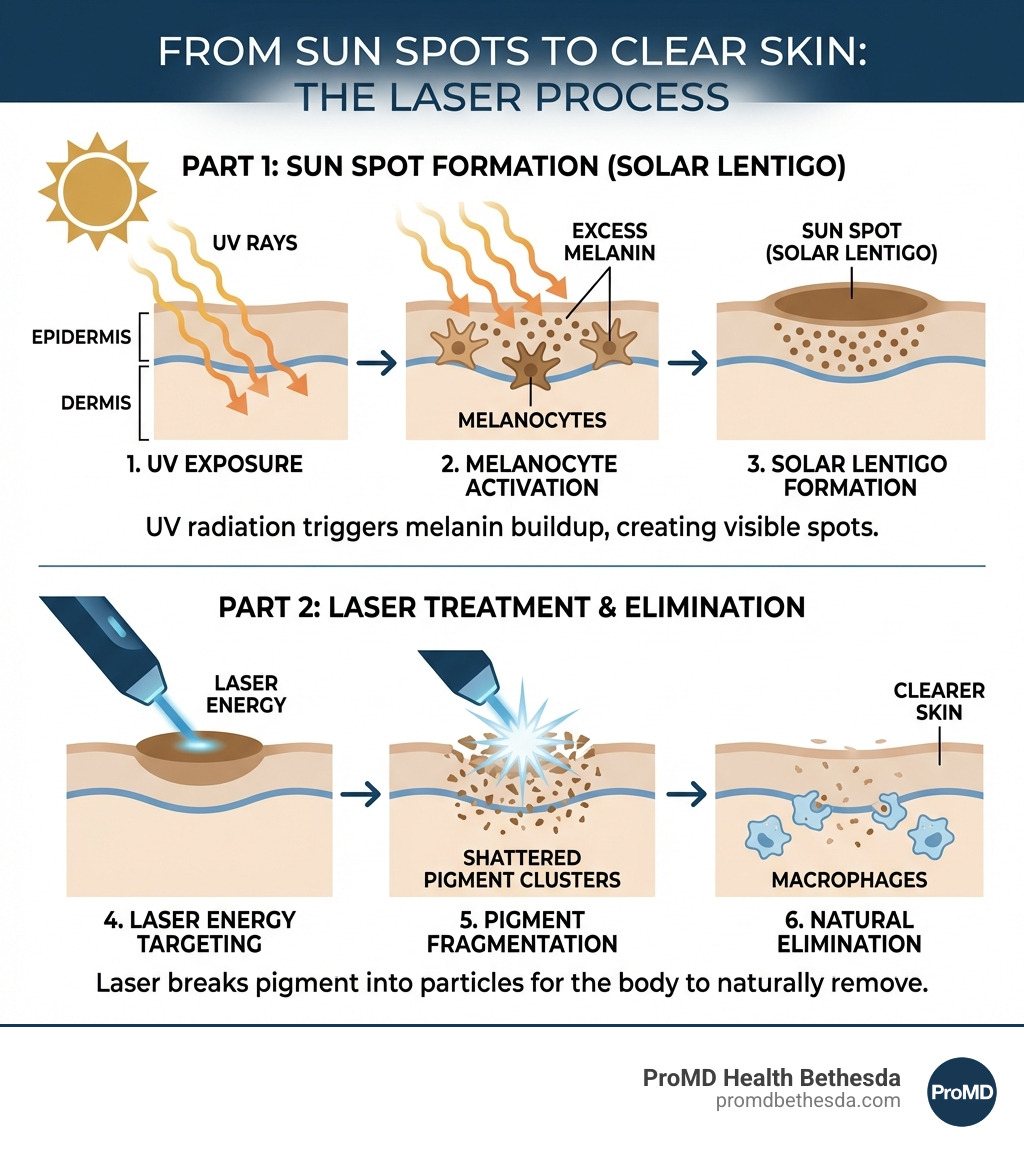
If you’ve noticed flat, brown spots appearing on your face, hands, or shoulders, you’re not alone. These marks—also called age spots or solar lentigines—develop when UV radiation from years of sun exposure triggers excess melanin production in your skin.
The good news? You don’t have to live with them.
Modern laser technology can target and remove these spots with remarkable precision. Unlike creams that may take months to show modest results, laser treatments work by heating and breaking apart the concentrated melanin deposits that create visible discoloration. Your body then naturally eliminates these fragmented pigment particles through its healing process.
However, not all brown spots are simply sun damage. Some may be melasma (which laser can worsen) or even early melanoma. That’s why a thorough evaluation by a board-certified dermatologist is essential before treatment.
The most effective approach combines advanced laser technology with proper skin type assessment, careful aftercare, and sun protection to prevent new spots from forming.
Understanding Sun Spots and Their Causes
When we talk about sun spots, we are usually referring to solar lentigines. You might know them by their more “vintage” names: age spots or liver spots. Despite the name, they have nothing to do with your liver—though they certainly have everything to do with the time you’ve spent enjoying the sunshine in Bethesda or Chevy Chase.
Sun spots are flat, oval areas of increased pigmentation. They are usually tan, brown, or black and appear on areas of the skin that get the most sun exposure, such as the back of your hands, the tops of your feet, your face, and your shoulders.
The primary cause is photoaging. When UV radiation hits your skin, it accelerates the production of melanin, the natural pigment that gives your skin its color. On skin that has had years of sun exposure, melanin becomes clumped or is produced in high concentrations, resulting in those pesky spots. While they can start appearing as early as age 25, they become much more common as we pass the age of 40.
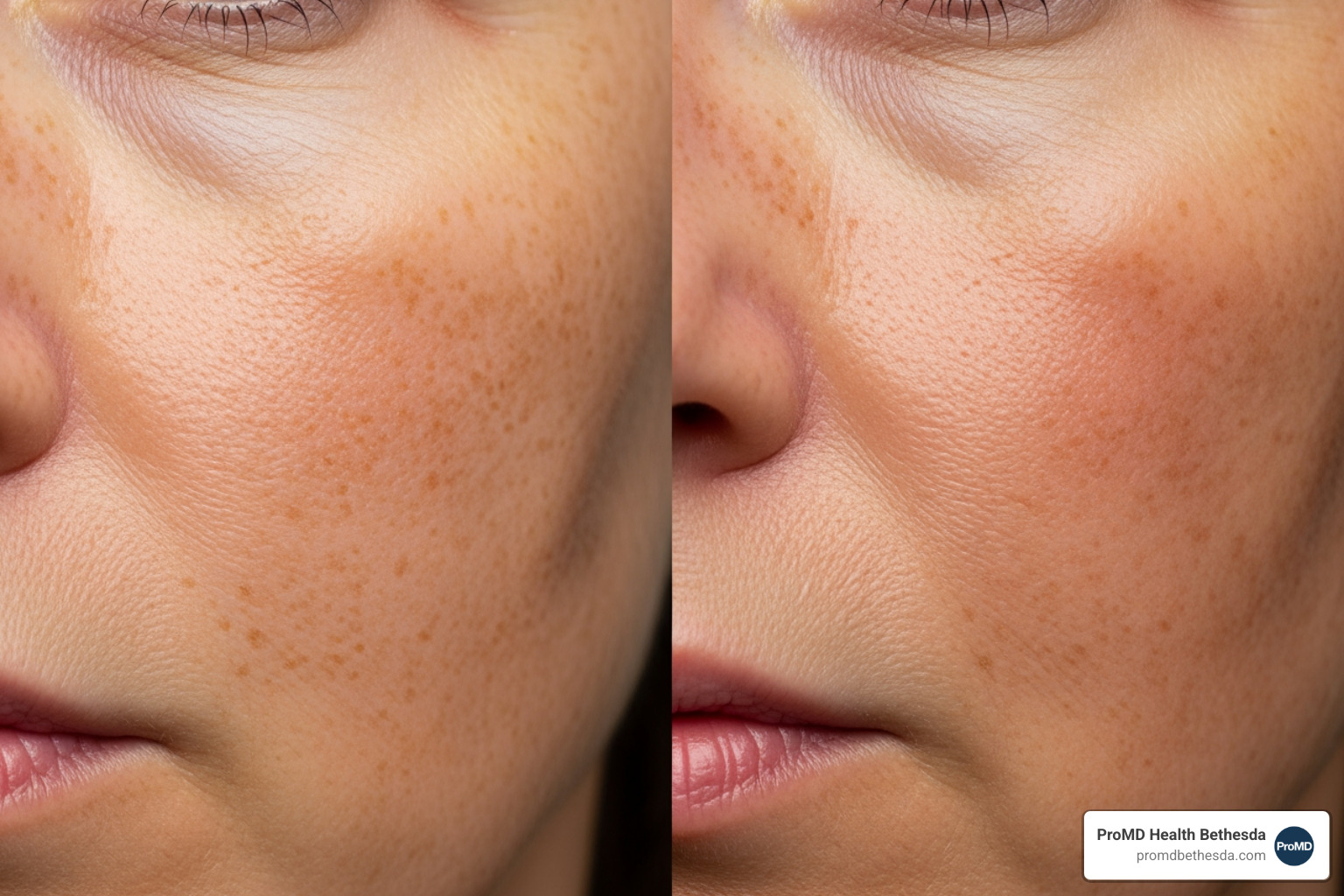
It is important to distinguish these from freckles. Freckles are often genetic and tend to fade in the winter when sun exposure is lower. Sun spots, however, are permanent fixtures unless treated. For a deeper medical dive into these lesions, you can review the Age spots (liver spots) diagnosis and treatment guide.
Distinguishing Sun Spots from Skin Cancer
One of the most critical steps we take at ProMD Health is ensuring that your “sun spot” isn’t actually something more serious. Some spots can mimic melanoma, a serious form of skin cancer, or lentigo maligna, a type of early melanoma that grows on sun-damaged skin.
We always recommend patients use the ABCDE rule to monitor their spots:
- A is for Asymmetry: One half of the spot does not match the other.
- B is for Border: The edges are irregular, ragged, notched, or blurred.
- C is for Color: The color is not the same all over and may include shades of brown or black.
- D is for Diameter: The spot is larger than 6 millimeters (about the size of a pencil eraser).
- E is for Evolving: The spot is changing in size, shape, or color.
If a spot looks suspicious, a biopsy may be necessary to rule out malignancy before any cosmetic laser treatment is performed. Safety is our priority, and we encourage you to Find a board-certified dermatologist if you notice any rapidly changing lesions.
How Laser for Sun Spots Works
The science behind Laser for sun spots is a concept called selective photothermolysis. It sounds like a mouthful, but the principle is simple: we use a specific wavelength of light that is absorbed only by the “chromophore” we want to target—in this case, melanin.
When the laser hits the skin, the dark pigment absorbs the energy, which converts to heat. This heat shatters the pigment into microscopic particles without damaging the surrounding healthy skin tissue. This is possible because of the “thermal relaxation time”—the laser pulse is so fast that the heat doesn’t have time to spread to the nearby cells.
Once the pigment is shattered, your body’s immune system sends in “clean-up” cells to carry away the debris, or the pigment rises to the surface and flakes off naturally.
Preparing for Your Laser for Sun Spots Treatment
Preparation is key to a safe and successful outcome. During your initial consultation in our Bethesda clinic, we will review your medical history to ensure you aren’t taking medications that make you sensitive to light (photosensitizers).
Key preparation steps include:
- Sun Avoidance: You must avoid tanning or heavy sun exposure for at least 4 weeks before treatment. Tanned skin has active melanocytes, which increases the risk of burns.
- Antiviral Medication: If you are prone to cold sores, we may prescribe an antiviral, as laser energy can sometimes trigger a breakout.
- Skincare Adjustments: Stop using retinoids or strong acids a few days before your session.
- Internal Support: Healthy skin heals faster. You can find More info about Skincare Supplements to help prep your skin from the inside out.
The Procedure: What Happens During the Session
When you arrive for your Laser for sun spots session, we make sure you are comfortable. We often apply a numbing cream 20–30 minutes before the procedure to minimize the “rubber band snap” sensation.
During the treatment:
- Eye Protection: You will wear specialized goggles to protect your eyes from the laser light.
- Cooling Systems: Many of our lasers use integrated cooling to soothe the skin as the laser pulses.
- The Sensation: You will feel a quick, hot snap. Most patients find this very tolerable.
- Duration: Depending on the size of the area, the session can last anywhere from 15 to 45 minutes.
To see what the transition looks like, browse our Before & After Gallery.
Choosing the Right Technology for Your Skin Type
Not all lasers are created equal, and the “best” laser depends heavily on your Fitzpatrick scale rating—a classification system that describes how your skin reacts to the sun (Type I is very fair, Type VI is very dark).
Laser Technology Comparison
| Technology | Best For | Downtime | Results |
|---|---|---|---|
| IPL (Intense Pulsed Light) | Redness and light sun spots | Minimal (1-2 days) | Needs 3-5 sessions |
| Fractional Laser (e.g., Halo) | Sun spots + Texture/Wrinkles | Moderate (3-5 days) | Dramatic; improves collagen |
| Chemical Peels | Superficial spots | Varies | Great for overall glow |
For those looking for non-laser alternatives or adjunct treatments, you can find More info about Peels here.
Intense Pulsed Light (IPL) and Pulsed Dye Lasers
IPL is often called a “photofacial.” While not technically a laser (it uses a broad spectrum of light rather than a single wavelength), it is the gold standard for treating large areas of sun damage. It targets both melanin and hemoglobin, making it excellent for patients who have both sun spots and “spider veins” or redness.
Pulsed Dye Lasers (PDL), like the VBeam, are more specialized. They target the blood vessels (vascular lesions) that often accompany sun damage. If your sun damage looks more like “port-wine stains” or persistent redness, PDL might be your best bet. You can read more Pulsed dye laser treatment details to see if it fits your needs.
Hybrid and Fractional Resurfacing
For patients in Bethesda who want to address sun spots and signs of aging like fine lines, we often recommend Hybrid Fractional Lasers like the Halo. This technology is because it delivers both ablative (surface-removing) and non-ablative (deep-heating) wavelengths at the same time.
It creates “microscopic treatment zones,” leaving pillars of healthy skin between the laser channels. This triggers massive collagen stimulation and faster healing. It’s like getting the results of a heavy-duty laser with the downtime of a much gentler one. If you’re interested in other ways to stimulate collagen, check out More info about Microneedling.
Recovery and Long-Term Results
The recovery process for Laser for sun spots is often described as a “coffee ground” effect. Within a day or two, the treated spots will darken and may look like small specks of black pepper or coffee grounds on your skin. Do not pick them! They will naturally flake off within 7 to 10 days on the face and up to 14 days on the body.
Recovery After Laser for Sun Spots
Post-treatment care is non-negotiable for the best results:
- Ointment Application: Keep the area hydrated with a bland ointment (like Aquaphor) or a specialized post-laser cream.
- Gentle Cleansers: Use only mild, non-abrasive cleansers.
- Swelling Management: Some swelling is normal for the first 24–48 hours; sleeping with an extra pillow can help.
For a curated list of products that support the healing phase, visit our More info about Skincare section.
Preventing the Return of Pigmentation
Laser treatment “erases” the spots, but it doesn’t change your genetic tendency to freckle or the fact that your skin “remembers” years of sun damage. To keep your skin clear:
- Broad-spectrum SPF: Use at least SPF 30 every single day, even if it’s cloudy in Rockville.
- Topical Antioxidants: Vitamin C and Niacinamide help inhibit melanin production.
- Protective Clothing: Hats and UPF clothing are your best friends during Maryland summers.
You can also support your skin’s resilience with Skincare Supplements in Bethesda: A Simple, Science-Backed Plan.
Frequently Asked Questions about Laser for Sun Spots
How many sessions are typically required for full removal?
Most patients see significant improvement after just one session. However, for deep-seated pigmentation or extensive sun damage, a series of 2 to 3 sessions spaced 4 to 6 weeks apart is usually recommended for optimal “clear skin” results.
Is laser treatment safe for darker skin tones?
It can be, but it requires extreme caution. Darker skin (Fitzpatrick IV-VI) has more active melanocytes. If the laser is too aggressive, it can cause post-inflammatory hyperpigmentation (PIH)—meaning the laser creates more dark spots. For our darker-skinned patients in Kensington and Garrett Park, we often use lower energy settings, specialized wavelengths (like Nd:YAG), or alternative treatments like chemical peels.
How much does laser treatment for sun spots cost?
Since this is considered a cosmetic procedure, it is generally not covered by insurance. Costs vary depending on the size of the area (e.g., just a few spots vs. the full face and chest). Generally, professional laser treatments range from $300 to $1,500 per session. We provide detailed pricing during your AI-simulated consultation.
Conclusion
At ProMD Health Bethesda, we believe that clear, radiant skin is a cornerstone of confidence. We don’t just “zap” spots; we provide a comprehensive wellness experience. Our unique AI Simulator allows you to preview your potential results, ensuring that your journey toward rejuvenation is informed and predictable.
Whether you are in Chevy Chase or Rockville, our expert team is here to help you navigate advanced aesthetics. From the precision of Laser for sun spots to the long-term benefits of medical-grade skincare, we are your partners in skin health.
Ready to see what’s possible? Explore our Category: Skincare to learn more or schedule your consultation today.

